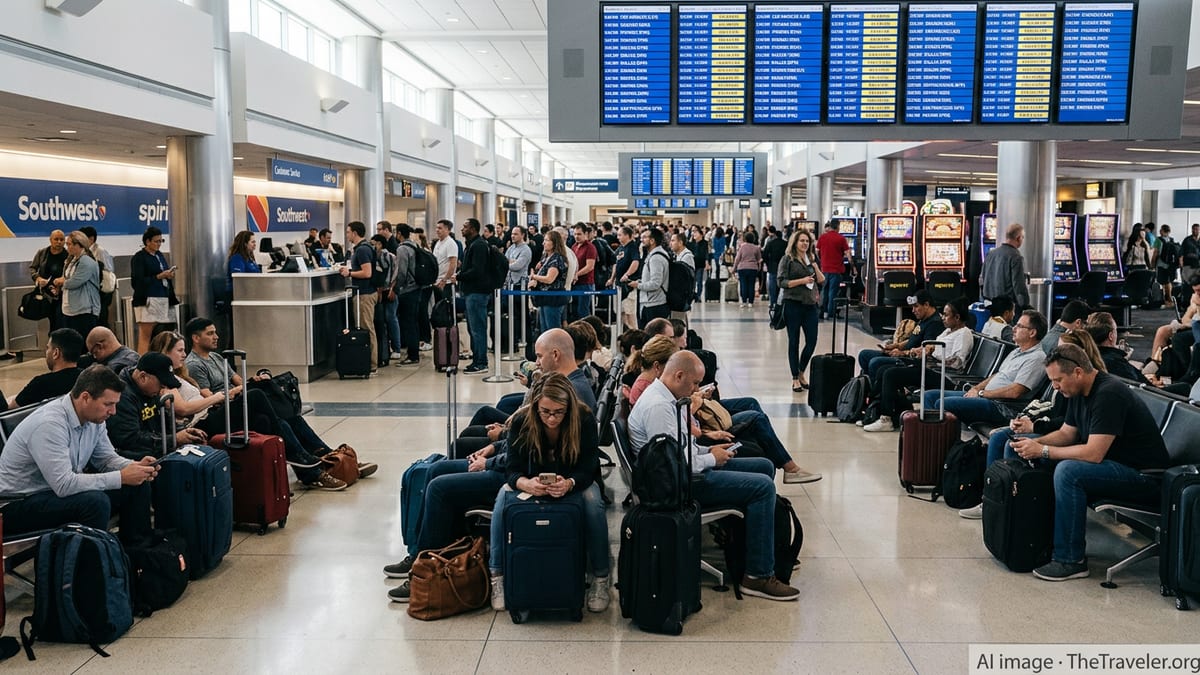
Hundreds of passengers face cascading delays and cancellations at Las Vegas Harry Reid International, disrupting travel to major US hubs including Los Angeles and Chicago.
The Traveler contains affiliate links. If you click through and make a purchase, we may earn a small commission at no extra cost to you. We are grateful if you use these as it helps a lot! Read the full policy.
More news on this day
Travelers moving through Las Vegas on March 15 faced mounting frustration as Harry Reid International Airport recorded 241 delays and 48 cancellations, disrupting flights for Southwest, Delta, American Airlines, Spirit and other carriers and rippling across major domestic routes to cities such as Los Angeles and Chicago.
Get the latest news straight to your inbox!
The wave of disruptions at Harry Reid International Airport quickly spread beyond Nevada, affecting travelers on some of the country’s busiest corridors. Flight tracking data on March 15 showed bottlenecks on routes linking Las Vegas with major hubs including Los Angeles, Chicago, Denver and Phoenix, amplifying the impact far beyond the desert city.
Connections to Los Angeles International Airport and Chicago O’Hare in particular were squeezed as rolling delays in Las Vegas pushed aircraft and crews off schedule. Passengers connecting onward from those hubs to cities across the Midwest, East Coast and Pacific Northwest encountered longer travel times, missed connections and, in some cases, unexpected overnight stays.
Published coverage and live operations dashboards indicate that the disruptions were most visible during peak midday and late afternoon departure banks, when low-cost and legacy carriers move high volumes of leisure and convention traffic through Las Vegas. As delays stacked up, turn times grew longer, straining ground operations and limiting flexibility to recover the schedule.
The situation echoed broader trends in U.S. aviation where localized problems at a single airport, particularly one with a high share of connecting traffic, can rapidly ripple through the national network. Even travelers flying into Las Vegas for weekend leisure trips reported extended gate holds and last-minute gate changes as airport staff worked to keep flights moving.
Publicly available flight status information shows that the bulk of Saturday’s disruptions at Harry Reid International involved large domestic carriers with dense schedules into and out of Las Vegas. Southwest Airlines, which operates one of the most robust networks at the airport, saw a mix of late departures and arrivals that compounded as the day progressed.
Delta Air Lines, American Airlines and ultra-low-cost carrier Spirit Airlines likewise contended with out-of-position aircraft and crew-time limitations as delays grew. Because Las Vegas flights often tie into tight connecting banks at hubs like Los Angeles, Dallas Fort Worth, Atlanta and Chicago, even short hold times on the ground in Nevada translated into missed onward connections elsewhere in the system.
According to airport-status dashboards and airline operations feeds, a portion of the 48 cancellations at Harry Reid on March 15 involved flights that were scrubbed proactively once carriers concluded that aircraft and crews could not be repositioned without introducing even greater disruption later in the day. In other cases, cancellations appear to have followed extended delays in which departures could no longer meet mandatory crew duty-time rules.
For airlines, such days highlight the ongoing challenge of balancing tight, efficiency-driven schedules with the need for operational resilience. When aircraft utilization is high and spare capacity is limited, weather constraints, traffic management initiatives or staffing gaps can quickly escalate into widespread delays and cancellations.
Harry Reid International regularly handles heavy weekend volumes as tourists, convention attendees and regional travelers converge on Las Vegas. Transportation data and airport reports indicate that March historically brings strong crowds, driven by spring break travel, large-scale events and favorable desert weather.
On March 15, the pressure of weekend traffic appears to have collided with a mix of operational constraints, leaving airlines and passengers with little margin for error. Published aviation analytics point to tight turn times at the gates and limited slack in aircraft rotations, meaning that even modest upstream delays elsewhere in airline networks translated into late arrivals in Las Vegas.
Once flights arrived behind schedule, ground crews faced compressed windows to unload baggage, clean cabins, refuel and board new passengers. Any additional hurdles, such as catering delays, aircraft maintenance checks or the need to swap equipment, added minutes that quickly accumulated into longer disruptions.
Airport-status indicators for Harry Reid in recent months have shown generally solid on-time performance overall, but with occasional spikes in delays during high-demand periods. The March 15 episode underscored how a confluence of demand, staffing and network factors can produce a short, intense burst of turmoil even at airports that typically operate smoothly.
For travelers, the statistics of 241 delays and 48 cancellations translated into hours of uncertainty at terminals across the country. Passengers headed to Las Vegas for weekend getaways reported long lines at check-in counters and service desks as they sought rebooking options or clarification on departure times.
Those departing Las Vegas faced a different set of challenges. With many flights to Los Angeles, Chicago and other major cities running behind schedule, travelers worried about making connecting flights onward to smaller regional destinations. Publicly shared trip accounts on social media described hurried dashes between concourses, unplanned overnight layovers and difficulties finding available seats on alternate flights.
Travel guidance from consumer advocates and travel platforms typically encourages passengers to build extra time into itineraries that pass through busy leisure hubs such as Las Vegas, especially on weekends and during peak travel seasons. The March 15 disruptions reinforced that advice, as travelers with tight connections were among the hardest hit.
In addition, disruptions of this scale often strain airport amenities. Seating near gate areas and food outlets can become scarce as flights stack up, while longer lines form at customer service counters. Travelers reported turning to airline mobile apps and digital tools to monitor gate changes and standby lists, which in some cases provided quicker updates than crowded physical service points.
The concentrated burst of delays and cancellations at Harry Reid International raises broader questions about how prepared U.S. aviation is for the full spring and summer travel rush. Transportation statistics show that domestic passenger volumes have trended higher year over year, while staffing and infrastructure have not always grown at the same pace.
Industry analyses suggest that carriers have made progress in trimming some of the most severe post-pandemic operational issues, yet the system still shows vulnerability on busy weekends and during adverse conditions. Las Vegas’s experience on March 15 illustrated how quickly an airport can move from normal operations to widespread disruption when schedules are packed and contingencies are limited.
Travel experts often recommend that passengers traveling through high-traffic airports like Las Vegas, Los Angeles or Chicago consider early-morning departures, which historically carry a lower risk of extended delays. Building in longer connection windows, particularly when traveling on separate tickets or during peak seasons, can also reduce the risk of missed flights if problems arise.
As spring break and event-driven travel continue to push demand higher in the coming weeks, travelers are likely to watch airline performance closely. The March 15 turmoil at Harry Reid International stands as an early-season stress test for carriers and airports, highlighting the importance of robust staffing, flexible scheduling and clear communication to keep passengers moving when the system is under strain.
Celestyal Discovery Cancels Greek Island Cruises Amid Middle East Standoff
Celestyal Discovery has cancelled key early-season Greek island sailings as the ship remains stuck in the Middle East, leaving Aegean cruise plans in disarray.
Storm-Snarled Skies Disrupt Hundreds of Flights Across Canada
A powerful late-winter storm triggered hundreds of flight delays and cancellations across major Canadian hubs, stranding passengers and squeezing airline operations nationwide.
New Nonstop US-Europe Flights Redraw the Transatlantic Map
A wave of new nonstop routes from U.S. cities to emerging European hotspots is reshaping how American travelers plan 2025 and 2026 trips across the Atlantic.
TUI Cruises Pulls Back From Gulf, Shaking 2026 Cruise Outlook
TUI Cruises has halted Arabian Gulf sailings amid regional tensions, raising fresh questions over the resilience, routing and future growth of Middle East cruise tourism.
Colombia Warning: Salt Cathedral of Zipaquirá Under Review
Colombia’s famed Salt Cathedral of Zipaquirá is under closer scrutiny. Here is what international visitors should know now about safety, tours, and travel planning.
Airport Automation Fuels Baggage System Boom Through 2026
Airports worldwide are racing to automate baggage handling, driven by record travel demand, falling mishandling rates and multibillion‑dollar infrastructure upgrades.
UAE Travel Chaos as 187 Flights Delayed and 81 Axed
Hundreds of flights across the UAE have been delayed or cancelled, disrupting travel through Dubai, Abu Dhabi, Sharjah, Al Ain and Ras Al Khaimah.
The Global Detour: Boeing Delays And Your Future Flights
Boeing’s ongoing supply chain strain is reshaping airline growth plans, route maps and ticket prices, with travelers likely to feel the impact for years.
PKP Intercity’s Nieśpieszny Brings 1980s Rail Nostalgia to Poland
PKP Intercity’s new Nieśpieszny retro train project revives 1980s rail travel, aiming to boost tourism, smaller destinations and Poland’s rail heritage.
Norovirus Outbreak Hits Star Princess, 193 People Sickened
A Caribbean sailing of Princess Cruises’ Star Princess has reported 193 norovirus cases among guests and crew, prompting intensified cleaning and tightened health protocols.
Carnival Scrubs 11 Fall 2026 Sailings on Carnival Firenze
Carnival Firenze will skip 11 short Baja Mexico voyages in October and November 2026, disrupting West Coast getaway plans but offering rebooking and refunds.
A Global Hub of Travel Knowledge
Great! Check your inbox and click the link.
Sorry, something went wrong. Please try again.
A Global Hub of Travel Knowledge
Great! Check your inbox and click the link.
Sorry, something went wrong. Please try again.