
Storm Goretti has hit the UK – with winds of up to 99mph recorded. Train companies are warning of severe disruption today, with some stations and lines closed altogether. Meanwhile, the National Grid is racing to reconnect homes that have lost electricity.
Friday 9 January 2026 06:14, UK
The runway at East Midlands Airport is closed “due to heavy snowfall”.
In a statement on X, the airport said it closed the runway at about 1am, with teams working hard to clear the runway and “restore operations as soon as possible”.
“The safety of our passengers is our top priority, and we appreciate your patience during this time,” it added.
“We will provide further updates as soon as possible.”
Authorities in Jersey, where winds were expected to top 90mph, have been logging reports of damage and blocked roads across the island.
As we reported at 2.55, a major incident was declared ahead of the arrival of Storm Goretti, with emergency services and government officials working together in a “Situation Room” overnight.
Pictures on the official government website, which the public uses to log reports, show the scale of the damage the powerful storm has inflicted on the island.
In one case, a large metal shed flew out of a garden and landed on a car.
Altogether, there are more than 30 active incidents involving fallen trees blocking, or partially blocking, roads on the island.
This is just one on St Saviour’s Hill.
Another tree blocked Beaumont Hill for a time before being moved to the side of the road.
Good morning – welcome back to our live coverage.
Here are five key points to update you on from overnight:
Watch: Tom Parmenter reports from Buxton in Derbyshire
Almost 71,500 properties lost power across England and Wales during the height of Storm Goretti, according to the National Grid’s map of outages.
Most of those were in the South West, though more homes and businesses have been reconnected overnight.
As of 4.20am, officials say 57,723 remain without power – the vast majority (41,234) are in Cornwall.
Another 13,099 homes are without power in the West Midlands.
In a post on X, National Grid said teams were working through the night to get power back on as quickly as possible, but the severe weather is making conditions challenging.
“Customers in the South West of England should be aware that we are currently aiming to restore supplies by 08:00,” the post added.
Many train companies are urging commuters not to travel on Friday as there is significant disruption to some services, according to the National Rail website.
While the storm has now passed, railways will need to be inspected for damage – and some stations are closed altogether.
West Midlands Railway is not running any trains until this afternoon, while London Northwestern Railway has suspended the route between Birmingham New Street and Liverpool Lime Street until this afternoon.
Transport for Wales has suspended some routes, among them services between Liverpool Lime Street and Chester, and between Shrewsbury and Swansea.
Other trains are operating with reduced services until the end of the day.
Great Western Railway anticipates disruption to its services until this afternoon.
There will be no trains between Plymouth and Penzance until 12pm – nor between Exeter and Barnstaple.
Meanwhile, there will be no services between Par and Newquay, Truro and Falmouth, and Plymouth and Gunnislake until 3pm at the earliest.
Rail replacement bus services are not available because of treacherous conditions on the roads.
Avanti West Coast has issued “do not travel” advice until 1pm today – and an amended timetable is in place from 7am to 3pm. Passengers are being strongly advised to travel outside of these times.
Chiltern Railways has reduced the number of its services by 50% for the whole of Friday – with no trains travelling north of Birmingham Moor Street.
On CrossCountry routes, services won’t operate between Coventry and Leamington Spa – and trains won’t be stopping at Birmingham International or Coventry.
Meanwhile, a handful of very early morning services on South Western Railway have been cancelled.
Jersey’s government declared a major incident ahead of the arrival of Storm Goretti.
It shared an image of officials working in the “Situation Room” at the island’s police headquarters to monitor the weather system as it passes through the English Channel.
In a post on X, the government added that winds were expected to peak at up to 90mph. We have not yet received official figures for maximum wind gusts.
The government also issued a plea for people to stay home and only call 999 if there was a risk to life.
While the National Grid has said its network “is built to be resilient”, it admits extreme weather can impact power supply.
With adverse weather expected due to Storm Goretti, it has set out ways to handle potential power cuts before and during the event.
Preparation
During
If you require additional support, call 0900 096 3080.
Around 50 people have been evacuated from two blocks of flats in Guernsey’s capital, St Peter Port, according to authorities.
A large operation is underway after a tree fell and caused structural damage to the buildings, according to a post on social media.
One person reported his experience in the comments section of the post on Facebook.
“Was watching tv and heard [an] almighty crash and looked out of the window and part of the roof in the block alongside me was on the ground,” it read.
The official page for the States of Guernsey earlier said it had received numerous reports across Guernsey and Alderney.
They include collapsing scaffolding, damage to windows and tiles flying off roofs in the high winds.
Authorities issued an update on Friday morning: “There is a large amount of debris spread across the island and a number of roads are completely blocked.
“In total, we’ve had 64 trees reported as fallen on public highways, but we’re sure there are many more that are yet to be identified.”
Officials added tree surgeons were attempting to clear roads, and added that a further update will be issued before 7am regarding whether schools would open.
Forecasting snow in the UK can be a big challenge. Our weather producer Joanna Robinson runs through the problems forecasters are facing…
There is often a fine line on whether the precipitation reaching the ground will be rain or snow.
Temperatures of 2C or below can bring snow, but just a slight change, by perhaps just a fraction of a degree, can mean rain is seen instead.
Some other things forecasters look at when determining whether snow will be seen are location and altitude, including distance from the coast, and precipitation intensity.
Temperatures in cities will typically be higher than in rural areas due to urban heat.
There is also a drop in temperature with height, so high ground is often more likely to see snow rather than low levels.
Frustratingly difficult
In winter, the relatively warmer waters surrounding the UK typically keep temperatures a little higher at the coast than would be seen further inland.
Finally, prolonged rain can also turn to snow, with evaporative cooling helping to lower the air temperature around it.
The heavier the rain, the more evaporative cooling that takes place and potentially the greater chance of snow.
Usually, the UK’s most significant snow events happen when warm, moist air moves in and meets cold air, but getting the detail right can be frustratingly difficult.
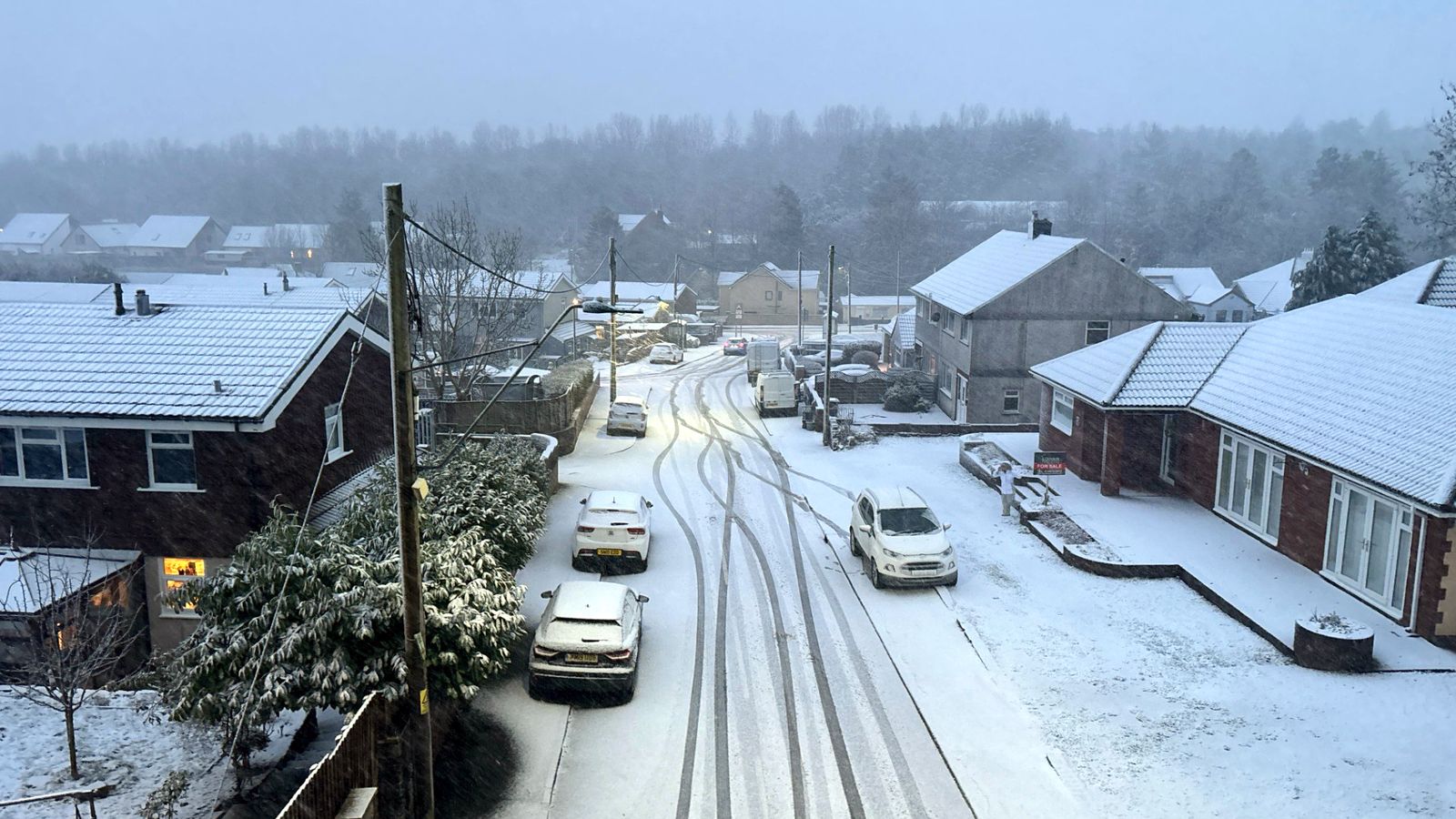
With the last Met Office red warning now finished, the most severe warning across the UK is an amber snow alert covering Wales and much of the Midlands.
Snow is expected to keep falling in these areas until the early hours of the morning before the warning ends at 9am.
Watch correspondent Tom Parmenter‘s report from Buxton, in Derbyshire, below.
Be the first to get Breaking News
Install the Sky News app for free
UK weather latest: Extensive travel disruption expected – as Storm Goretti leaves thousands without power – Sky News
You Might Also Like

Europe Car Rental Market Expected to Rise to USD 59.0 Billion by 2033 | With a 11.1% CAGR – openPR.com

Dominica’s Ocean Oasis Hotel: Combining Eco-Tourism with Luxury in the Heart of the Caribbean – Travel And Tour World