
Hundreds of delayed and canceled Delta, Spirit and Southwest flights at Atlanta’s Hartsfield-Jackson are disrupting travel to New York, Los Angeles, Chicago and other major U.S. cities.
The Traveler contains affiliate links. If you click through and make a purchase, we may earn a small commission at no extra cost to you. We are grateful if you use these as it helps a lot! Read the full policy.
More news on this day
Travelers across the United States faced mounting disruption on Friday as widespread delays and cancellations at Hartsfield-Jackson Atlanta International Airport forced Delta Air Lines, Spirit Airlines and Southwest Airlines to scrub or stall more than 300 flights, snarling routes to New York, Los Angeles, Chicago and other major cities.
Get the latest news straight to your inbox!
Operational bottlenecks at Hartsfield-Jackson, the primary hub for Delta and a key station for both Spirit and Southwest, triggered a cascade of schedule disruptions throughout the day. By early afternoon, tracking data showed 303 combined delays and 15 cancellations across the three carriers, with many more flights facing rolling departure pushes as crews and aircraft fell out of position.
Atlanta’s central role in the U.S. aviation network magnified the impact. Flights that originated on time elsewhere quickly became ensnared as they attempted to connect through the congested hub, leaving passengers stuck on taxiways, parked at remote stands or waiting at crowded gate areas for reassignment. The knock-on effects spread quickly to secondary airports as aircraft and crews failed to arrive for subsequent departures.
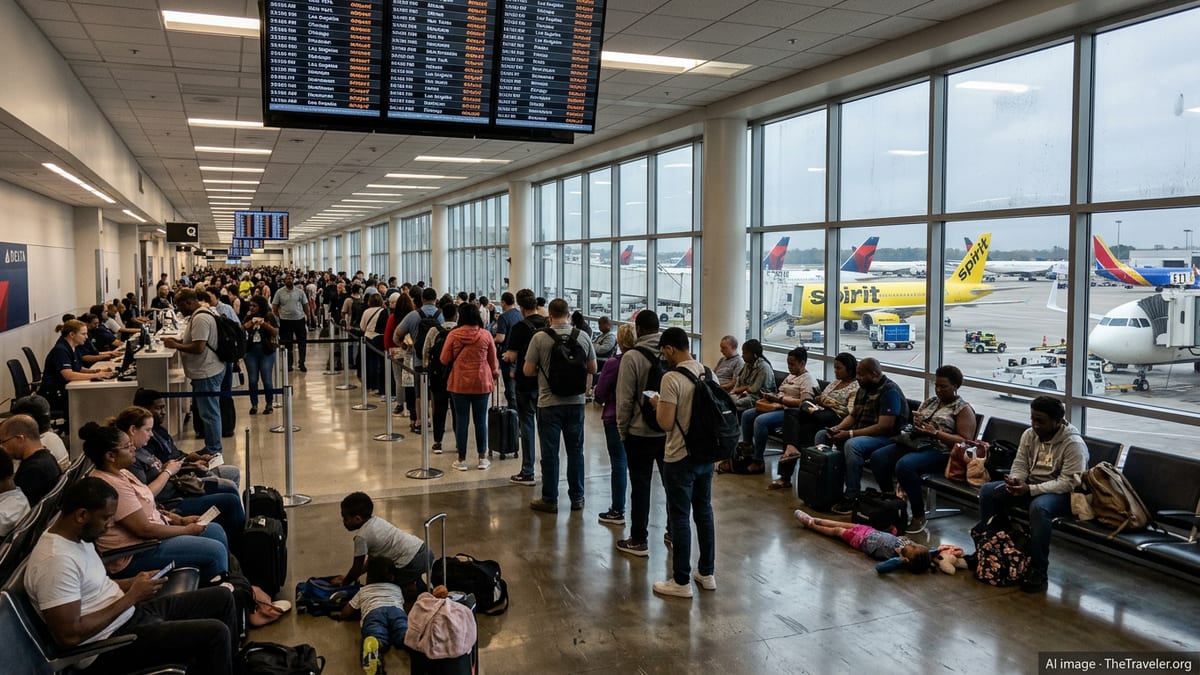
At security checkpoints and check-in halls, long lines formed as frustrated travelers tried to rebook or seek clarification on shifting departure boards. With many flights still officially listed as delayed rather than canceled, passengers described a pattern of incremental schedule changes that stretched waits from minutes into hours, making it harder to plan meals, onward connections and overnight stays.
Inside the terminal, monitors displayed a patchwork of red and yellow status updates, while public address announcements struggled to keep pace with rapidly changing gate and time information. Airport staff urged passengers to stay close to their gates and rely on airline apps for the latest updates, but connectivity issues and conflicting notifications added to the confusion.
Delta, which operates the single largest share of flights at Hartsfield-Jackson, bore the brunt of the disruption. The carrier reported dozens of late departures as it worked to inspect aircraft, reposition planes and rotate flight crews who were approaching duty-time limits after a week of irregular operations. Several Delta passengers reported sitting on board for extended periods before being asked to deplane as aircraft were taken out of service or reassigned.
Spirit Airlines, which runs a dense schedule of low cost flights through Atlanta, also saw multiple services delayed or canceled as crew availability tightened. With leaner staffing and fewer spare aircraft than larger legacy carriers, even minor schedule disturbances can force Spirit to consolidate flights or stretch delays when pilots or flight attendants are not positioned where they are needed. Travelers reported last minute gate changes and short-notice cancellations that left limited rebooking options on already full alternate flights.
Southwest Airlines, which relies on a point to point network and uses Atlanta as one of several regional spokes, encountered its own complications as late arriving aircraft from other parts of the country missed connecting windows. Some flights were held to accommodate misconnected passengers, only to encounter additional delays as air traffic control programs adjusted takeoff slots during peak afternoon periods.
All three airlines encouraged travelers to make use of mobile apps and customer service channels to change their itineraries without additional fees. However, call centers and in person help desks were quickly overwhelmed, with some passengers reporting multi hour holds and long queues at service counters as they sought new routes or travel credits.
The disruption in Atlanta quickly spilled over to major coastal and Midwestern gateways. Flights from Hartsfield-Jackson to New York area airports, including John F. Kennedy and LaGuardia, experienced repeated delays, leaving transatlantic connections at risk and forcing some passengers to overnight in New York rather than reach their final European destinations as planned.
On the West Coast, Los Angeles International Airport saw late evening banks of arrivals from Atlanta pushed well behind schedule. This affected not only leisure travelers returning from business and family trips but also cruise passengers attempting to reach embarkation ports in Southern California. Delays to overnight flights out of Los Angeles, in turn, threatened next day departures to Hawaii and Latin America.
In Chicago, both O’Hare and Midway reported clusters of delayed Atlanta services, complicating one of the country’s busiest domestic corridors. Travelers connecting onward to secondary Midwestern cities such as Milwaukee, Indianapolis and Des Moines found that missed connections often meant waiting until the following day, as available seats on later flights quickly sold out.
Secondary markets across the Southeast and Mid-Atlantic also felt the strain. Cities such as Raleigh, Nashville and Charleston rely heavily on Atlanta for one stop connectivity to the rest of the country, and schedule disruptions at the hub left many of those flights operating significantly behind schedule or departing with rebooked passengers filling nearly every remaining seat.
For travelers stranded in Atlanta, the operational challenges quickly turned into an overnight logistics problem. With hundreds of passengers vying for same day rebooking, available seats dwindled and many were offered departures more than 24 hours later. Hotel inventory near the airport tightened by late evening, leaving some travelers to search for rooms well beyond the immediate vicinity or sleep in terminal seating areas.
Airport concessions reported brisk business as passengers sought meals and snacks during the prolonged waits. However, many outlets closed on their regular schedules, leaving limited food options available overnight despite the unusually high number of people remaining in the concourses. Families with small children, older travelers and those with medical needs faced additional stress as they struggled to secure quiet spaces and basic supplies.
Several passengers described difficulties retrieving checked baggage after cancellations, as ground handling teams prioritized turning active aircraft and clearing arriving flights. Some travelers were advised to file baggage claims and return the following day, while others chose to depart on rebooked flights without their luggage in order to secure scarce seats out of Atlanta.
Volunteer airport assistance teams and airline agents distributed basic amenity kits and, in some cases, hotel vouchers or meal credits, although availability varied by carrier and fare type. Travel insurance providers reported an uptick in claims inquiries related to trip delays and missed connections, particularly from business travelers facing added costs for rebooked last minute itineraries.
Airline operations experts warned that the disruption centered on Hartsfield-Jackson could take at least another 24 to 48 hours to fully resolve, even if conditions stabilize quickly. As aircraft and crews return to their normal rotations, some early morning and late evening flights may still face schedule adjustments while airlines work through backlogs of stranded passengers.
Travelers holding tickets through Atlanta over the weekend were advised to monitor their flights closely, arrive at the airport earlier than usual and consider carrying essential items in hand luggage in case of unexpected delays. Where possible, rebooking to alternative routings that bypass Atlanta, even with additional connections, may offer a better chance of arriving close to the original schedule.
Industry analysts noted that the episode underscores the fragility of tightly timed hub and spoke networks during periods of stress. When a central hub such as Hartsfield-Jackson experiences significant disruption, the sheer volume of connecting traffic makes it difficult for airlines to recover quickly without ripple effects across the national system.
While Delta, Spirit and Southwest continued working through the backlog of delayed and canceled flights, passengers across the country were left to piece together revised itineraries, often at the cost of lost vacation time, rescheduled meetings and missed family events. For many, the latest wave of travel chaos served as a reminder that flexibility, travel insurance and realistic buffer times remain essential tools when flying through the nation’s busiest airport.
Why Cruises Are Being Canceled in 2026
From Middle East tensions to dry docks and redeployments, a mix of security, maintenance and market forces is reshaping cruise schedules in 2026.
Airports Eye Private Security as Shutdown Strains TSA
As the latest U.S. government shutdown fuels hourslong TSA lines, more airports are weighing private security firms to keep checkpoints moving.
Norovirus Outbreak Sickens 150 on Star Princess Cruise
More than 150 guests and crew aboard Princess Cruises’ new Star Princess have fallen ill with norovirus on a Caribbean sailing returning to Fort Lauderdale.
Carnival Rolls Out Express Dining on 15 Cruise Ships
Carnival Cruise Line is rolling out a faster Express Dining option on 15 ships, promising multi-course dinners in under an hour without sacrificing service.
US Deploys Marines to Middle East as Iran Crisis Deepens
The United States is sending thousands of Marines and naval assets to the Middle East as conflict with Iran disrupts Gulf shipping and rattles global markets.
Norovirus Suspected as Cruise Outbreak Sickens Over 150 Aboard
More than 150 passengers and crew on a Caribbean cruise have fallen ill with vomiting and diarrhea, as U.S. health officials probe a suspected norovirus outbreak.
Norovirus Suspected After 150 Fall Ill on Star Princess
More than 150 passengers and crew on Princess Cruises’ Star Princess have reported gastrointestinal illness as U.S. health officials probe a likely norovirus outbreak.
US Navy Amphibious Force Heads to Middle East Amid Tensions
A Marine expeditionary unit aboard three US Navy amphibious ships is diverting to the Middle East, reshaping regional security and key maritime travel routes.
Cancellations and Delays Snarl Flights at Burlington Airport
A cluster of cancellations and delays at Patrick Leahy Burlington International disrupted key routes to major hubs, stranding travelers and straining regional carriers.
TSA Delays Snarl Spring Break Travel Amid DHS Shutdown
Hours long TSA lines at key U.S. airports are disrupting spring break travel as a partial government shutdown squeezes security staffing nationwide.
Rising Oil Costs Put Pressure on U.S. Airfares
With oil and jet fuel prices jumping amid Middle East turmoil, U.S. travelers are being urged to lock in 2026 flights before fares climb further.
A Global Hub of Travel Knowledge
Great! Check your inbox and click the link.
Sorry, something went wrong. Please try again.
A Global Hub of Travel Knowledge
Great! Check your inbox and click the link.
Sorry, something went wrong. Please try again.
Travel Chaos at Atlanta’s Hartsfield-Jackson Ripples Nationwide – thetraveler.org
You Might Also Like
![Read more about the article Avis Gave Him A 'Free Upgrade'—Then Sent A $2,000 Bill And Claimed He Drove 40,000 Miles In 5 Days [Roundup] – View from the Wing](https://breathtakinglagoon.com/wp-content/uploads/2025/04/wp-header-logo-154-300x225.png)
Avis Gave Him A 'Free Upgrade'—Then Sent A $2,000 Bill And Claimed He Drove 40,000 Miles In 5 Days [Roundup] – View from the Wing

Heavy Rain Travel Advisory From Harlem To Hollis Reports The National Weather Service – Harlem World Magazine
