Elliott Report
Elliott Report
By Christopher Elliott
Published
Updated
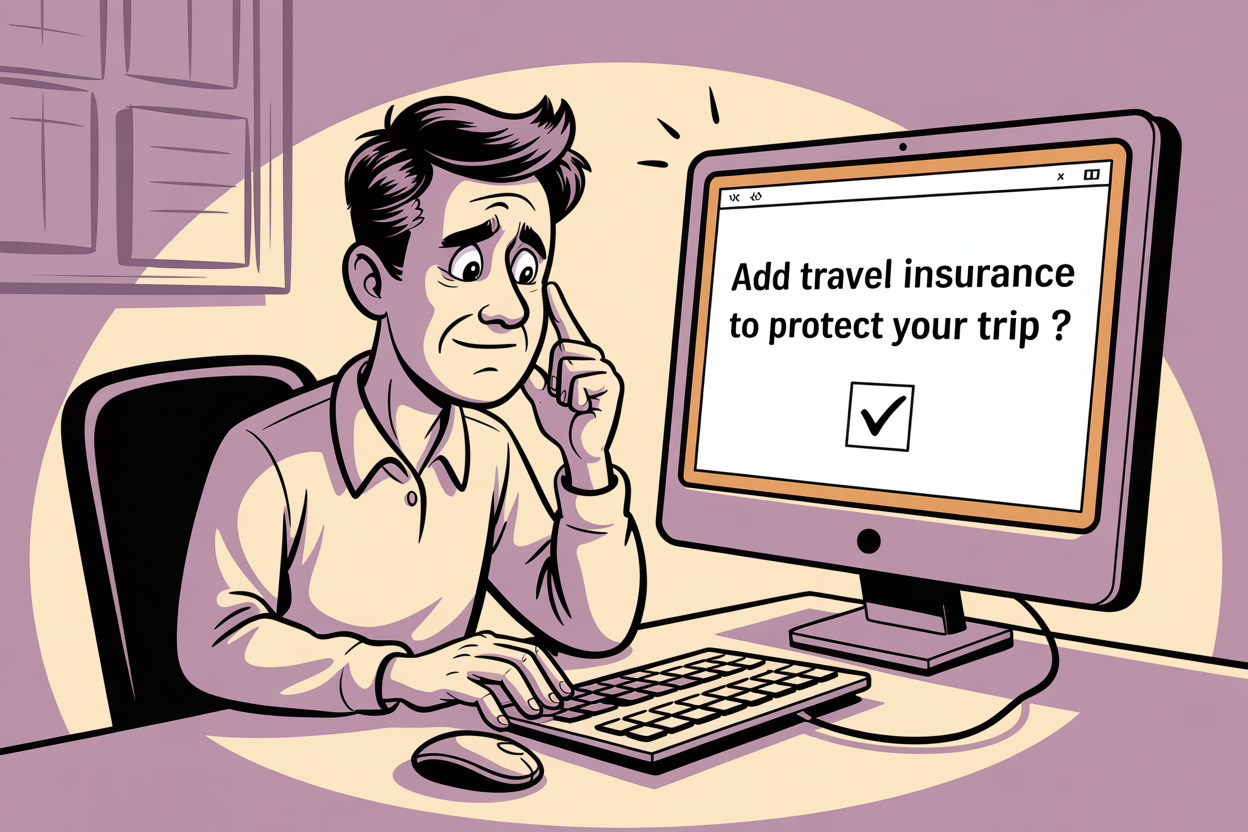
You’re minutes away from confirming your dream vacation. You’ve selected a flight, hotel and rental car. And then you see the question: “Add travel insurance to protect your trip for just $89?”
One click, and you’re covered. Right?
Maybe, maybe not.
That convenient checkout insurance you’re about to buy is what industry insiders call the fast-food version of coverage — cheap, quick, and likely to leave you hungry for real protection when you need it most.
Almost 1 in 4 travelers experienced a flight delay or cancellation, according to recent data from AirHelp. Yet many of those same travelers who thought they were covered by insurance discovered their checkout policies offered little more than expensive and illusory peace of mind.
“Checkout travel insurance is often cheap and incomplete, and we all know cutting corners on safety is risky,” says Danielle Graham, sales manager for Global Rescue. “Most of these policies don’t include essentials like medical evacuation or security extraction.”
Research by Yonder Travel Insurance found that travel supplier policies cover 15 to 30 percent fewer cancellation reasons, offer 10 to 33 percent less medical evacuation coverage, and provide about three times less missed connection protection compared to retail policies.
And that’s the problem. The U.S. travel insurance market reached $8 billion in 2023 and is predicted to hit $15 billion by 2030, but a growing chunk of those sales comes from add-on policies that don’t always protect you.
I know quite a few people who have had very bad surprises buying cheap online travel insurance. Many of these companies have great sale platforms online but will never pay out on claims. Either they find small loopholes to justify denial or they keep asking for complex documentation which you eventually cannot provide to their satisfaction. I strongly recommend spending a few dollars more for Allianz, AXA or other multinational companies with real track record.
Here’s what travel companies don’t want you to know: those checkout policies are massive profit centers. Patrick Caruso, an independent insurance agent, recently quoted a client $34 for standalone coverage that would have cost $89 through an airline’s checkout process.
“The markup on checkout policies is brutal because the booking platform takes their cut too,” Caruso said. “When I price standalone travel insurance for my clients, I’m seeing 40 to 60 percent savings for equivalent coverage.”
The math gets worse when you realize you’re paying more for less.
“Most people don’t realize that checkout policies are underwritten by the same major insurers I work with directly, just with more restrictive terms and higher prices,” Caruso explains. “You’re literally paying more for less coverage and worse claims handling.”
Danny Karon, author of “Your Lovable Lawyer’s Guide to Legal Wellness,” agrees: “The price you pay for the coverage is often inflated, and the payout rate can be as low as 8 cents for every dollar spent.”
Chahanler Marks learned this lesson the hard way. On a cruise booking, he clicked the checkout insurance box, assuming he’d be covered.
“When a canceled flight out of Atlanta threw off my plans, the policy barely helped,” recalls Marks, an IT specialist from Chattanooga, Tenn. “The coverage looked simple but left me eating most of the costs.”
Alex Smith had a similar wake-up call. After purchasing checkout insurance for both a $780 round-trip flight and a $1,200 cruise, he discovered the policies’ limitations when a flight delay caused him to miss the first night of his cruise.
“The insurer only paid out cancellations that fit a very strict list of conditions, and my lost accommodations of $300 were not covered,” says Smith, who runs a software company in Toronto.
The timing trap catches many travelers off guard. Caruso, the travel advisor, had a client whose father suffered a heart attack two weeks before a cruise.
“The checkout policy wouldn’t cover cancellation because it was purchased ‘too close to departure,’ while a standalone policy would have covered it fully,” he says.
Many experts say checkout insurance is designed to protect the travel company’s interests, not yours.
“Most ‘trip protection’ buttons have no named underwriter, no 24/7 assistance, and they almost always give vouchers instead of cash should something go wrong,” said Mark Whitman, a travel insurance consultant at Rise & Shield.
Travel agent Maria LaDuca also warns that if you have to cancel, you’ll usually just get a future credit instead of your money back.
“And those plans almost never cover the big things that really matter, like medical emergencies, evacuations, lost luggage, or long delays,” she adds.
Jackie Mondelli, chief marketing officer of Squaremouth sees this constantly: “These checkout travel insurance policies may appear at checkout even for fully refundable bookings, where trip cancellation coverage is not necessary.”
That’s not all. Neville Mehra, co-founder of the travel insurance platform Genki, says there are other consequences of buying add-on insurance at checkout. But you may not find out about them until you have a health problem while you’re on the road.
“Ending up in a hospital in a foreign country — there’s really no limit to how much it might cost in the case of a severe accident or illness,” Mehra said. “We’ve seen cases even in countries that are considered budget destinations like Mexico and Thailand where travelers have ended up in the hospital with bills ranging from $30,000 to $100,000 for inpatient surgeries for things like appendicitis.”
Many checkout policies either exclude medical coverage entirely or cap it at laughably low amounts, according to experts.
Max Coupland, CEO of Insuranceopedia, warns that travelers often discover these gaps too late.
“Checkout insurance often has very narrow definitions of covered reasons for cancellation, things like illness or severe weather, while excluding common scenarios such as work-related cancellations, pre-existing medical conditions, or strikes,” Coupland says.
For anything beyond basic travel, checkout policies become virtually useless. Whitman of Rise & Shield points to a common scenario that leaves adventurous travelers exposed.
“Most checkout policies exclude mountaineering or cap trekking at 2,000 to 3,000 meters, so altitude illness or a heli-evac isn’t covered,” Whitman said. “Here’s my rule of thumb: if the activity or altitude isn’t spelled out, you’re not covered.”
Professional photographer Jeffrey Wang, who logs over 100,000 miles annually with expensive equipment, learned to avoid checkout options entirely.
“These policies are often disappointingly narrow and designed to protect the trip cost for casual travelers,” Wang says. “Not the specialized gear or creative investment that defines my livelihood.”
But checkout insurance isn’t always worthless. For simple domestic trips or short weekend getaways, it can provide basic protection at a reasonable price.
“For simple, low-cost trips, checkout insurance may be sufficient,” Coupland said. “For bigger, international, or nonrefundable trips, shop a standalone policy for broader protection.”
Some travel companies do offer legitimate value. EF Go Ahead Tours provides “cancel for any reason” policies for $75 on trips that can cost thousands per traveler. When you’re spending serious money, that level of flexibility becomes worthwhile.
But you have to do your due diligence before clicking the “buy” button. Scott Fleming, president of Aon Affinity Travel Practice, notes that while checkout policies offer convenience and customization for specific trip types, “we recommend that consumers always review their coverage to ensure it meets their individual needs.”
The experts are nearly unanimous: shop carefully for standalone coverage. Very carefully.
“I usually tell clients that they should shop around to find a plan that is best suited for them,” said John Cook, president of QuoteWright.com. “The travel plans at checkout are generally stripped-down plans that are designed to hit a specific price point that maximizes sales rather than benefits to the traveler.”
Suzanne Morrow, CEO of InsureMyTrip, echoes this advice.
“Independent, third-party travel insurance providers typically offer broader protection, often at a more competitive price,” she says.
The average cost of comprehensive travel insurance runs 5 to 6 percent of your trip costs, according to recent analysis. For a $7,000 trip, that’s roughly $350 to $420 — often less than what you’d pay for multiple checkout policies that cover only portions of your journey.
Travel guide Lahcen Ait-Hami has watched this play out with his clients in Morocco. “Travelers who purchased a separate policy usually felt more secure, especially when their trip involved multiple stops, longer stays, or activities like camping in the Sahara. The separate policy is more protective and easier to comprehend.”
When shopping for standalone policies, focus on what really matters.
“It’s always a good idea to review the terms and conditions to make sure the benefits align with the specific travel itinerary,” says Rhonda Abedsalam, vice president of travel insurance at AXA Partners US.
Look for policies that include:
Steve Johnson, chief product officer at Backpack Insurance, says you have to make sure you get the real deal — not some stripped-down, overpriced version of insurance.
“Ask yourself: Is it complete travel insurance, or is it only flight insurance?” he says. “Is it a comprehensive policy, or does it only cover the traveler’s bags? Does it only cover travel purchases made using a specific credit card?”
For frequent travelers, annual policies can offer the best value. Diana Steele, who works for a university in Cleveland, says her $275 annual policy has saved her a lot of money.
“Each year, I’ve had a mishap — urgent care visit, canceled flight, emergency dental work — that cost me at least slightly more than the insurance itself,” she says. “My last trip, to Spain in June, had a canceled return flight that left me stranded overnight in Madrid. I spent 250 euros to remain in the hotel. By the following Thursday, my claim was paid in full.”
One thing is clear: When you’re booking your trip, you have a decision to make about travel insurance.
“Buy your travel insurance when you book your trip,” advises Daniel Durazo, a spokesman for Allianz Partners. “If you wait to buy insurance, you may not be covered if an event happens between when you book and when you purchase the insurance.”
The question is, where should you buy?
The best advice is to shop around. Sure, it takes a few extra minutes. But would you buy car insurance from a car dealer without comparing rates? Would you purchase homeowner’s insurance from your real estate agent just because it’s convenient?
The travel industry has trained us to expect convenience at every step, but some conveniences might cost more than they’re worth. That checkout insurance box isn’t necessarily there to protect you, but it will always protect the travel company’s bottom line.
Travel companies push “one-click” insurance policies right before you finalize your booking. We want to know how you protect your vacation investments and whether you trust these quick add-on policies.
Readers warned cheap online insurance never pays claims, shared stories of denied claims from both checkout and standalone policies, and questioned whether any legitimate company exists with clear policies that actually pay out.
alex knows people who had bad surprises buying cheap online travel insurance. Great sales platforms but they never pay out. They find loopholes to justify denial or keep asking for complex documentation you can’t provide to their satisfaction. Strongly recommends spending more for Allianz, AXA or other multinationals with real track records. OnePersonOrAnother said travel insurance is generally a ripoff with payout ratios far lower than auto or health insurance.
Debra Beasley filed claims with both checkout and single trip insurance plans. Both were denied. She carries an annual policy now but doesn’t trust any of them. Who knows if your need will match the specific criteria in these complicated policies? All insurance is a crapshoot with exceptions in every policy. Howard Schwartz asked if anyone actually had travel insurance pay a claim timely without aggravation. The 20 pages of fine print is insane and they can always find loopholes.
Marty Biscan never buys checkout insurance. He only buys comprehensive for trips like safaris with significant advance payments, and medical/evacuation ($500K minimum each) for other international trips. For domestic he doesn’t buy any. Joyce R Lewis is traveling to Kenya and her outfitter required insurance. Their companion company charged $1,342 for a $9,000 trip, which was the best price. One company wanted 92% of the price for tickets over $350.
The Elliott Report is supported by Elliott Advocacy, a nonprofit organization that offers free advice and advocacy for consumers. If you need help with any problem, please contact us through this form. We’re always here to help.
We publish the names and emails of customer service managers. Check out our directory.
Check out Elliott Confidential, our free, daily newsletter with links to your favorite commentary, tips and news about consumer advocacy. You’ll also connect with other readers who want to make the world a better place.
If you have a consumer problem, please contact our team at Elliott Advocacy through this form. We’re always here to help. Our help is free.
Check out Elliott Advocacy Today, our free, daily newsletter with links to your favorite commentary, tips and news about consumer advocacy. Did we mention it’s free?
The Elliott Report is a consumer news site supported by Elliott Advocacy, a nonprofit organization that offers free advice and advocacy for consumers.
Elliott Confidential, our award-winning newsletter, keeps you posted on our random acts of consumer advocacy. Plus, we have insightful letters, insider tips, and more.