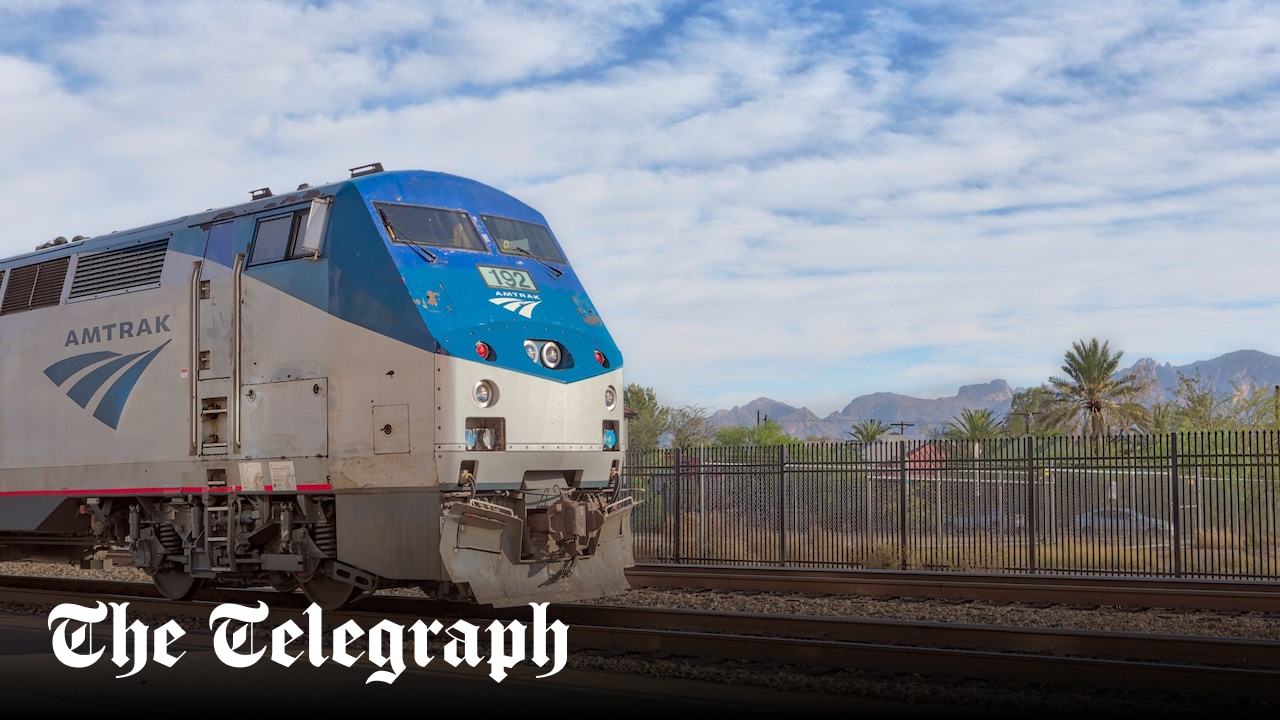
Forget hitting the highway, the Sunset Limited offers a slower, more scenic route from New Orleans to Los Angeles
Copy link
twitter
facebook
whatsapp
email
Copy link
twitter
facebook
whatsapp
email
Copy link
twitter
facebook
whatsapp
email
Copy link
twitter
facebook
whatsapp
email
It was 9.34am on Saturday morning and, despite being only 30 minutes into my 48-hour journey, I was already lost for words.
The train chugged onwards along the Huey P Long Bridge and, laid out beneath me, the mighty Mississippi sprawled in all her sunlit glory.
This was my introduction to the Sunset Limited, America’s longest-running named passenger train service, and the start of a two-day journey that would take me from the choux-pastry beignets and jazz bars of New Orleans to the Tinseltown glamour and coastal chic of Los Angeles. I had barely begun, and yet here I was communing with one of the defining geographical features of the American South. Speechless, indeed.
The Sunset Limited has been plying this route, or variations of it, since 1894 and, like its northern cross-country cousins, the California Zephyr from Chicago to San Francisco and the Empire Builder from Chicago to Seattle, it ranks among the United States’ truly epic rail adventures.
Unlike those journeys in cooler climes, the thrice-weekly Sunset Limited traces a path along the southernmost reaches of Louisiana and Texas, through New Mexico and Arizona, before finally rolling into California, the Golden State.
In doing so, it passes through three time zones, Central, Mountain and Pacific, and a striking range of landscapes, from creeks and canyons to deserts and mountains, red rock ridges and vast stretches of what we once called the Wild West, where it is still easy to picture cowboys riding off into the sunset. For part of the journey, the track runs directly alongside the contentious border wall between Mexico and the United States.
An epic journey requires an epic train, and the Sunset Limited does not disappoint. I could scarcely believe its scale, a vast double-decker Superliner standing more than 16ft tall, with a towering, sleek stainless steel exterior.
These trains, part of the Amtrak fleet, may have been built decades ago, with some dating from the 1970s and more modern models from the 1990s, but they still mean business.
I was berthed in a basic roomette, a compact space with two seats that convert into a bed at night, room for a modest-sized bag, with larger luggage stored elsewhere, and close proximity to shared washroom facilities, including a surprisingly good shower.
It may not have had the panache of the Pullman cars that once ran this route 130 years ago, but I spent happy hours gazing out of the expansive window, adjusting both to train time, which in the United States inevitably means slow travel, and to a mindset that delights in constant motion and ever-changing scenery.
When I fancied company, there would invariably be an announcement inviting those with reservations to head to the dining car for one of the three meals that punctuate the travelling day and provide ample opportunity to mix and mingle with fellow passengers.
This was how I met Steve and Judy, an amiable retired couple heading home to San Antonio of Davy Crockett and Alamo fame, and new converts to the pleasures of travelling by train rather than spending hours on car and truck-filled highways.
I also met Bill, a Vietnam War veteran with a passion for vintage train travel and cars with proper “shift-sticks”, and Ben, an IT specialist from Los Angeles who enjoyed the conviviality of life on board but also the option of retreating to his cabin for some quiet time.
The highlight of my dining car encounters, however, was Jeri and Cleon, a delightful couple in their late 80s who had been engaged as college sweethearts, lost contact for 70 years after second thoughts intervened, and were now, at last, very happily together.
I shared meals with all of them as the train headed west, including Amtrak’s signature flat iron steak, a breakfast quesadilla and some rather lovely coffee streusel cake. We discussed life, the universe and the pleasures of train travel, wisely steering clear of politics by mutual consent.
As we talked, a rich tapestry of scenery unfolded outside the window, shifting from the slow-moving bayous and sugarcane fields of subtropical Louisiana to the high desert plateaus of oil-rich Texas, the dust-red rock formations of New Mexico and the Arizona scrublands dotted with towering saguaro cacti.
I was torn between breaking the journey and doing the whole thing in one long stretch, but in the end I opted to stop in Tucson, Arizona, reboarding the train for the next scheduled service to Los Angeles two days later. This gave me the chance to explore a city that, thanks to the Beatles’ song Get Back, had been lodged in my consciousness for as long as I could remember.
I knew very little about Tucson or its layered history, which spans original settlement and land cultivation by indigenous peoples, periods of Spanish and Mexican rule, its acquisition by the United States and an influx of Chinese labourers. The latter played a key role in extending the railroad to Tucson in the 1880s and later settled in the Barrio Viejo district, now celebrated for its colourful adobe houses.
Vibrant murals dotted across the city reflect these multiple influences, as do restaurants serving creative fusions of the many culinary traditions that have mingled here, producing a level of gastronomy recognised by Unesco as among the finest in the world.
During my brief stop, I grazed on a mesquite-grilled pork chop at the trendy Tito & Pep restaurant, followed by carne seca enchiladas and a Horny Cucumber Margarita at El Charro Café, the oldest Mexican restaurant in the United States.
Before long, however, I was itching to get back on the move. I checked out of the Hotel Congress – a Tucson institution steeped in gangster legends and rock ’n’ roll energy – and made the short walk back to the station, joining the crowd waiting for the 8.15pm departure to Los Angeles.
We heard the hoots of the train’s horn well in advance – long, sonorous blares that seemed to echo down the decades and conjure up all the magic of the American railroad’s glory days.
I couldn’t wait to reboard, returning to the cosiness of my cabin and the sensation of moving through the night, this time leaving the desert plains of Arizona behind and heading on to the fertile lands of California.
I slept fitfully, reliving the journey’s many highlights, before sitting up groggily in my bed just before 5am and glancing out of the window. We were gliding into Union Station as dawn broke over the City of Angels and, suddenly, I was speechless again.
Adrian Bridge was a guest of North America specialist operator Journeyscape, which offers a 10-night trip travelling aboard Amtrak’s Sunset Limited train from New Orleans to Los Angeles, stopping in Tucson, from £3,550 per person.
Includes flights from London, train tickets (roomette, including food) and an excellent range of hotels – Old 77 in New Orleans, Hotel Congress in Tucson, and the Frank Gehry-designed Conrad in Los Angeles Downtown (with views on to Gehry’s even more spectacular Walt Disney Concert Hall). For more information on Tucson, go to Visit Tucson.
Copy link
twitter
facebook
whatsapp
email
Explore hotels that have been tried, tested and rated by our experts