
Shower possible.
Shower possible
Updated: March 30, 2026 @ 6:09 pm
Routine operations at the NWS Aviation Weather Center in Kansas Ciry, KS, on Feb 23, 2026. NWS Photo by Robert Hyatt
WDRB Meteorologist
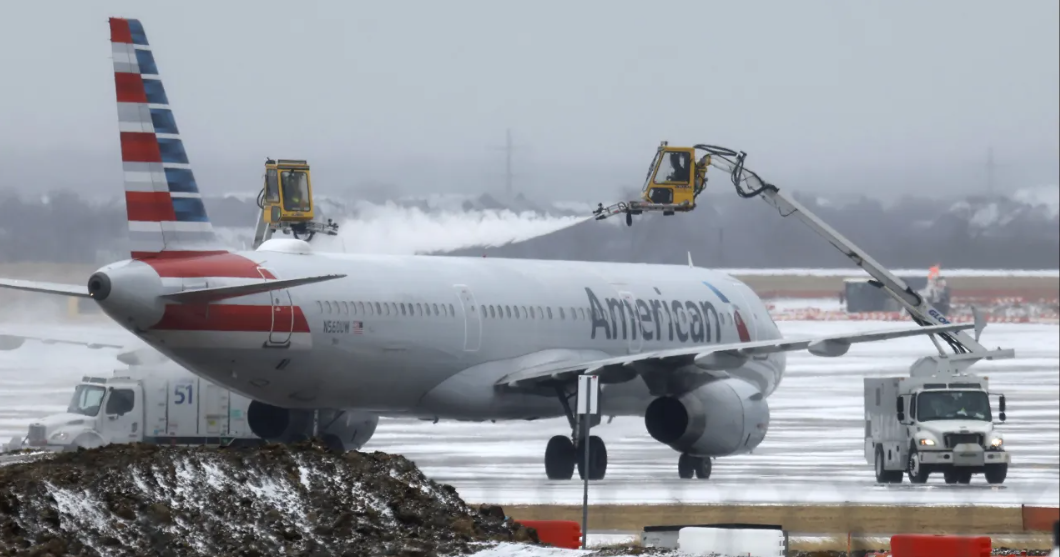
Ground crews de-ice an American Airlines jet at Dallas-Fort Worth International Airport on January 24, 2026 in Texas. (Image credit: Ron Jenkins/Getty Images)
Passengers, pilots, and crew: Get ready for greater peace of mind.
Starting in late March, a new NOAA weather forecast system will provide improved prediction of two aviation hazards that pose threats to flight safety and create anxiety among passengers: airplane icing and turbulence.
Covering the contiguous United States, the new Domestic Aviation Forecast System (DAFS) will generate more detailed forecasts of evolving icing and turbulence risks, giving pilots real-time intelligence about changing weather conditions along their flight path.
DAFS was developed with funding from the Federal Aviation Administration’s (FAA) Aviation Weather Research Program. The system is transitioning from development teams led by NOAA Research into operational use at NWS’s National Centers for Environmental Prediction.
“This is the culmination of extensive research and years of work that gets right to the heart of our aviation forecast mission: supporting passenger safety and the aviation industry,” said Terra Ladwig, acting chief of NOAA Global Systems Laboratory’s (GSL) Assimilation, Verification, and Innovation Division.
“The DAFS is another example of how NOAA continuously works with the FAA to deliver the most accurate, timely and useful aviation forecasts,” said Joshua Scheck, aviation support branch chief for NOAA’s Aviation Weather Center. “Improving prediction of turbulence and icing will strengthen NOAA’s ability to provide critical flight safety information to the FAA and the aviation community.”
Routine operations at the NWS Aviation Weather Center in Kansas Ciry, KS, on Feb 23, 2026. NWS Photo by Robert Hyatt
NOAA National Weather Service meteorologists provide thousands of aviation weather forecasts each day. NOAA’s Aviation Weather Center in Kansas City, Missouri, issues more than 300 additional aviation weather forecasts daily, along with 55,000 in-flight aviation weather warnings per year on average.(Image credit: Robert Hyatt/NOAA NWS)
To help the FAA generate flight paths that route planes around dangerous weather, National Weather Service’s 122 Weather Forecast Offices provide more than 3,000 regularly scheduled forecasts to approximately 700 airports daily. The NWS Aviation Weather Center (AWC) issues more than 300 additional aviation weather forecasts daily, along with 55,000 in-flight aviation weather warnings per year on average. The AWC also distributes nearly 12,000 automated aviation forecasts daily in a variety of formats as a Meteorological Watch Office.
The FAA and NOAA partnership has existed for over 25 years, with early versions of the icing and turbulence algorithms evolving in step with next-generation NOAA weather forecast models.
The new aviation forecast system is based on NOAA’s most advanced operational regional forecast model, the High-Resolution Rapid Refresh, (HRRR), which was specifically designed to track rapidly evolving severe weather events.
The HRRR provides an updated forecast every hour on a 3-kilometer (1.8-mile) surface grid with 50 vertical slices through the atmosphere. What makes the HRRR unique is that it ingests three-dimensional radar data every 15 minutes. This allows meteorologists to “see” ongoing precipitation and predict the formation of individual thunderstorms – common causes of flight-level icing and turbulence – with superior accuracy.
Previously, icing and turbulence guidance were generated from hourly updating numerical weather models on a coarser 13-kilometer (8-mile) surface grid. With DAFS, icing and turbulence forecast updates will be more precise.
“The enhanced horizontal and vertical resolution provides more detailed forecasts, which potentially gives pilots more options to navigate around hazards.” said Curtis Alexander, GSL’s deputy director.
NOAA AWC meteorologists and those embedded with the FAA’s 21 Air Route Traffic Control Centers will then create tailored aviation products, including aviation and airport-area forecasts that can be distributed by networks such as aviationweather.gov and aviationweather.gov/help/data/ for preflight and in-flight safety.
Icing forecasts: One of DAFS’ tools provides enhanced forecasts of in-flight icing probability, severity, and supercooled large droplet conditions for the contiguous U.S. plus Alaska. In-flight icing occurs when liquid water droplets at below freezing temperatures freeze on contact with the aircraft’s cold surface. Ice buildup can affect the performance and efficiency of propellers and rotors, stability and steering controls, radio antennas, air intakes and more, sometimes with deadly consequences. The risk is especially high in clouds containing supercooled large drops, which can pose a significant danger for some aircraft.
Turbulence forecasts: DAFS also improves prediction of several types of turbulence that can cause serious injuries to aircraft occupants and airframe damage, and require rerouting of flights. In addition to low-level turbulence, clear air turbulence and mountain wave turbulence, the updated algorithm also predicts turbulence within clouds ranging in size from small storms to large systems.
Reach meteorologist Bryce Jones at BJones@wdrb.com, on Twitter or on Facebook. Copyright 2026. WDRB Media. All rights reserved.
WDRB Meteorologist
{{description}}
Email notifications are only sent once a day, and only if there are new matching items.
Your browser is out of date and potentially vulnerable to security risks.
We recommend switching to one of the following browsers: