
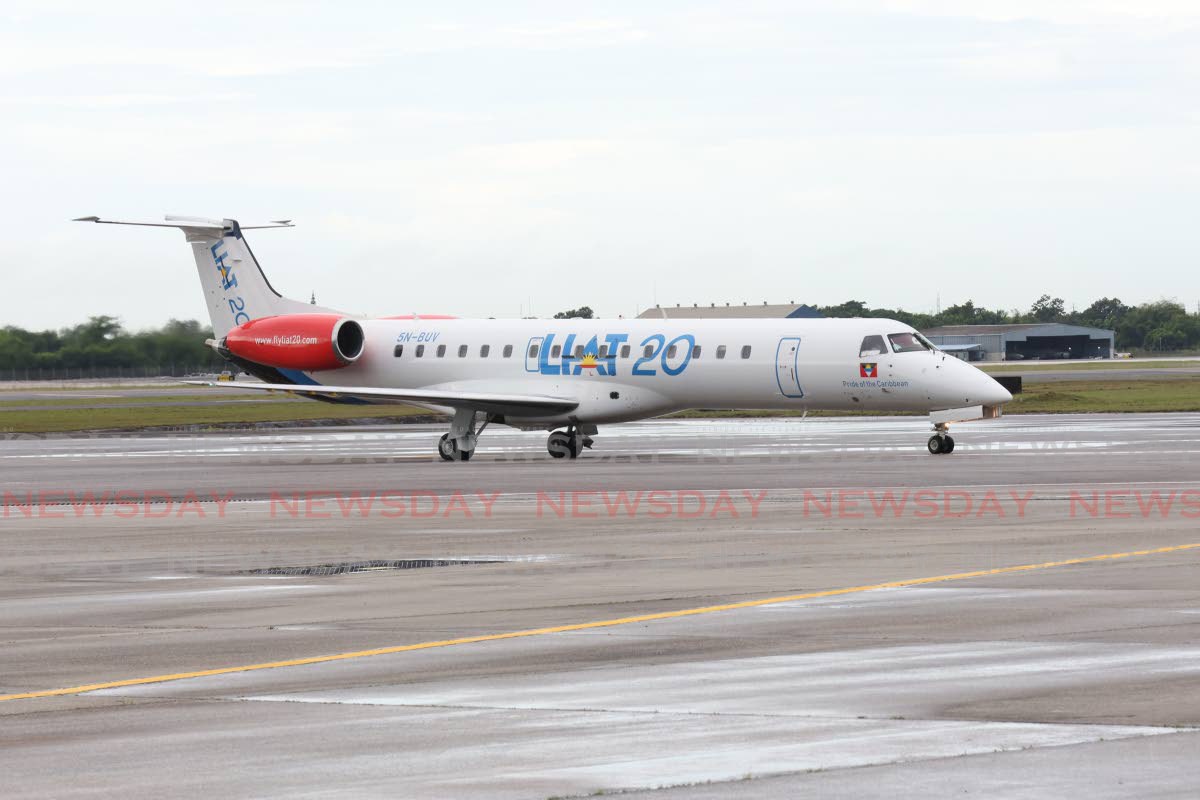
Last week, during a press briefing on the proposed air services by St Maarten-based Windward Islands Airways International NV (Winair) between TT and St Maarten, Winair’s CEO Hans van de Velde explained the airline’s cautious yet confident approach with regard to its TT operations. “We don’t want to make the mistake other airlines have made in the past, wanting to go too fast. So, we will do it steadily. And if success is there, and we think it will be there, we will grow,” said van de Velde.
On February 1, the airline will begin nonstop twice-weekly scheduled service between Trinidad’s Piarco International Airport (POS) and Sint Maarten’s Princess Juliana International Airport (SXM) using its 48-seater ATR 42-500s.
On the issue of low fares for intra-Caribbean travel, van de Velde said, “It’s impossible in this region to operate for low prices, because running an airline here is expensive, and there are a number of reasons. One is that there are very high taxes,” he said. “So, we have an introductory fare of US$200 one way, literally half of it is tax. As an airline, you don’t keep that; that tax goes to the government. So, offering low prices is not very realistic, and we have seen in this region that many airlines went bankrupt. It shows that it’s difficult to run an airline,”
Other airlines have raised the issue of high taxes on airline travel. In April 2018, during the launch of the CaribSKY alliance by LIAT 1974, Air Antilles and Winair, the airlines called the Caribbean governments are being encouraged to revisit the level of taxation on airline tickets for regional travel.
LIAT’s CEO Julie Reifer-Jones said taxation was a “ticklish issue” but a solution had to be found.
She said a recent study showed that intra-regional travel had declined significantly. LIAT, she said, was now moving 750 000 passengers annually in comparison to one million in the past.
“When we tried to get behind the numbers and look at some of the factors impacting that decline, the taxes – and this includes both airport and the taxes directly from the government – are acting as a significant deterrent to travel across the region.
“Because we are connecting passengers across several territories, we are actually picking up taxes from three or four territories every time somebody flies from one destination to the next and we also have the issue of in transit taxes because we’re stopping at St Maarten or we’re stopping in St Vincent or we’re stopping in Barbados,” Reifer-Jones said.
The CEO revealed that while LIAT 1974 had raised its base fare by about three per cent between 2009 and 2016, taxes had increased by about 56 per cent.
“What the passenger sees is not the base fare. They are going to see the total package and their reaction to buying a ticket to travel to Guadeloupe or travel to Dominica is going to be impacted by that total bottom line picture,” she said.

In September 2022 the International Air Transport Association (IATA) warned Caribbean countries that they are pricing themselves out of the global tourism market.
The caution came at the Caribbean Aviation Day in the Cayman Islands on September 14, 2022. The event was staged under the theme ‘recover, reconnect, revive,’ the event saw government ministers, industry experts, and senior aviation executives come together to discuss key challenges impacting the region and opportunities for growth.
With global passenger air traffic now at 74.6 per cent of pre-covid levels, IATA vice president for the Americas, Peter Cerdá stressed that Caribbean destinations are “running the risk of pricing themselves out of the global travel and tourism market, where passengers have more choice than ever before.”
“A recurring theme is also taxes and charges levied on aviation. Yes, we understand that the provision of adequate infrastructure for aviation comes at a cost, but very often it is difficult to see the correlation between the level of costs and charges, and the actual service provided,” said Cerdá.
He highlighted that while globally taxes and charges make up approximately 15 per cent of the ticket price, in the Caribbean this constitutes 30 per cent of the price on average, with some destinations reaching as high as 50 per cent of the total ticket cost. When compared to destinations like Lima, Peru, Cancun, Mexico, add other relatively close beach destinations whose taxes and fees only represent 23 per cent, the Caribbean is becoming a less attractive destination.
“Today’s passengers have a choice, and as the total cost of vacations increasingly becomes a decision-making factor, governments must be prudent and not price themselves out of the market,” urged Cedá, noting that t the World Travel and Tourism Council (WTTC) forecasted a possible annual 6.7 per cent travel and tourism GDP increase between 2022 and 2023 if the right policies are implemented.
Speaking later at the conference, Barbados’ Tourism Minister Lisa Cummins defended the taxes and charges to her country. “Let us break down where fees and charges go to in-country because the things that we want and the things that we have to be able to provide come with a price tag,” said Cummins. She argued that taxes and charges do not go to the government’s consolidated fund as revenue, but instead go back into providing infrastructure and services in the aviation industry.
“We realised that even if Barbados would, and we have been looking at it, look at the changes that we potentially can make to our tax structure… We don’t have the number of seats that compensates for those losses in revenue,” said Cummins about the trade-off between government revenue and taxes.
The 2025 State of the Tourism Industry Conference (SOTIC) was hosted by the Caribbean Tourism Organization (CTO) in Barbados from September 30 to October 3, 2025, at the Hilton Barbados Resort, centered on “Reimagining Caribbean Tourism: Research, Relevance and the Road Ahead.” The event brought together over 400 regional and international leaders to discuss sustainability, innovation, and industry growth.
The conference discussed the high cost of regional travel which remains a vexing issue for travellers between the Caribbean islands. Among the key factors contributing to these high costs are the taxes imposed by regional governments on airline ticket prices.
The conference noted that intra-Caribbean flights often carry taxes and fees that exceed the base airfare, significantly increasing the cost of tickets for travel between islands. In contrast, Europe and Southeast Asia tend to have lower aviation taxes, especially for regional travel. Budget airlines thrive in those regions due to minimal fees and government support — a phenomenon not commonly seen in the Caribbean.
These taxes have several negative impacts on intra-regional travel as they discourage regional movement, with locals being priced out of flying between islands. In turn, this hurts tourism as visitors face unexpectedly high costs, reducing demand.
The taxes also strain local airlines. Homegrown carriers struggle to compete with subsidized foreign airlines, making it harder for them to survive in the market. Among those homegrown airlines is LIAT Air. The company, which began operations in 2024, faces several challenges, including the need to distance itself from its failed predecessor, LIAT 1974. These problems are only exacerbated by hefty taxes, as highlighted by airline CEO Hafsah Abdulsalam on the opening day of the SOTIC 2025.
In an impassioned response to questions about the challenges contributing to high airfares, Abdulsalam emphasized that both her airline and regional governments must play their part in improving connectivity. Abdulsalam, who also revealed LIAT’s plans to connect the region with South America and Africa in the near future, noted that regional taxes remain a major issue.
“We need to be a lot more efficient, for efficiency reduces costs. Production and reduced costs ultimately reduce the amount we charge for the ticket,” she said.
A 2018 Caribbean Development Bank (CDB) working paper stated that air connectivity growth in the Caribbean has been generally and relatively weak, and limited with one of the primary barriers to connectivity in the Region being high costs such as taxes, airport fees and other charges in air transportation.
The CDB recommended as follows:
A reduction in aviation taxes: The price elasticity of demand to airfares (which include taxes) reflects the travellers’ sensitivity to changes in price – and the taxes in the Caribbean add to this price. This distortion appears to be greater for intra-regional travel.
A reduction in airport charges: Lowering charges may allow airlines to operate in markets which are considered thin and where operating costs are important for viability. This may also be a way for airports to attract services, especially for the extra-regional markets.
These recommendations are still very relevant today.