
Brian McCurdy
We use affiliate links and may receive a small commission on purchases. Read more about us.
Whether you’re traveling across the globe or headed out on a quick weekend getaway, a thoughtfully designed travel pack can help you stay comfortable and organized while on the move. Key considerations include carry-on compatibility for air travel, sufficient capacity to store your belongings, pack weight, and preferences for storage and organizational layouts. With these elements in mind, we have hauled dozens of travel backpacks all over the world—from the bustling streets of Kathmandu to quaint towns across Europe. These are our favorite travel backpacks, ranging from minimalist options for a couple of nights away to larger bags with removable daypacks for extended trips, with the Cotopaxi Allpa 50L Adventure Travel Pack coming out on top. For more background information, see our detailed comparison table and buying advice below the picks, along with details about our testing process.
Editor’s note: We updated our travel backpacks guide on February 12, 2026, to add the Cotopaxi Allpa 50L Adventure Travel Pack as our best overall pick, add the Decathlon Quechua NH Escape 500 Rolltop 23L to our other favorites section, and add a tested and dismissed section to discuss backpacks we’ve tested but chosen not to include in the main lineup.

Capacity: 50L
Dimensions: 27 x 14 x 10 in.
Weight: 4 lb. 6 oz.
Other sizes: None (though original Allpa design is available in 28, 35, and 42L)
What we like: Excellent modular design and organization; well-conceived adjustable fit.
What we don’t: Expensive, a bit heavy and bulky.
The Cotopaxi Allpa 50L Adventure Pack stole the show this year with its versatility, internal organization, and excellent carrying comfort. For travelers who want to pack light but hate being stuck with an oversized backpack once they arrive, this bag offers one of the more elegant solutions we’ve seen. The standout feature is the removable 8-liter top compartment, which detaches to become a sling-style daypack—perfect for flights, sightseeing, or quick missions around town without dragging your whole load along. The main body opens via a U-shaped zipper and is packed with smart storage, including a dedicated shoe/laundry pocket, a padded sleeve that fits a 16-inch laptop and tablet, a hidden passport pocket accessible while wearing the pack, and a stretchy side sleeve that easily swallows a full-size Nalgene. When the top lid is removed, a compression strap lets you lash down a jacket or midlayer, keeping the system tidy and efficient.
Despite its sizable capacity, Cotopaxi also nailed the carry. An adjustable torso system provides up to 4 inches of length adjustment, and the hipbelt (which spans 28-56 inches) can be stowed for overhead-bin duty. Like the rest of the Allpa line, the pack is built from 100% recycled fabrics and feels ready for years of travel abuse thanks to the burly 840-denier (D) fabric. At $305, it sits at the premium end of the spectrum, but considering you’re getting both a full-featured carry-on pack and a standalone day sling, the value is actually quite strong. If you’re a minimalist traveler who wants maximum flexibility without packing a second bag, the Allpa 50L Adventure is one of the most compelling designs on the market.
Read more: Cotopaxi Allpa 50L Adventure Travel Pack review
See the Cotopaxi Allpa 50L Adventure Travel Pack
Capacity: 45L
Dimensions: 22 x 13 x 9.5 in.
Weight: 4 lb. 8 oz.
Other size: 30L
What we like: Easy to access, expandable design, and thoughtful feature set.
What we don’t: Expensive, a little heavy, and too techy for some.
Peak Design’s Travel Backpack may look unassuming on the outside, but don’t be fooled: This bag is packed with thoughtful travel-ready features. First is the expandable design, which lets you switch between 35 and 45 liters by simply zipping or unzipping the front zipper. Access is another highlight, including entry points at the top, side, front, and rear for easily retrieving items pretty much anywhere in the pack. Storage is also excellent with padded laptop and tablet sleeves, a divisible main compartment, large and stretchy dual side pockets (not common on travel packs), and multiple interior pockets. And it’s all wrapped up in a thick nylon canvas shell that’s durable, streamlined, and very modern.
What complaints do we have about the Peak Design Travel Backpack? Price is the most glaring downside: it’s one of the most expensive designs on our list. And while the bag is undeniably sleek, it’s pretty utilitarian-looking (which could be a good thing, depending on your personal preferences). It’s also on the heavy side at 4.5 pounds, which isn’t unreasonable but does add considerable heft compared to many competitors. Finally, the Travel Backpack is technically not carry-on compliant when expanded, measuring 22 x 13 x 11 inches (the standard U.S. domestic carry-on limit is 22 x 14 x 9 in.). But it works at the compressed 35-liter size (or smaller 30L option), and photographers in particular will love the shape, which nicely accommodates multiple camera cubes, lenses, and other accessories. For daily use, we’re also big fans of Peak Designs’ Everyday 20L Backpack Zip, which closely resembles the travel pack, but is lighter, smaller, and cheaper.
See the Peak Design Travel Backpack
 Capacity: 40L
Dimensions: 21.5 x 15.75 x 8.25 in.
Weight: 3 lb. 10.2 oz.
Other sizes: None
What we like: Good capacity and organization for far less than the competition.
What we don’t: Lacking in padding and support for shuttling heavy loads; no lockable zippers.
Travel packs are an expensive bunch, but Amazon offers an affordable yet surprisingly capable option in their Carry-On Travel Backpack. We’ll start with the good news: As its name implies, the bag is carry-on compliant, and it comes with most of the standard features we look for in a practical travel pack. These include a zippered laptop sleeve, internal and external compression straps, easy-access pockets for travel documents, and good organization in the main compartment. Like the Peak Design Travel Backpack above, the Amazon Basics can also be expanded to boost packing space while still meeting carry-on restrictions. And for the price, the 40-liter Carry-On Travel Backpack is a great value, undercutting most similarly sized models on this list by $100 or more.
Now for the bad news: This Amazon Basics pack is far less capable than many of the other options here for shuttling a full load. The shoulder straps are only lightly padded, and the hipbelt is a thin and basic webbing design that won’t feel comfortable under the weight of a full load. The rest of the design has a cheaper feel, too, including a shiny and dated-looking exterior, a lot of plastic (read: breakable) components, and standard, non-lockable zippers. You don’t get dedicated water bottle storage either, which isn’t a necessary feature but certainly is nice to have. Still, if you’re an occasional traveler and aren’t yet ready to make a more sizable investment, the Amazon Basics pack is a perfectly serviceable entry-level option at a great price. For another capable budget design that comes with packing cubes and lots of colorway options, we also like Asenlin’s 40L Travel Backpack. Additionally, we’ve had great luck with the Wonhox Large Travel Backpack, which has most recently accompanied us to Africa, Europe, and countless domestic trips. It comes with similar downsides, but for the budget-conscious traveler, it fits the bill.
See the Amazon Basics Carry-On Travel Backpack
 Capacity: 40L
Dimensions: 23 x 15 x 9.5 inches
Weight: 2 lb. 13 oz. (men’s), 2 lbs. 11 oz. (women’s)
Other size: 18, 30L
What we like: Competitive balance of price, organization, weight, and carrying comfort; crosses over nicely for hiking.
What we don’t: Makes some sacrifices in the name of versatility, including an unpadded laptop sleeve and no internal divider.
REI Co-op is known for providing reliable gear at palatable price points, and the Ruckpack 40 is no exception. For a very competitive price, the Ruckpack checks a whole lot of boxes for occasional and well-versed travelers: It’s extremely comfortable to carry thanks to a backpacking pack-like suspension system that nicely distributes weight, easy to access and organize with a generous U-shaped opening and practical zippered storage, and impressively light for the capacity at 2 pounds 13 ounces. The Ruckpack also crosses over decently well for hiking—especially in the smaller 18 and 30L capacities—with a sleeve and port for a hydration bladder, trekking pole attachments, dual water bottle pockets, and even an included rain cover (the 18L version has one water bottle pocket and no cover). Finally, the pack is available in both men’s and women’s styles with two size options for each.
However, as with most designs that aim to do it all, the REI Ruckpack does make some concessions in the name of versatility. First, while the hydration reservoir sleeve can fit a 15-inch laptop, it’s not padded, which isn’t ideal for protecting electronics during travel. Additionally, the U-shaped zipper doesn’t open as wide as the clamshell-style openings on many alternatives here, making it harder to reach the contents at the very bottom of the bag. Finally, there’s no internal divider or compression straps inside the main compartment, although our tester found packing cubes to be just as effective—if not more so—for organizing her clothing and toiletries. Taken together, the Ruckpack is a highly versatile and thoughtfully built design at a great price.
Read more: REI Co-op Ruckpack 40 review
See the Men’s REI Co-op Ruckpack 40 See the Women’s REI Co-op Ruckpack 40
Capacity: 30L
Dimensions: 20 x 12.5 x 7 in.
Weight: 2 lb. 10 oz.
Other size: 40L
What we like: Seemingly limitless organization, stylish, and very thick materials; comes with a removable shoulder strap for an alternate carrying option.
What we don’t: Complex build and shoulder and hip straps could be a little more cushioned.
Topo Designs may fly a little under the radar compared to brands like Cotopaxi and Osprey, but don’t let that deter you—this company makes exceptionally well-built and good-looking packs for everything from commuting and travel to more technical pursuits like biking and climbing. Their Global Travel Bag 30L here is a shining example and stands out in one major way: internal organization. Put simply, there’s no shortage of options for divvying up your belongings, from the vertical daisy-chain webbing on the front to the expandable side water bottle pockets, ample zippered storage inside and out, a laptop sleeve on the backpanel, and several interior mesh pockets. Like the Cotopaxi Allpa, the Global Travel Bag is also well equipped for rough use, including a mix of 1,000D and 1,680D ballistic nylon that gives the pack a noticeably burly, confidence-inspiring feel—at a very manageable 2 pounds 10 ounces to boot. And last but not least, the Global comes with a removable shoulder strap so you can carry it on one shoulder in addition to backpack-style.
That said, the extensive feature set adds some complexity to organization. We like the big clamshell opening to the main compartment, but we had to reorganize to make everything fit into the various compartments (they’re optimized for Topo Designs’ Pack Bags, which are smaller than our standard packing cubes). The tall and slim shape is also best suited for clothing rather than bulky gear, which may be limiting for outdoor adventures that involve camping or backpacking. Additionally, we wished there was a bit more padding along the shoulder straps and hipbelt while walking through airports with the pack stuffed full, but it distributed the load pretty well (and the hipbelt can be tucked away when not in use). In the end, no pack is perfect, but the Global Travel Bag 30L is a well-built, durable, and stylish option for overnights, short weekend getaways, and even minimalist adventures abroad.
See the Topo Designs Travel Bag 30L
Capacity: 70L
Dimensions: 26 x 15.4 x 18.5 in. (men’s), 26 x 15 x 18.1 in. (women’s)
Weight: 4 lb. 7.2 oz. (men’s ), 4 lb. 6.6 oz. (women’s)
Other sizes: 40, 55L
What we like: Massive capacity with a removable and functional 15-liter daypack.
What we don’t: Doesn’t meet carry-on size requirements; very heavy.
The packs above are great for vacationers and travelers heading out for a week or two, but those embarking on longer/or gear-heavy trips abroad will almost certainly need more storage and capacity. Enter Osprey’s Farpoint 70 (and women’s Fairview 70), which comes with a 15-liter daypack that can be attached to the front to maximize capacity or used separately for around-town adventures once you reach your destination (Note: the main bag by itself is 55L). Importantly, both come well-appointed: The daypack boasts a dedicated tablet/hydration sleeve and water bottle pockets, while the main pack has great cushioning along the straps and back, a well-ventilated backpanel, easy access via the large front panel, and an adjustable torso system for dialing in a good fit. It’s all wrapped up in a thoughtful and sustainable package, including recycled and bluesign-approved fabrics.
All that said, there’s one glaring downside to opting for a larger-capacity design like the Farpoint and Fairview 70: it doesn’t meet most carry-on size requirements. The standard domestic carry-on limit in the U.S. is 22 x 14 x 9 inches, while the Farpoint measures 26 x 15.4 x 18.5 inches (the women’s Fairview is every-so-slightly smaller at 26 x 15 x 18.1 in.). Another complaint is that the daypack obscures the pack’s main compartment when attached, making it tedious to access your belongings quickly. Even so, you’d be hard-pressed to find a more versatile and comfortable system for less (the daypack is a serious investment on its own), making the Farpoint and Fairview our favorite high-capacity pick.
See the Men’s Osprey Farpoint 70 See the Women’s Osprey Fairview 70
 Capacity: 46L
Dimensions: 21.5 x 14 x 9 in.
Weight: 3 lb. 7.2 oz.
Other sizes: 30, 65L
What we like: Practical, generous storage, and purpose-built for adventure travel.
What we don’t: We wish there were a women’s-specific version.
Osprey is a leader in the backpacking backpack market, and much of that technology and expertise has trickled down nicely into their travel pack collection. The Sojourn Porter 46L is a case in point, combining the impressive carrying comfort that the brand is known for with a practical, carry-on-friendly build and feature set for travel. Starting at the outside, you get a rigid foam back panel with well-cushioned shoulder and hipbelt straps that feel reminiscent of Osprey’s larger backpacking designs, a handy compression system to effectively cinch things down, lockable zippers for the main compartment, and a beefy side handle for hauling the pack duffel-style. The inside is a similar story with ample pockets of varying sizes, compression straps to keep clothes tidy, and padded sidewalls to help protect valuables during travel.
The Sojourn Porter 46L is impressively sturdy and durable, and it includes reinforced cord loops for attaching to Osprey’s Daylite or Farpoint/Fairview daypacks (sold separately). We do wish Osprey offered the design in a women’s version for those with smaller torso and waist measurements, but the unisex sizing is standard in the travel market (Osprey’s Farpoint/Fairview and the REI Ruckpack are among the few models to come in a separate women’s version). In the end, if it fits you well, the Sojourn Porter offers an excellent mix of capacity, features, and comfort for the price, making it a viable option for gear-intensive adventures where you need that Goldilocks amount of storage—enough for trips that are a little more gear-heavy, but not so much that you’re stuck weilding a heavy, oversized bag for the length of your travels.
See the Osprey Sojourn Porter 46L
 Capacity: 35L
Dimensions: 19.3 x 12 x 6.3 in.
Weight: 3 lb. 7 oz.
Other sizes: None
What we like: Checks all the boxes for most travelers; features are well-conceived.
What we don’t: Some reports of discomfort from the shoulder straps; you can go bigger for the price.
The North Face’s expedition-ready Base Camp duffels have long been popular among serious adventurers, and the Base Camp Voyager travel pack is a logical and carry-on-friendly addition to the collection. We found a lot to like about the pack during testing, including its burly, abrasion-resistant exterior and myriad storage options. We particularly enjoyed the Base Camp’s front pocket layout, which makes it easy to divvy up travel documents and electronics with a variety of mesh, zippered, and oh-so-soft fleece-lined pockets. The smaller details are equally well sorted, from the well-padded shoulder straps and backpanel to the fleece-lined laptop sleeve and generous daisy chain system for attaching gear externally. Finally, despite being a little smaller than many of our top picks, the 35-liter Base Camp Voyager includes water bottle pockets that can easily swallow a 24-ounce Hydro Flask.
However, despite being an excellent bag, the Base Camp starts to look a little less competitive when stacked up against options like the REI Ruckpack 40 above. For a bit less, the REI is more capable of crossing over for hiking with a hydration-bladder-friendly sleeve inside the main compartment, attachment points for trekking poles, and a suspension system that’s more in line with standard daypacks. Depending on your needs, the Ruckpack might be the better option, but the Base Camp Voyager offers better organization for urban travel in a more modern-looking package. A final note: Those with broader builds may experience discomfort where the shoulder straps meet the backpanel, but our narrow-framed female testers have had no comfort-related issues.
See the TNF Base Camp Voyager

Capacity: 40L
Dimensions: 20.5 x 13 x 8.75 in.
Weight: 3 lb. 4 oz.
Other size: 55L
What we like: Functional organization inside and out; expands to accommodate bulkier loads.
What we don’t: Considerably pricier and heavier than the prior version; no longer offered in two sizes for either capacity.
Eagle Creek first started making packs in the mid-1970s, and their Tour 40L travel pack reflects that longstanding market presence. For starters, the bag has great exterior storage, including a stretchy side water bottle pocket and an expansion zipper for boosting capacity in the main compartment (when expanded, the pack measures 20.5 by 13 by 10.75 inches). Additionally, the book-style opening provides quick access to the pack’s contents, and the interior and exterior compression straps make it easy to snug things down. Other notable features on the Tour include side and top grab handles for easy loading and carrying, puncture-resistant and lockable zippers that are easy to operate even with gloves, and good overall carrying comfort.
However, we feel like the current Eagle Creek Tour is a step back in many ways. While the prior version was a standout value, the latest model rings up at a less competitive price and weighs a considerable 10 ounces more. It’s also no longer offered in two sizes, which lines up with the rest of the market but was nevertheless a selling point of the past-generation Tour. On the bright side, the Tour can now be attached to rolling luggage via the grab handle, which doubles as a trolley sleeve, and the design is a little more modern-looking overall. In the end, while we feel the latest Tour is less of a standout than its predecessor, it’s still a well-built travel pack from a respected brand.
See the Eagle Creek Tour 40L
Capacity: 35L
Dimensions: 22 x 12 x 10 in.
Weight: 2 lb. 15 oz.
Other sizes: 20, 28, 42L
What we like: Very tough, well-executed organization, and fun styling.
What we don’t: No load lifters or exterior compression straps; can feel saggy when fully loaded.
When compiling our list of the best travel packs, we prioritized functional organization, easy on-the-go access, durable materials, and carry-on compatibility, and Cotopaxi’s Allpa 35L Travel Pack checks all these boxes. However, we did bump the Allpa 35L down in the rankings this year due to unimpressive carrying comfort and capacity. While this pack is very popular, Cotopaxi’s new Allpa 50L Adventure updates the harness for better carry comfort and offers greater capacity for travelers looking to maximize their carry-on space. That said, just like the Allpa 50L, this smaller Allpa is still exceptionally durable with a mix of 840D TPU-coated and ballistic ripstop nylon, and, in use, we’ve found it to be remarkably tough and highly water-resistant. We also love the full wraparound zipper for unrestricted access to the main compartment, and the electronics sleeve is big enough to hold both a laptop and a tablet at the same time, which isn’t common. Finally, we appreciate that Cotopaxi addressed some of our complaints about the prior version of this pack by adding a water bottle pocket, more breathable mesh shoulder straps, and a luggage pass-through sleeve for connecting the pack to a roller bag (although they did do away with the stowable rain cover).
While the Allpa 35L is nicely sized for long weekend trips or shorter getaways abroad, it’s smaller than competitors like the Peak Design Travel Backpack, Osprey Sojourn Porter 46, and many other carry-on-friendly designs (Cotopaxi does sell a larger 42L version that still meets most airline requirements, and the 50L Adventure above can be used as a carry-on if you remove the top lid). Further, while overall carrying comfort is good, there are no load-lifter straps to bring the pack closer to your body, meaning the bag feels a bit saggy when fully loaded down. The interior pockets are a little awkwardly sized, and the lack of external compression straps makes it hard to secure bulkier loads. But overall, these are minor complaints that do little to dampen our enthusiasm for an otherwise well-rounded, great-looking bag. And for those looking to check their luggage, the Allpa roller bags are equally tough and user-friendly.
See the Cotopaxi Allpa 35L

Capacity: 35L
Dimensions: 20 x 13 x 8 in.
Weight: 3 lb. 11.2 oz.
Other sizes: 22, 27L
What we like: High-end Yeti construction and top-notch durability.
What we don’t: Expensive and heavy for the capacity; webbing hipbelt detracts from overall comfort.
Yeti’s coolers and insulated drinkware are their bread and butter, but the focus on premium craftsmanship doesn’t end there. On the travel side, their Crossroads 35L is exactly what we’ve come to expect from the brand: excellent durability and functionality in a modern package. The body of the pack is made with Yeti’s tough, confidence-inspiring TuffSkin nylon (inspired by motorcycle gear), while the PU-coated base adds a nice dose of assurance when setting it down. All of the other components have an equally durable and supportive feel, from the foam-heavy shoulder straps to the thick, protective backpanel.
Yeti clearly put a lot of thought into the exterior of the Crossroads, but the interior is well-executed, too. The clamshell opening folds back to reveal a pocket-equipped mesh panel and a generous main compartment that remains accessible when wearing the pack. You also get dedicated storage for a water bottle and laptop, as well as a pass-through sleeve for securing to a roller bag. Our biggest gripe is the lack of padding: The detachable hipbelt is made of thin webbing and doesn’t offer much support, and the shoulder straps and backpanel have a noticeably thick and rigid feel, which is great for durability but detracts from overall comfort. And as with most Yeti products, the pack isn’t particularly cheap or light. Finally, the 35-liter Crossroads is on the smaller side and will require precise packing to fit more than about three to five days’ worth of belongings. But again, build quality is top-notch, and minimalists used to packing light may not mind the small sacrifices in comfort and storage.
See the Yeti Crossroads 35L Backpack
 Capacity: 45L
Dimensions: 22 x 12.8 x 11 in.
Weight: 4 lb. 8 oz.
Other size: 35L
What we like: Backpacking pack-like comfort and support with excellent organization for travel.
What we don’t: Arguably overbuilt and overpriced for the average traveler.
Matador may lack the name recognition of brands like Osprey and Cotopaxi, but don’t let that fool you: This Boulder-based upstart is quickly growing thanks to their outside-the-box thinking. From their travel collection, the GlobeRider45 stands out as a very intentionally designed model that spares no expense on features. In addition to being on the larger end, the carry-on-compliant GlobeRider offers solid comfort and support with good padding along the straps and backpanel, a light but sturdy aluminum frame stay, and a well-executed suspension system that’s reminiscent of a backpacking pack. Organization also abounds with a large external stash pocket, thoughtfully designed electronics pockets, vertical daisy-chain webbing, and a practical interior layout that includes a packing cube-like space on one side and open clothing storage on the other. All told, it’s an intriguing pack that does a great job merging the utility of both backpacking and travel designs.
It’s worth noting that we previously had Matador’s cheaper, lighter Seg45 ranked here, which boasts a unique segmented design that lets you customize organization by day or activity. When unzipped, the five compartments at the front of the pack reveal independent (and stowable) storage cube-like areas for clothes and other soft items, while the main compartment below provides added space for dirty clothes, shoes, and other bulkier gear. But, while innovative, the Seg45 falls well short of the GlobeRider in carrying comfort, largely due to the thin webbing hipbelt and lack of frame. The pocket-heavy exterior also made it hard for us to remember where we put certain items, and it reduced the usable space in the main compartment. Both packs are arguably overbuilt for infrequent travelers, but the GlobeRider stands out as the more balanced option for those willing to splurge.
See the Matador GlobeRider45
Capacity: 40L
Dimensions: 20.5 x 13 x 9.1 in.
Weight: 3 lb. 3 oz.
Other size: 28L
What we like: Premium build quality; removable rolltop bag is handy for dirty clothes.
What we don’t: Hipbelt sold separately.
Swedish brand Thule is best known for their bike and roof racks, but they also make sneaky-good packs. Our favorite in their collection is the 40-liter Aion, which combines Thule’s premium build quality with a nice assortment of travel-ready features. One unique—but very functional—addition is a removable TPU rolltop bag for stashing dirty laundry, which prevents odors and dirt from spreading to the rest of your belongings. The rest of the design is nicely appointed, including dedicated water bottle storage, an easy-to-access clamshell opening, plenty of zippered spaces for electronics and valuables (including a padded laptop/tablet sleeve), internal compression straps to keep items secure and tidy, lockable zippers, and carry-on-compliant dimensions.
What pushes the Thule Aion down in our rankings? At this price point and capacity, we’re surprised the bag doesn’t come with a hipbelt. You can purchase Thule’s compatible Aion Sling Bag separately, which can pull double-duty as a hipbelt and bag for around-town use, but it’s a fairly expensive addition, and we think this feature should be standard for a pack this size. To be fair, the rest of Aion’s build is very well executed, including a noticeably thick and robust 600D waxed canvas shell and a PFAS-free DWR coating to fend off moisture. If you don’t mind the added investment for the waist belt/sling bag, this is a promising design with competitive specs to match. For a bit more, it’s also worth considering Thule’s Landmark 60L, which comes with a padded hipbelt and features a removable daypack. The Aion carries more comfortably (attaching the Landmark’s daypack can make for an unwieldy experience) and offers better durability, but the Landmark has its advantages.
See the Thule Aion Travel Pack
Capacity: 30L
Dimensions: 20 x 12 x 7 in.
Weight: 2 lb. 13 oz.
Other size: 22, 45L
What we like: Highly durable, good-looking, and well-executed backpanel storage.
What we don’t: Limited capacity means it’s best suited for commutes or as a secondary bag for travel.
Patagonia’s Black Hole is legendary in the world of duffel bags, and the Mini MLC 30L travel pack variant shares that bag’s excellent durability and good looks in a more organized, carry-on-friendly design. Like the duffels, the Black Hole Mini MLC is made of strong (and recycled) polyester ripstop that’s highly tear-resistant, with a TPU film on the exterior to fend off precipitation. It also boasts the signature daisy-chain webbing along one side for securing extra gear. Importantly, however, the travel focus is clear: You get three carrying options (backpack, over-the-shoulder, or briefcase-style), compatibility with a roller bag, and a generously sized opening with two separate chambers for customized organization.
Why do we rank the Patagonia Black Hole Mini MLC 30L here? The most glaring downside is its 30-liter capacity, which is undersized for trips lasting longer than a few days (unless you’re a staunch minimalist). Patagonia does offer a larger 45-liter version if you need more space, though we found it lacking in structure, making the pack feel noticeably bulky and cumbersome when stuffed full. Thankfully, both options feature the same well-executed backpanel design we love, which includes sleeves on one side for a laptop and a tablet, and zippered and drop-in pockets on the other for divvying up cords and accessories. Again, the Mini version is underbuilt for extended trips abroad but remains an excellent pick for commutes, daily use, and as a secondary bag for travel.
See the Patagonia Black Hole Mini MLC 30L
Capacity: 23L
Dimensions: 18.1 x 11 x 8.7 in.
Weight: 1 lb. 13.3 oz.
Other size: 16L
What we like: Very affordable and lightweight, great organizational features.
What we don’t: Not as durable as others here; minimal structure and small capacity.
If you’re after a clean, low-key travel backpack, the Decathlon Quechua 23L Rolltop is a surprisingly capable little hauler. The polyester shell has a lightly rugged, outdoorsy feel, with a reinforced base panel that adds durability and a bump in water resistance where it matters most. We also really like the access: You get a classic rolltop opening for bulky loads, plus a side zipper and rear entry point that make it easy to grab gear without digging through the whole pack. Inside, Decathlon did an admirable job with organization for a budget-friendly design, including useful mesh and zippered pockets, a soft microfiber tablet sleeve, a false-bottom laptop compartment for drop protection, and even a clearly labeled key leash.
On the carry side, the 23L Rolltop punches above its weight. The back panel and harness feel supportive and well-balanced for all-day wear, whether you’re navigating an airport, hopping on transit, or walking across town. A stretchy shoulder-strap pocket keeps a phone or card right at hand, and while you do notice it against your chest, the convenience is hard to argue with. The pack doesn’t have the stability of other, burlier options here, and the materials don’t feel premium in the way that higher-end travel packs do, but that’s not really the point here. For travelers who want a simple, functional, and well-organized 23-liter pack on the cheap that transitions easily from the terminal to exploring your destination, the Quechua offers a lot of thoughtful design for the price.
See the Decathlon Quechua NH Escape 500 Rolltop 23L
Beyond the travel backpacks highlighted above, we’ve spent time with a wide range of other high-quality options that just missed the final cut. Our aim is to spotlight the true standouts—backpacks that deliver the best mix of value, performance, and long-term reliability. Every pack we recommend has been tested across multiple seasons, but we also like to share the other capable models we evaluated to give readers a clearer sense of the broader field.
We removed the Gregory Border Carry-On 40 this round. This is a fantastic pack, but we have yet to test the latest model (the old design lived on this guide for some time). We loved the older iteration’s comfortable shoulder harness and large, well-organized clamshell-style opening, so once we get some experience with the latest iteration, we will be sure to share our thoughts.
We also opted not to keep the Tortuga Travel Backpack Pro 40L in our lineup due to its high price and hefty build. It’s a really nicely made bag, but the combo of weight and price makes it one we’re hesitant to recommend over other options above.
We cut the Pacsafe EXP45, as it’s a niche design that prioritizes safety over carrying comfort and access. The bag is rife with protective features, from cut-resistant materials to lockable, puncture-resistant double zippers and built-in stainless steel cable locks, but these features add weight, and there are no load lifters to pull the pack closer to your body. The laptop sleeve is also positioned at the front of the bag, and we prefer heavier items to be situated close to the back for better weight distribution. In other words, comfort- and convenience-focused travelers will likely want to look elsewhere, but the Pacsafe does have its place for those who prioritize safety and security.
And lastly, we cut the Nomatic Travel Bag 40L. It’s also quite pricey and feels overbuilt for quick getaways or those with a smaller frame. That said, if it fits you, the intentional organization layout and travel-ready feature set are undeniable selling points.
*“Carry-on” refers to whether or not each pack meets standard domestic and international air travel restrictions, which must be under 22 x 14 x 9 inches or 45 linear inches when adding L+W+H.
**The Allpa 50L is carry-on compatible only if you remove the top lid and use it as your personal item. This brings the dimensions of the full pack from 27 x 14 x 10 inches down to 21.5 x 14 x 9 inches, with the sling measuring 13 x 8.5 x 5.5 inches.
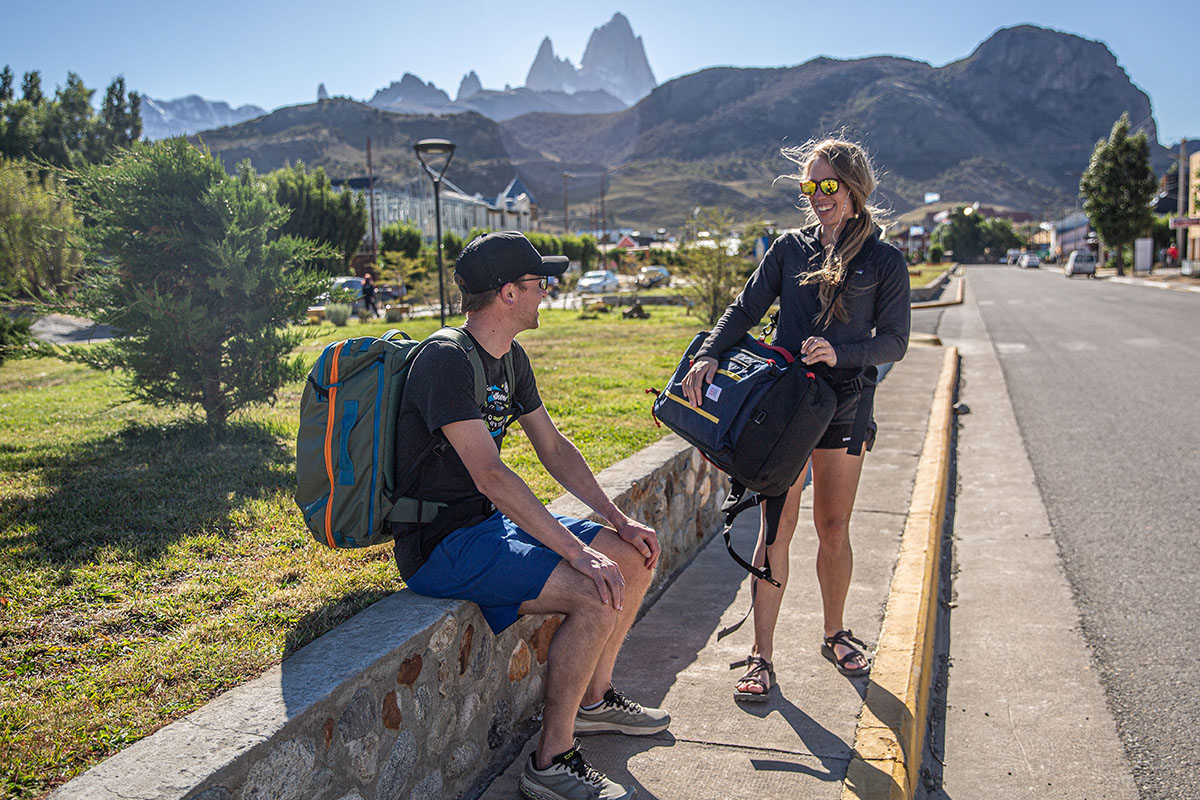
True to our name, globetrotting is a big part of what we do at Switchback Travel. Former managing editor Sarah Nelson put together our initial list of 16 travel packs in 2022 after a trip to El Chaltén in southern Argentina with fellow staff members and gear testers. Senior editor Chris Carter took over in 2025 with input from contributor and avid traveler, Maggie Slepian, and editor-in-chief, Penney Garrett. From takeoff to our return flights home, we put travel backpacks through their paces by stuffing them to the brim with two weeks’ worth of clothing and gear, schlepping them through domestic and international airports, shoving them into overhead compartments and below our seats, and getting intimately familiar with organizational layouts for divvying up our documents and electronics. Upon our return, we also evaluate each pack closely for signs of wear, like tears and stains.
Our current list reflects our personal experiences as well as feedback from our freelancers, travel-savvy friends, and the online travel community. We continue to test travel packs on adventures near and far, adding and removing designs as the market shifts and as we get firsthand experience with more options. As always, we’ll continue to add any other standouts and favorites to the list above with each update. For more organization options, check out our articles on the best duffel bags, best wheeled duffel bags, and best fanny packs.
The first question to answer when choosing a travel pack is how much capacity you anticipate needing. For reference, the options above range from 23 liters on the small end (the Decathlon Quechua NH Escape 500 Rolltop) all the way up to 70 liters for the Osprey Farpoint 70 and women’s Fairview 70. Most travelers will land on something in the middle, with the sweet spot for many being in the 40- to 45-liter range—it’s no coincidence that well over half of the models above fall into this grouping, which is largely due to their carry-on-compliant dimensions.
In general, we’ve found that packs of this size can easily accommodate a week or two of clothing, toiletries, and other travel accessories (and even more if you pack light). For reference, we had no issues fitting 14 days’ worth of belongings into a 40-liter bag on a trip to Patagonia. If you stick to weekend adventures, you can keep things lighter and more compact (and save some cash in the process) by opting for something smaller in the 30-liter range. On the flip side, those embarking on longer expeditions abroad might need to step up to a larger design, such as the Osprey Farpoint 70 or 80. This generally means your bag will no longer be carry-on compliant, though a savvy option like the Cotopaxi Allpa 50L Adventure can swing both ways—leave the lid on top if you’re checking it, or remove the lid (which transforms to a sling bag) and use it as your personal item so the rest of the bag can fit in the overhead bin.
Dimensions are a crucial consideration for most travelers, and especially those headed abroad. With that in mind, we’ve listed the length, width, and height measurements for each travel pack above, both in the write-ups and in our comparison table. As you may notice, similarly sized travel packs don’t vary too considerably in terms of dimensions. This is mainly due to carry-on size restrictions, which we break down in more depth below.
Carry-on Size Restrictions
Right off the bat, we’ll note that there is technically no standardized size requirement for carry-on luggage domestically or abroad. That said, the universally accepted dimensions in the U.S. are 22 x 14 x 9 inches, or 45 linear inches when adding L + W + H. We’ve indicated whether each travel pack above meets these requirements in our comparison table.
It’s also important to call out expandable models here, like the Peak Design Travel Backpack, which is carry-on compliant when compressed to 35 liters (22 x 13 x 9.5 in.) but not when expanded to its maximum 45-liter capacity (22 x 13 x 11 in.). You may be able to get away with carrying these bags onboard, but don’t count on it, especially if you’re traveling during peak season to a popular destination. When in doubt, you can always check with your airline ahead of time.
All of the packs above are purpose-built for travel with extensive organizational layouts and thoughtfully placed pockets for separating valuables, electronics, and other accessories. That said, some layouts are more functional than others, and a final decision will largely come down to your intended use and what works best for the items that you plan to bring along. For instance, sleek options like the Peak Design Travel Pack are great for digital nomads and remote workers who need to organize a lot of electronics, while backpacking-inspired designs like Osprey’s Farpoint and Sojourn Porter have fewer tech-focused features but work great for adventure travel. We break down some of the key organizational components below, from laptop and tablet sleeves to water bottle storage and pack-opening styles.
Laptop and Tablet Sleeves
Laptop storage is a must-have in a travel pack, and all of the picks above come with a dedicated spot for larger electronics. In terms of dimensions, most sleeves can accommodate up to a 15 or 16-inch laptop, and many come with separate smaller compartments in the same space for a tablet, too. This area is typically well-padded to protect electronics and positioned along the backpanel for the best access and weight distribution (keeping heavier items closest to your back will help maximize comfort and balance).
Water Bottle Pockets
Side water bottle pockets are becoming increasingly common on travel packs, and we utilize them frequently on domestic and international trips alike. In fact, most of the models above include water bottle pockets, with the exception of the budget-friendly Amazon Basics Carry-On. It’s worth noting that a couple of options can also accommodate hydration reservoirs: The REI Co-op Ruckpack 40 has a bladder-friendly sleeve that doubles as laptop storage (along with an access port at the top for a tube), while the Osprey Farpoint’s removable daypack has a similar dual-purpose design.
Opening Styles and Access
Easy access is a hallmark of a good travel backpack. The clamshell-style opening is far and away the most popular design, and for good reason: With the pack laid flat, you can easily see and access the entire main compartment. Some backpack-inspired designs, like the Cotopaxi Allpa 50L Adventure and Osprey’s Sojourn Porter 46 and Farpoint 70, utilize generous U-zip designs instead, which are pretty functional but make it a little harder to reach contents in certain areas. Finally, it’s important to note that some bags come with multiple access points, which can be a nice feature for accessing your belongings while on the move.
Comfort can be somewhat subjective, but a few features help certain travel packs stand out from the rest of the market. Typically, the most comfortable designs feature shoulder straps and hip belts with thick padding and good adjustability to dial in the fit. Sternum and load-lifter straps can also be very helpful in distributing a heavy load effectively. One brand that stands out in this area is Osprey, which makes sense given their expertise in the backpacking pack market. One of our favorite options for shuttling heavy loads over long distances is the Osprey Sojourn Porter 46, which features thick cushioning and good adjustability at the shoulders and waist belt, and comes with load lifters to bring the weight closer to your back. We’ve also been loving the Cotopaxi Allpa 50L Adventure Travel Pack for hauling heavier loads.
On the flip side, models without hipbelts are generally the least comfortable, especially when worn for extended periods. From the list above, only the Thule Aion doesn’t come with one, although the Aion Sling Bag can be attached to serve as a hipbelt. Thin webbing designs—like what you get with the Amazon Basics Carry-On and Yeti Crossroads—aren’t much better, providing very little support and structure to keep the pack’s weight on your hips (rather than your back). If you plan to be walking long distances with your pack through airports or city streets, we consider a well-padded waist belt a critical feature and worth the added investment.
The models above are designed to be worn on your back as backpacks, but many travelers appreciate the ability to carry their pack suitcase-style or over the shoulder. These options are especially helpful when standing in line to check in at the airport or retrieve travel documents. For instance, the Peak Design Travel Pack boasts 360-degree grab handles that make it quick and easy to take the pack off and carry it one-handed through security checkpoints or narrow airplane aisles. Designs like the Topo Designs Global Travel Bag 30L and the Patagonia Black Hole Mini MLC also come with detachable shoulder straps, which can be helpful when you need to access items inside but want to keep the pack off the ground and remain hands-free. Finally, many of the offerings here can be secured to a roller bag via pass-through sleeves.
In addition to pockets and electronics sleeves, there are a few other features specific to travel packs that are worth having on your radar. Lockable zippers are fairly standard at the mid to upper end of the market (budget designs tend to forgo them), as are removable and/or stowable straps and compression straps or dividers to keep things tidy in the main compartment. As is common with backpacking models, some travel packs also come with built-in rain covers that stow away when not in use, including the REI Co-op Ruckpack 40. Finally, the ability to attach your travel pack directly to a rolling suitcase via a pass-through handle or sleeve can be really helpful. The Cotopaxi Allpa 35L and Yeti Crossroads 35L both have this feature.
Given the inherently rough nature of travel, all of the packs above are well-built and hard-wearing enough to withstand frequent use. That said, some are more durable than others, and looking at denier (a measurement of fabric thickness) can help differentiate between models. For instance, the Topo Designs Global Travel Bag is one of the thickest and most abrasion-resistant options on our list with a combination of 1,000D nylon and 1,680D ballistic nylon. The Cotopaxi Allpa bags are another standout, with thick 840D TPU-coated nylon that we’ve been using for years with hardly a scratch. At the thinner end, Matador’s GlobeRider45 uses a mix of mostly 100 and 420D fabrics, although the nylon body is coated with a PU laminate to boost weather and abrasion resistance, and Matador included reinforcements in high-wear areas.
Other durability-related additions to keep an eye out for are thick padding along the interior to promote structure and protect your belongings, weather-resistant details like YKK zippers and DWR coatings on the outside to fend off precipitation, and thicker materials at the base to help protect the pack when you set it down. And we should note here that cost often correlates pretty closely with overall quality. In other words, budget packs like those from Amazon or Decathlon feel noticeably cheaper than most other options above and will likely wear down far more quickly. If you’re a frequent traveler, it’s worth investing in a pricier and more premium option that will last.
The weight spread isn’t huge among travel pack designs, but even a 1-pound difference may still be noticeable during long treks across town or the airport. For reference, a notably lightweight option on our list is Topo Designs’ Global Travel Bag 30L (2 lb. 10 oz.), while the Osprey Farpoint 70 is on the heavy side at 4 pounds 7.2 ounces. Most models fall somewhere in the middle, with the majority of 40- to 45-liter designs hovering somewhere between 3 and 4.5 pounds. You can also snag something smaller like the Decathlon Quechua NH Escape 500 Rolltop 23L for the light weight of 1 pound, 13.3 ounces. In the end, weight won’t be a primary consideration for many travelers, but those backpacking through Europe or expecting to cover serious ground will probably want to shop toward the lighter end.
Unlike their backpacking pack counterparts, travel packs are most often only offered in a single unisex option. This can make it difficult to dial in fit, especially for those with particularly narrow or broad builds. One exception above is the REI Co-op Ruckpack 40, which is offered in both men’s and women’s versions, each of which comes in two sizes. The Osprey Farpoint and Fairview are another example. Regardless of which option you choose, we always recommend trying on multiple packs before buying to see which fits you best (or at least purchasing from a reputable manufacturer with a generous return policy). You’ll want to be sure you can adjust the shoulder straps and waist belt to fit snugly around your torso and waist. Sternum straps and load lifters can also help bring the load closer to your back, maximizing comfort and weight distribution.
As we mentioned above, most travel packs are unisex by design. In fact, only two models on our list are offered in women’s-specific versions: the Osprey Fairview (the Farpoint’s counterpart) and REI Ruckpack 40. Key differences include varying colors, minor weight variations, and smaller torso and waist measurements. The Fairview also has more contoured shoulder straps and a curved hipbelt to better conform to narrower torsos/shoulders and larger hips, although the packs share an otherwise identical overall construction and feature set. Regardless of gender designation, we always recommend choosing the pack that fits you best.
It’s common nowadays to see pack manufacturers incorporate more eco-friendly practices into their production, including recycled and Bluesign-approved fabrics and PFAS-free DWR coatings. One example is Patagonia’s Black Hole Mini MLC 30L, which uses recycled and Bluesign-approved polyester and is certified to the Fair Trade standard. A final feature to look out for is a PFAS-free DWR coating, which forgoes the use of per- or polyfluorinated chemicals—”forever chemicals” known to be harmful to the environment. With many states stepping up to ban the sale of products containing PFAS, the outdoor industry is seeking better solutions for water- and stain-resistant finishes (for more, read Patagonia’s take on the issue).
Packing your travel pack can often feel like playing a hard game of Tetris, especially for those of us who aren’t great at traveling light. To help, many of the brands above offer compatible accessories for their packs, including packing cubes, protective hard cases for electronics, and more. Importantly, these add-ons are often modular and fit neatly into the main compartment of a compatible backpack. Some of our favorites include Topo Designs’ Pack Bags, Peak Design’s Packing Cubes and Tech Pouches, and Eagle Creek’s Pack-It compression cubes. In the end, these accessories aren’t a necessary purchase for many travelers (and you certainly don’t need to buy them from the same manufacturer as your pack), but they can go a long way toward maximizing organization and space and streamlining your load.
The packs above make it easy and comfortable to shuttle your belongings across the globe, but not everyone needs a specialized travel design. Duffel bags are another popular way to fly with a lot of clothing and gear, and many modern designs come with deployable backpack straps for more easily hauling through airports and around urban areas. However, duffels lack the impressive assortment of dedicated storage compartments and pockets for items like keys, passports, and electronics, are generally less comfortable to carry over long distances, and often don’t meet carry-on size requirements.
Alternatively, some travelers may opt to use a standard backpacking pack. This can make a lot of sense when you’re traveling to hike, backpack, or embark on other adventures and plan to use your pack both for travel and for outdoor use when you arrive. Again, however, the lack of travel-specific features and organizational options can make it harder to divvy up your belongings effectively. In the end, if you plan to fly domestically or abroad with any regularity (more than a couple times a year), we think most will find the investment in a dedicated travel pack worth it.
Back to Our Top Travel Backpack Picks Back to Our Travel Pack Comparison Table
Senior Editor Chris Carter grew up in rural Kenya, an upbringing that has shaped his life in more ways than he can count. From an early age, he was adventuring and traveling, and hasn’t stopped since. Now based in Chattanooga, Tennessee, this foundation informs his video, art, and writing in the outdoor industry and beyond. He is an alum of the Triple Crown, having hiked the PCT (2018), CDT (2021), and AT (2021), and lately you can almost be guaranteed to find him hanging off the end of a climbing rope or traveling to a new destination for trail exploration.
Switchback Travel is a part of AllGear Digital’s portfolio of media brands.
Switchback Travel is a part of AllGear Digital’s portfolio of media brands.