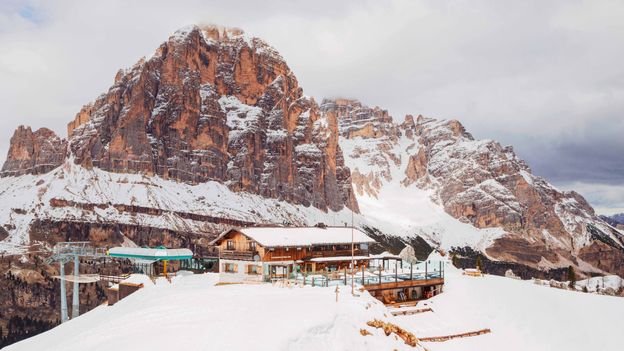
This year, the world will turn its gaze to Italy's Cortina d'Ampezzo as it co-hosts the 2026 Winter Olympics. Veteran Olympic skier Kristian Ghedina shares his hometown picks.
Nestled between the jutting spires of Italy's Unesco-listed Dolomites mountain range, the small town and ski resort of Cortina d'Ampezzo (altitude 1,224m), is often called the "Queen of the Dolomites". Located in a valley near the rainbow-hued Cinque Torri mountain, Cortina's distinctive Tyrolean architecture has remained mostly untouched by modern developments.
This jewel-like ski resort is also one of Italy's favourite wintertime destinations, luring local jet setters and professional skiers for the settimana bianca, or "white week" – the Italian custom of taking a weeklong winter ski retreat. The resort has become so synonymous with style that designer and athletic labels like MC2 Saint Barth and Kappa have used its name to sell a myriad of clothing items. And yet, Cortina d'Ampezzo has been largely unknown overseas – until now.
This sleepy ski town is about to attract a global audience as one of the hosts of the 2026 Milano Cortina Winter Olympics. But 2026 will hardly be its first Olympic foray; Cortina d'Ampezzo was also the host of the 1956 Winter Olympic Games. It's further known for being the birthplace and home of retired Olympic downhill skier Kristian Ghedina.
"In Cortina, every youngster skis," says Ghedina. "I've travelled the world… but I'm attached to my land, my town. It's a very strong bond that [you have] with snow and skiing."
The SpeciaList
Kristian Ghedina is a Cortina d'Ampezzo born-and-bred skiing coach and 13-time World Cup gold medalist, making him the second-most awarded Italian skier in downhill history. The 2025 documentary, Storie di Sci, highlighted his career amid the history of Italy's ski scene.
Ghedina has spent his life on the slopes; his mother, Adriana Dipol, was the town's first female instructor. After qualifying for his first national competition at age 16, Ghedina won 13 World Cup gold medals and has become an ambassador for the sport and his hometown.
We asked this veteran ski champ about the best things to do, eat and see during a settimana bianca in Cortina d'Ampezzo.
"It's a fantastic place. It's in a beautiful, open valley," says Ghedina, noting Cortina's status as a luxury resort. "It's earned its image… It's a brand name by now, a bit like saying Venice or Monaco."
But the town also has a demure charm, one that Ghedina particularly loves – especially in the quieter months. "I prefer Cortina in the off season, in the autumn," he says. "It has fantastic colours, there are fewer people".
Formerly part of the Austro-Hungarian empire, Cortina is multilingual – in addition to Italian and German, many locals speak Ladin, a local language similar to Romansch – and the region's culture in many ways more closely mirrors that of nearby Switzerland and Austria than what many consider quintessentially "Italian".
Here are Ghedina's favourite ways to enjoy Cortina d'Ampezzo.
Skiing is impossible to escape in Cortina d'Ampezzo; a town whose fortunes were built upon the sport. Affluent tourists flooded into the town by the end of the 19th Century, leading to the development of some of Cortina's main landmarks — including its distinctive neo-Gothic belltower, known in Ladin as el Cianpanín. The town opened its Ski Club in 1903 and hosted the winter games 53 years later. Over the decades, it has developed the infrastructure for many winter sports – including bobsleighing and figure skating – and pistes of different levels, which can be reached from the centre via cable car.
Tip:
Ghedina's top tip: "Make an effort to wake up early and take the first lifts at 08:00 or 08:30," he says. "If you truly want to fully enjoy the beauty of our slopes, our area, and our mountains, I recommend doing this before it gets crowded."
"The slopes are steep here," says Ghedina. "People from the neighbouring valleys [Val Gardena and Val Bardia] come to ski in the winter. They enjoy our slopes more, they have remained the same. You can ski better here. You have smaller crowds, which is a plus."
As for the best ski slope? "Olimpia delle Tofane," says Ghedina. One of Italy's most famous downhill descents, having gained renown after the 1956 games, Le Tofane stands at 1,778m high and allows skiers to schuss right to the centre of town amid stunning scenery of the surrounding Cinque Torri and rugged mountains. It will host the Olympic women's and Paralympic Alpine skiing competitions during the 2026 Milano Cortina Winter Olympics.
Outside Italy, the catch-all term "Italian cuisine" is overwhelmingly associated with Bolognese, Roman and Southern Italian dishes like lasagna, pasta cacio e pepe and pizza. But up in snowy Cortina and the neighbouring regions, typical dishes are hearty, buttery and calorie-dense: the perfect fuel for any wintry excursion.
While visitors will indeed find pizza and pasta at most of the area's restaurants, traditional local recipes have a decidedly more Austro-Hungarian flavour.
"Here, you can eat casunziei, ravioli made with potato and red or white turnip, served with melted butter and poppy seeds," says Ghedina. "Game also makes for a popular secondo (meat dish)."
Amongst Cortina d'Ampezzo's best-known local specialties is the aptly named bombardino: a brandy and eggnog mixture served with whipped cream. A true "hyper-caloric bomb", says Ghedina.
All of these can be savoured at Ghedina's local culinary pick; the Rifugio Scoiattoli. Opened in 1969, the chalet is a local institution, and is reached by skiers and hikers venturing up to the Cinque Torri mountain range.
Great food – from casunziei and polenta to deer fillet – aside, Ghedina points out the chalet's scenery. "There's a fantastic panorama of the [mountain range], it'll leave you speechless," he says. "A true 360° view."
Website: https://www.rifugioscoiattoli.it
Address: G24W+VJ, Loc. 5 Torri, 32043
Phone number: +39 333 814 6960
Instagram: @rifugioscoiattoli
For the many devotees of the settimana bianca, unwinding with a few drinks after a day of skiing is just as important as the sport itself.
As the sun sets, snow chasers head to bars to mingle and unwind, making après-ski the social highlight of the winter calendar.
While post-ski socialising has a relatively recent presence in Cortina d'Ampezzo, the town's association with the shenanigans of the fashionable elite is certainly not new.
"[Already] at the beginning of the 1900s, you had wealthy gentlemen coming for their holidays," says Ghedina.
In the following decades – prompted by the 1956 Winter Games and post-war Italian economic boom – winter tourism began to accelerate, with well-to-do Italians from northern regions flocking to the Alps to ski.
"They shoot Christmas films here. Many businessmen have bought their homes and bring friends… it's a true hub, especially in the high season," says Ghedina.
But tourism has not gone entirely unscathed from local disapproval: "Some traditionalists criticise the [wealthy] who come, spend and build, don't respect nature."
So to experience the hippest après-ski and the most fashionable scene Cortina has to offer, Ghedina suggests heading to Chalet Tofane.
"It's a fun place," he says. "There's a nice facility, a great open space."
The Chalet opened a mere six years ago – the brainchild of Michelin-starred chef Graziano Prest and expert sommelier Kristian Casanova – and has become a sought-after spot for parties and outdoor aperitivi (pre-meal drinks and light bites), famed for its stunning mountain-top views of the town.
Website: https://chalet-tofane.it
Address: Lacedel, 1, 32043 Cortina d'Ampezzo BL
Phone number: +39 351 8562956
Instagram: @chalettofanecortina
Apart from skiing, the Dolomites – with their mesmerising mountain peaks and ancient trails – offer spectacular hikes. Few visitors come to Cortina d'Ampezzo hoping for a history lesson, but the Sentieri della Grande Guerra – or "trails of the Great War" offers a double whammy of spectacular views and a less charming past.
Back in World War One, the site was the battleground for Italian and Austro-Hungarian troops. After the former managed to occupy Cortina, soldiers blew up the "Castelletto" rock to finally be able to attack Habsburg troops.
More than a century later, the fields are no longer the site of bloody battles but rather a bucolic pathway that encircles Cortina d'Ampezzo and offers breathtaking views of the Marmolada and Tofane mountains. Over at the Lagazuoi area, remnants of the battles – including trenches – can still be found, much to the satisfaction of history buffs as well as nature lovers.
The appeal of the Sentieri della Grande Guerra isn't strictly seasonal, as Ghedina notes. "They're very picturesque, and great to visit in the summer."
The 20km-long trail is just part of Cortina's cobweb of pathways, which extend approximately 300km.
For Ghedina, choosing a specific panoramic spot in Cortina d'Ampezzo is quite the challenge, as the area is not short on natural beauty.
Indeed, Cortina boasts one of the crowning jewels of the rugged mountain range: the Cinque Torri ("Five Towers"), a cluster of five jutting rocks made up of the area's distinctive grey limestone, which have an almost rosy glimmer at sunset.
But when pressed to answer, Ghedina says that the views offered by the Rifugio Faloria are the area's best.
A rustic cabin sitting on the Faloria mountain, the Rifugio Faloria's terrace reveals the full breadth of Cortina's valley and surrounding mountains.
"You have a terrace with a panoramic view of the entire village," says Ghedina. "The advantage of having this wide-open valley is the stunning mountain frame, offering a view of the basin."
Surrounded by the idyllic, quiet grandeur of Cortina's surroundings, it's not hard to imagine why Ghedina fell in love with the slopes that took him to peaks of success.
Website: https://faloriacristallo.it/parliamoci/
Instagram: @faloria_cortina
BBC Travel's The SpeciaList is a series of guides to popular and emerging destinations around the world, as seen through the eyes of local experts and tastemakers.
—
This article was first published in 2024 and has since been updated.
If you liked this story, sign up for The Essential List newsletter – a handpicked selection of features, videos and can't-miss news, delivered to your inbox twice a week.
For more Travel stories from the BBC, follow us on Facebook, X and Instagram.
Buried beneath Paris since 1912, the ghost river Bièvre shaped the French capital in unexpected ways.
A 1950 visit from the US sparked an unexpected revival after near-total destruction in this Arctic town.
In the village of Magome, a 16th century discipline leads to a sharper focus on the present moment.
In Kazakhstan, tiramisu-coloured canyons and otherworldly gorges are the keepers of our geological history.
A resident of the Greek island of Ikaria, known as the island of immortals, shares her tips for longevity.
From Hitler's last shelter to an underground tunnel connecting eleven small houses in the German countryside.
Forget Berlin and Paris. This German city quietly champions free love in a way you wouldn't expect.
From an alchemical pharmacy to a shadowy dungeon, uncover the many secrets of Casanova's mysterious world.
From the Malta Knights keyhole to a set of vanishing columns, discover the Eternal City's visual secrets.
At their peak, they were akin to royalty. Today, their estates conceal hidden treasures.
100-year-old Roland Reisley is the last original member of Usonia, a small visionary community in the woods.
From the Mouse Bunker to the Embassy of Czechoslovakia, the Cold War buildings that changed history.
Nordic etiquette: Learn how to sauna and ice plunge like a Finn and feel great afterwards.
On Mount Chimaera, fire has been spitting out from rocks for over 2,500 years. Our local SpeciaList explains why.
A dive into 3,500 years of underwater archeology, sunken cities and Lycian tombs with Prof Hakan Öniz.
How did bathing become such an intrinsic part of Icelandic cultural identity?
Chris Pratt talks about this year's unique present from Arnold Schwarzenegger that will be hard to re-gift.
Architect Lina Ghotmeh brings her vision to an ambitious project, redesigning the British Museum's Western Range.
The Norwegian author's raw honesty and fearlessness has made him one of literature's most compelling voices.
Tech Now visits a Wisconsin lab where scientists model how glaciers melt to better predict sea‑level rise.
Some 100,000 of these small dives are hidden in plain sight across Japan. Now, travellers are finally discovering these locals-only hangouts – and the beloved "mamas" who run them.
A Norwegian rocket launched on 25 January 1995 in order to study the Northern Lights, was mistaken by Russia for an incoming nuclear missile on a direct course to Moscow.
Adding the right seasoning or dressing to your food can help your body absorb more vitamins and minerals, according to research.
From compost-powered cities to dark-sky pioneers, these lesser-known US towns are proving that sustainability and great travel go hand in hand.
Sometimes dubbed the 'pleasure chemical', dopamine is often wildly misunderstood. Nikolay Kukushkin delves into what the much-discussed neurotransmitter really does to our brains.
Copyright 2026 BBC. All rights reserved. The BBC is not responsible for the content of external sites. Read about our approach to external linking.