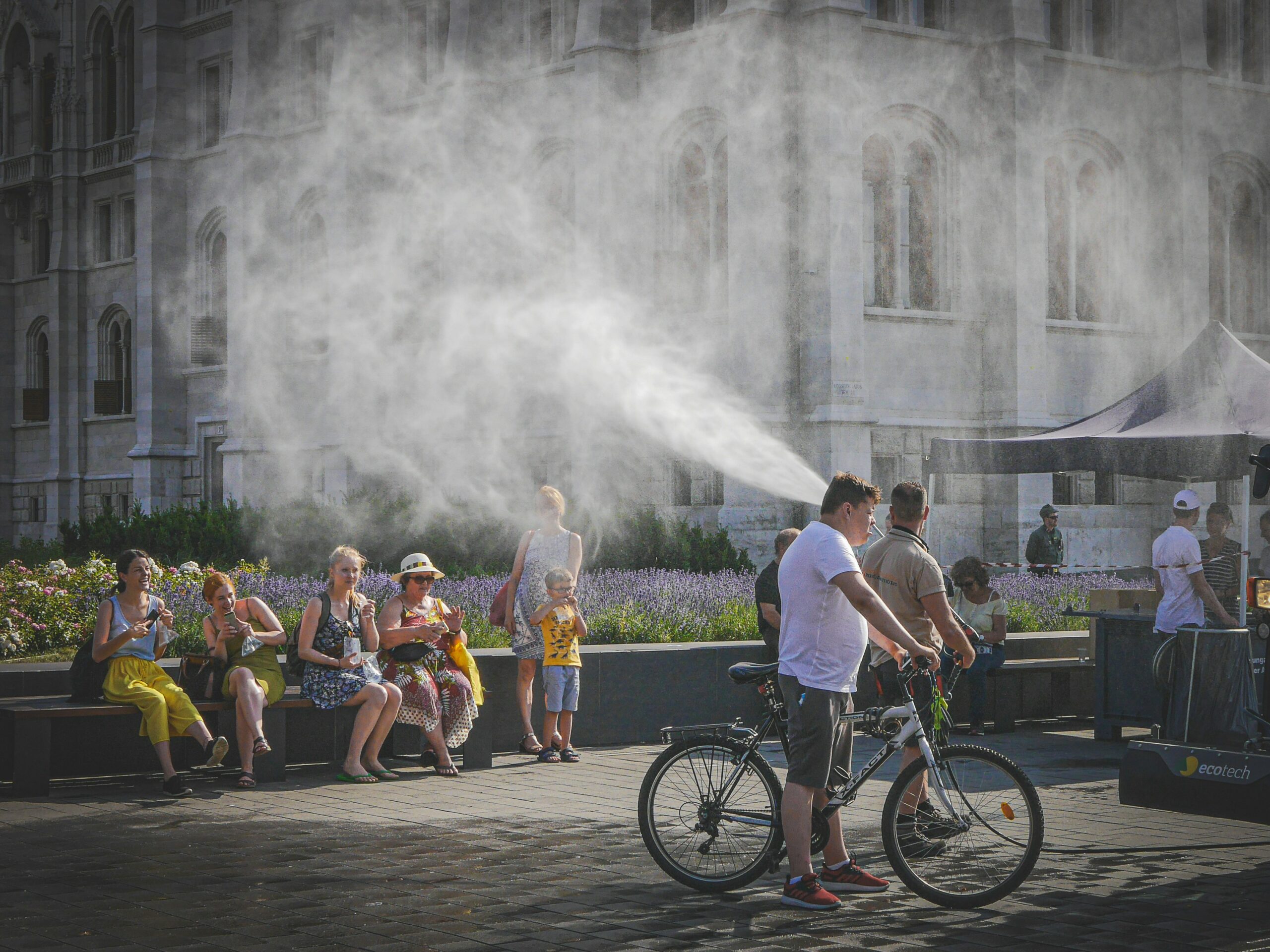
© Evgeniy Beloshytskiy on Unsplash
Deborah O’Donoghue is a reporter at Travel Tomorrow. This British-Irish writer lived in the UK and France before moving to Belgium. She has travelled all over the world and worked in car body repairs, in the best fish ‘n’ chip shop in Brighton, and been a gopher in a comedy club, as well as a teacher. She’s a past winner of the Commonwealth Broadcasting Association Short Story Prize. Her début novel, Sea of Bones, was published by the UK’s Legend Press in 2019 and Droemer Knaur Germany in 2021.
Extreme temperatures across Europe have prompted red alerts for severe risk to life across a suite of nations, including France, where at least 18 people have died in the heat. Two children were among the dead; their bodies were found in their family car in Carpentras in the south of the country. Germany, Italy, Luxembourg, Spain, and Switzerland have also issued the highest levels of warning, with the mercury expected to reach over 40°C in the week to come.
The heatwave is forecast to last for at least a week, as hot air from the Sahara pushes temperatures between five and 10 degrees above the average for this time of year. Some of the region’s most popular tourist spots will be hit by the unseasonal warmth, which is predicted to hit 44°C in parts of Spain — a country that welcomed a record-breaking 96.8 million international visitors in 2025. Those who have chosen to stay away from traditionally hotter areas will not escape. San Sebastian in the north will see temperatures double the usual.
France banned drinking at the Fête de la Musique this weekend, cancelled trains, and suspended school classes, because a heat dome parked over Western Europe and pushed 35 of the country's departments to the highest heatwave alert. Portugal and Spain are forecast to hit 45°C.… pic.twitter.com/85S3yqccUx
Over half of France, the world’s most touristed nation, is labouring under the severe conditions, trains are running reduced timetables, and hundreds of schools are shut early. That in itself is a situation that creates other risks, as parents struggle to find childcare, and coastal areas and rivers become, in some instances, fatal attractions for youngsters and inexperienced swimmers. Météo-France has said there will be no immediate let-up of the “widespread, long-lasting and intense” heat.
Italy has issued warnings for 12 cities, including beloved tourist destinations such as Florence, Rome, and Venice, as well as Milan, where Fashion Week events are underway.
Temperatures are set to climb across Europe on June 22, with a projected 40 degrees Celsius across parts of France https://t.co/pLw5HRoviU pic.twitter.com/RpLIDRh3zH
Other historically cooler European nations are also affected. The United Kingdom’s Met Office is among the authorities issuing a red warning, forecasting temperatures of 38°C on Wednesday and Thursday, while in Belgium, train operator SNCB/NMBS cancelled rush hour trains for Monday and Tuesday to prevent severe infrastructure damage and dangerous conditions for passengers. Intense heat causes steel rails to expand and potentially buckle, while overhead power lines can sag and touch trains.
The heatwave comes as Belgium’s “Tales of Future Weather” pilot project has taken climate statistics and created striking fictional weather scenarios aimed at raising awareness of the warming planet and helping cities prepare for extreme conditions. The project’s climate models accurately predicted high-season temperatures rocketing over 40°C for prolonged periods, with major impacts on electricity networks, public health, and local infrastructure.
As in recent summers where climate records have been surpassed, the risk of wildfires is high, especially in southern nations. Greece is already tackling a wildfire that has brought motorway traffic to a standstill in the centre of the country.
For travellers and residents across the bloc, the conditions mean immediate action should be taken to prevent harm. Staying hydrated, wearing skin protection, and staying out of the sun are essential, and intense physical exertion should be avoided. Construction work sites are likely to be closed as a precaution. Longer-term action means facing up to the climate effects of fossil fuel consumption and carbon emissions, and finding more sustainable ways to undertake life’s journeys.