
The ideal carry-on travel backpack is comfortable, keeps your belongings safe and organized, and suits your style. And, unlike a rolling carry-on bag or a traditional suitcase, a backpack makes navigating public transportation and uneven streets fast and easy.
The best pack for most travelers is the Cotopaxi Allpa. It’s comfortable to carry and has an efficient internal organization system, making it easy to pack and live out of. The zippers are lockable, and we love the clamshell open, which makes it a snap to find just what you’re looking for.
If you are on a tighter budget, it’s hard to go wrong with the Osprey Daylite Carry-On. It’s a quality pack that is durable, offers dedicated organization pockets, has a laptop compartment, and sells for about half the price of higher-end bags.
Since 2013, we’ve been traveling the world for work and play with the top carry-on backpacks. We’ve purchased more than 60 and spent months taking every pack on overnight flights, navigating public transportation, and trekking the uneven streets of foreign cities. No matter where you go, whether for work or pleasure, we’ve found a pack that is just right for your travel style.
Editor’s Note: We updated this article on October 14, 2025, adding more info on the Tortuga 40L, and adding a section on the pros and cons of a travel backpack, and why many travelers are choosing to use one instead of a traditional suitcase.
The mesh dividers in the Allpa can feel restricting to some, especially those who want to pack bulkier items. Also, the laptop sleeve offers rather limited protection. The pocket is padded but not rigid, and when the bag is stuffed full and bumped along your spine in transit, you risk putting excess pressure on the electronics within. If the Allpa sounds almost but not quite right for you, also consider the Thule Subterra 2, which offers more adjustable organization features and better laptop protection. If you don’t typically travel with a laptop, the Cotopaxi pack is a compartmentalized traveller’s dream.
Read more: Cotopaxi Allpa 35L review
The semi-rigid nature of the Subterra makes it impossible to cinch down if you don’t use the full 40L volume. Our tester notes the pros and cons of this: “Because it holds its shape, this bag feels bigger than 40 liters. If I don’t pack my laptop, I usually squeeze a few extra outfits in the lid because I can’t compress the space anyway.” The Peak Design 45 is another structured pack, but it can be cinched and expanded as needed (and it has anti-theft zippers). That said, for those who travel for different purposes and want a pack that will work for every trip, the lowkey design, structured protection, and removable laptop sleeve on the Subterra are big draws.
Read more: Thule Subterra 2 Convertible review
If you’re looking for a hip belt on your bag, you won’t find one on the Daylite. And while it holds a laptop, the padding on this pocket is thin and not particularly protective. Our testing team’s biggest complaint with this bag is that its thinner material doesn’t hold its shape — making it harder to live out of — and without careful folding and packing, the contents were often quite jumbled when we reached our destinations. The North Face Base Camp Voyager, which costs a bit more but has similar organizational features, holds its shape better, and looks sleeker.
Read more: Osprey Daylite Carry-On 35 review
What the Black Hole MLC lacks is any easy-access external pockets. Not even so much as a water bottle side pocket adorns the outside of this bag. It’s designed to get your stuff to where you’re going, but it’s not as convenient on the way there. The other downside about the Black Hole is that when we pack this bag full, it’s not particularly comfortable to carry for longer than it takes to get through security and board your plane. The Osprey Sojourn Porter has a similarly large capacity but with more robust compression and more comfortable straps for long-term carry.
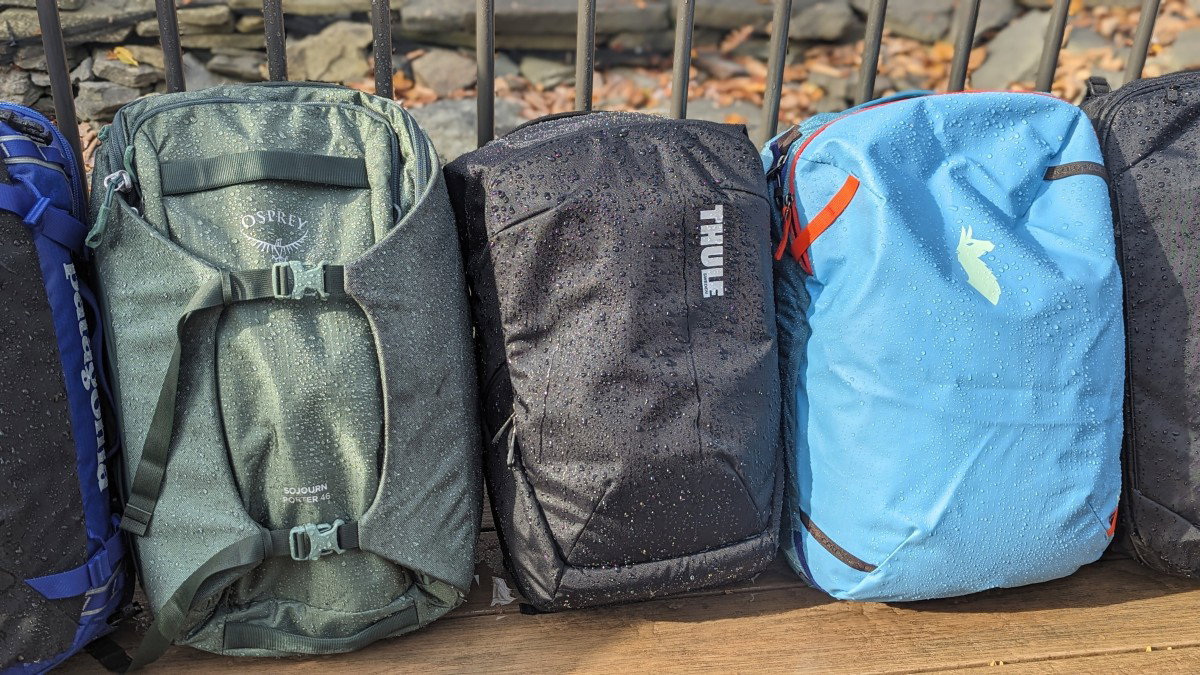
Unfortunately, the compression straps effectively cut off access to the “small stuff” pocket, forcing you to put down the bag and unclip the top strap to fully access the contents of that pocket. The Porter is also not as rectangular as many other travel bags, and if you take full advantage of all 46 liters of space, it’s easy to end up with a bulky turtle shell bag that is difficult to cram into the overhead bin. The Tortuga 40L has a more traditional design and has similar carry comfort features. However, the Sojourn Porter still reigns king when it comes to packing oddly shaped and weighty gear.
Read more: Osprey Sojourn Porter 46L review
The Tortuga has more of a rounded (dare we say, turtle-like) shape, which feels balanced on your back, but is not as stable when set on the ground. A clamshell lid opens up to a single main compartment that houses the majority of the bag’s storage, which is pretty underwhelming compared to the organization of other bags we tested, like the Cotopaxi Allpa. Aside from two slim mesh pockets, it’s all open, and there’s no compression system. If we didn’t fill the pack up completely, our things would usually get jumbled around in transit; a few packing cubes go a long way in this bag. The removable hip strap is oddly floppy, and the main benefit we got out of it was the easy-access pockets, which kept us from needing to take the pack off every time we needed to get our passport or phone out of the bag. Despite the lack of structure, the strap still has enough padding to be surprisingly comfortable.
All these features aren’t for everyone, though, and some travelers may feel pigeonholed into a certain way of packing and traveling. This is also one of the heaviest base-weight bags we’ve tested, thanks to all the extras. And for a bag made to carry heavy electronics, the straps could be better padded. The Thule Subterra 2 has a similarly sleek profile and better laptop-specific travel features, but no camera-centric accessories. If you are a photographer, searching for a travel backpack, this one is great, but also one of the most expensive we’ve tested — and the actual internal components to protect individual pieces of gear are an additional cost.
We’ve taken these packs on all sorts of adventures over the years and have a knack for picking out the features that matter the most when it comes to living on the road. We use them everywhere we go, whether that be far-off lands or neighboring states, our day-to-day lives at home, using them around town and on work commutes. We pack and unpack each bag numerous times, taking note of how easy it is to store and organize our belongings in various configurations. We also evaluate the padding and weather protection that each bag provides.
For weeks at a time, we live out of these bags, both at home and while traveling, which allows us to accurately gauge how easy it is to grab the clothes and items we are looking for without destroying the organization within the pack. Lastly, we test the comfort, fit, and versatility of each bag by loading them up and carrying each bag around. Strap adjustability, available sizes, and its ability to be useful in a variety of scenarios all play into a bag’s overall score. To find out more about our testing process, check out our complete How We Test article.
-Versatility (10% weighting)
This review is brought to you by Hale Milano, Liz Chamberlain, and Hayley Thomas. Hale is a travel expert, having explored over 35 countries by foot, plane, boat, and car. He spent a period of his life traveling for work, hopping on planes with a few days worth of clothes and a computer week after week, so he knows the value of an efficient and functional travel bag. His passion for gear includes the bags he uses to pack it all in, and he brings a fresh perspective to our travel backpack testing team. Liz is no stranger to travel and has worked in the retail gear industry for years. She understands the importance of both form and function and brings a critical eye to this review. Hayley lived in a van for several years, so it’s no secret that travel is a big part of her life. You can frequently find Hayley traveling to new climbing, biking, and skiing destinations — almost always with a backpack in tow.
From the outside, many of these packs look similar to a regular backpack. So what makes them so special (and expensive)? And can one of these replace a rolling carry-on?
A draw for many is the opportunity for one bag travel. Our lineup features bags designed to excel as your primary travel bag and still fit within the size restraints of a carry-on. If you can pack minimally, travel backpacks sport a low-key exterior that doesn’t scream “tourist,” but they still offer many of the same organizational features that make them suitable for international travel and ultimately allow you to go places where wheeled luggage just can’t. Maybe you’re traveling on a shoestring budget, and every other day, you’re schlepping your belongings from hostel to boat dock to bus station to airport, or maybe you rented a charming Parisian flat on the seventh floor of the building, only to find that the elevator is either broken or nonexistent. In either case, you’ll be grateful to have a pack that doesn’t add unnecessary strain to your back and shoulders during long travel days.
Another increasingly common function of these bags is that they can be great for remote workers or business travel. Many of them have well-organized, dedicated tech storage and protective materials that allow you to pack your whole work setup (laptop, tablet, charging cables, mouse, you name it) in addition to a few changes of clothes and a spare pair of shoes.
We put each pack through rigorous testing under a very critical eye. We used a thoughtfully curated packing list to compare performance across models objectively and help you find your perfect travel pack fit. Over the years, these bags have accompanied us on adventures to destinations near and far, for overnight trips and multi-week jaunts around the globe.
In the travel bag category, the most significant price differentiator is typically the material and build quality. Some budget bags offer many of the same features as the very costly ones, but durable materials with reinforced seams and straps tend to cost slightly more than less protective and heavyweight materials.
The Osprey Daylite combines the high-quality materials and design of our top-scoring bags with a price point that’s much friendlier on the wallet. The Daylite boasts high-end fabric and features with a simple design and a no-frills yet quality option. A lower-budget standout is the Coowoz Essentials. This affordable bag isn’t doing anything groundbreaking, but it far outperforms other bags in the price range, and not everyone needs bulletproof luggage to survive day-in and day-out abuse from travel.
A bag that can last a decade (or more) with you can also be a good value, even if it costs a bit more. The Osprey Sojourn Porter, and Cotopaxi Allpa provide excellent features and high-quality construction. Both bags perform well across all of our testing metrics, and believe it or not, they are still not the most expensive.
Related: How to Pack Luggage Like a Pro
First and foremost, what can you pack? If you can’t fit the essentials or your items arrive damaged, the rest is a moot point. To assess our lineup of bags in this metric, we evaluate the storage volume, stability, weather protection, and electronic protection features in our bags. We use a standard three-day packing list to test each bag’s ability to stow clothing and other common travel supplies such as toiletries, electronics, and souvenirs.
A standout in this metric is the Peak Design Travel 45. This massive gear hauler fits all of our supplies with room to spare — even without needing to open the expanding features of this bag. When packed full, we can still access small pouches on the outside or reach inside for items. It has both an expanding zipper and space-collapsing magnets to help tailor the size of the bag to your packing list.
The Peak Design is also quite stable, so there’s no need to worry about it accidentally falling over when packed with sensitive electronics. Speaking of which, the large padded laptop sleeve set against the back panel is ideal for protecting laptops and tablets while still providing easy access. To cap it off, the 100% recycled 400 denier nylon shell is fully waterproof, and the watertight zippers and seams protect the contents from any water intrusion.
Thanks to its dual compression straps, the Osprey Sojourn is a beast when it comes to packing a high volume of clothing, and the padded shell of the bag helps protect fragile items from bumps in transit. While it won’t protect your bag from getting lost, we love that the Sojourn comes with a TSID Luggage Registration tag. Once you complete the free registration, the tag links to the owner’s information and can be more easily identified across a network of over 2,800 airports worldwide, helping you find your bag if it ever does get lost in transit (knock on wood).
The Nomatic is another great option for protecting your travel essentials. This bag boasts an RFID protective pocket to keep your payment cards and IDs safe. On top of comfortably accommodating all your gear, the Nomatic’s water-resistant fabric and zippers kept all contents perfectly dry during our rain tests.
The Cotopaxi Allpa takes a unique approach to storage, using integrated mesh packing pockets, and the Osprey Farpoint has a more traditional single large compartment with internal compression straps to secure contents. Both options allow you to fit plenty of clothes and supplies, but which one you may prefer depends on your packing style.
Honorable mentions in our storage and protection metric are the Tortuga Travel Backpack 40L and the Patagonia Black Hole. The Black Hole is more akin to a duffel than a backpack; there’s even a grab handle right in the center of the back panel in case you want to carry it lengthwise instead of on your back. The Black Hole is also one of the more durable bags we tested; the 100% recycled TPU laminate material easily sheds water during rain showers and resists abrasions during transit in the trunk of a car or the cargo hold of a plane.
The Tortuga has protective laptop and tech features that make it a great work-away bag. It earns a perfect score in our rain protection test thanks to its proprietary SHELL200 three-layered sailcloth fabric and waterproof zippers. The Tortuga also has lockable zippers, so if you’re looking for a little extra protection on your travels, this may be a good choice. The large capacity pack can easily fit a full packing list, but we wish it had compression straps to keep everything cinched in tightly for those instances where we don’t need to pack it to the brim with clothes.
Having a travel backpack allows you to move faster on foot than a rolling suitcase, but it should also be easy to use during your downtime so that you can spend more of your vacation doing what you want rather than digging through clothes to find what you need. We assess how easy the pockets on each backpack are to access on the go, as well as how convenient each bag is to live out of. Many of these backpacks have convertible carry methods, and we try out each one. Some also have unique features that just make life easy.
One of our favorite bags to use is The North Face Voyager. Though not as feature-heavy as other models, it is the thoughtful simplicity that makes it pleasant to pack and live out of. The main pouch holds its shape well when empty, making packing items a breeze, and we are big fans of the removable internal divider that segments the compartment into two folded-shirt-sized areas. Outside the bag, pockets for accessing items are heavily featured and well-organized.
The Cotopaxi Allpa is almost the polar opposite of the Voyager, but just as livable. The Cotopaxi features three internal and integrated mesh pockets, like built-in packing cubes. This can be great for when you’re destination hopping and don’t have time to constantly reorganize. Beyond packing the bag, we appreciate that the waist belt is removable. We prefer this over hide-away storage, where you have to stuff or slide the waist belt into a tight slot.
The Thule Subterra 2 Convertible splits the middle between the simplicity of the Voyager and the ultra-organization of the Cotopaxi Allpa. The rigid material helps the Subterra hold its shape, and there is a mesh pouch inside the main compartment, ideal for smaller items. The dual-zip closure lets you keep the contents of your main compartment secure while accessing the built-in laptop pouch and removable attaché case.
The Osprey Sojourn Porter backpack boasts a large main compartment with an open cavity design, and the sturdy sidewalls and material hold the shape of the bag open for easy access and packing. Compression straps and two small mesh zipper pockets help to round out the internal organization.
The Topo Designs Global Travel Bag is user-friendly, with the caveat that you have to love organization. With more pockets than most people can keep track of — 15 to be precise — this bag has a space for everything; the only way you can improve the organization of this bag is to buy a label maker and stick on the labels yourself. However, if you are as forgetful as we are, you might spend more time zipping and unzipping pockets to search for a single item than if you were to just rummage through one big pocket.
The Tortuga Travel Backpack is another very livable bag. The main compartment of the Tortuga folds completely open, providing unfettered access to the very large packing area and a mesh storage pocket on the inside flap. Externally, there is a large pocket that runs the length of the bag and has some small pouches, a laptop sleeve, and a padded tablet sleeve for organizing your frequently used items.
Active travel days can be the most exhausting of the trip. A travel-specific backpack that carries comfortably when weighed down with all your belongings is a guaranteed way to improve happiness and lessen frustration. We test each bag’s comfort under a heavier-than-average load and evaluate the padding and effectiveness of the backpack straps.
No backpack in our lineup matches the performance of the Osprey Farpoint. This backpack boasts a harness system that rivals top-tier hiking backpacks. A LiteWire frame suspension helps bring weight from your back to the hip belt, and a mesh foam AirScape back panel provides breathability while keeping the weight close to your back. The waist, shoulder, chest, and load lifter straps are all incredibly comfortable. The entire torso length of the harness system is adjustable as well.
The Osprey Sojourn Porter is another incredibly comfortable bag that can handle a heavy packing list and long wear times. Its firm and supportive waist belt, cushy shoulder straps, and load lifters help to distribute weight across your body.
The Tortuga checks off all of the comfort must-haves with firm foam padding on the back panel, waist belt, and thickly padded shoulder straps, and well-thought-out weight distribution. When buckled, the waist belt is quite comfortable and effective; however, the quick attachment clips allow it to swing, dangle, and get tangled easily when not in use, so we prefer to either buckle the straps around the waist or just remove them altogether. The pack sits closely to your back, and every part of the harness system is highly adjustable, down to the placement of the shoulder straps.
The Thule Subterra 2 is another standout in this metric. It’s not quite as supportive as other bags, yet we found it very comfortable for the size and weight we most often packed during testing. The backpack straps were well-padded. The shoulder sling lacked enough padding to support the entire bag when full; however, when used for the laptop attaché, it was more than adequate.
The Peak Design backpack has ergonomic shoulder straps, a thickly padded adjustable hip belt that can be tucked away when not needed, and excellent overall structure.
The North Face Voyager and Topo Designs packs are both pretty comfortable. The Voyager’s back panel padding is on the firmer side and is quite supportive when stuffed with 3+ days of clothing and toiletries.
The ideal travel backpack can facilitate seamless transitions from one leg of your trip to the next, encouraging a fun travel experience and helping transportation go smoothly. It should function well on any of the various trips that fit into your lifestyle, whether it is filled with bathing suits for the beach vacation, adequate tech storage for remote work, or room for an extra daypack for hiking.
The Thule Subterra 2 has the most potential for versatility in our eyes. We’d just as soon grab the Thule as a carry-on bag for our next backpacking trip abroad as we would for a weekday work trip wearing business casual. That said, the Thule is a dedicated travel bag; it’s too bulky for daily wear into the office or around town and lacks the suspension systems that might help it pull double duty on the trails in a pinch.
The Osprey Farpoint has the potential to do double duty, particularly for more outdoor-focused trips. The fully equipped harness, suspension, and compression systems make it an ideal pack if you want to leverage the Farpoint for heavier loads, such as day hikes, if needed. Visually, it has a more rugged design, but we think that style can appeal to a variety of individuals, whether you are a dirtbag climber or just dipping your toes into gorpcore fashion.
The North Face Voyager is small enough that it can be used for a daily commute into the office, packed with a laptop and binders. The Hynes Eagle 40L Carry On and Asenlin 40L Travel backpacks, with their small size and plethora of color options, respectively, will feel at home in most settings, even if they don’t excel in one. They are quite versatile bag choices for travelers looking to maximize the use they can get out of their bag.
Here are four key considerations to help narrow down your next travel backpack selection. See much more detail in our full How to Choose A Travel Backpack article.
Finding the right travel backpack can be almost as tricky as finding your ideal travel companion. Everyone has a different reason to travel, and there is a huge variety of travel backpacks available today. The common theme is their ability to help you move fast and light on your travels while carrying all the gear you need comfortably on your back. Some of these carry-on packs highlight storage and organization, some function like a deluxe duffel, and some specialize in carrying heavy gear comfortably. We hope that with the help of this review, you are able to match the best travel backpack to your specific uses and preferences.
How can we improve GearLab? Got feedback?
Let us know!
Material on GearLab is copyrighted. Reproduction without permission is prohibited.
All trademarks property of their respective owners
Privacy | Cookies | Terms
Best Travel Backpacks – GearLab
You Might Also Like

Florida property manager on the run accused of HOA embezzlement for trips, plastic surgery – fox4beaumont.com

15 Reasons Florida’s Infrastructure Can’t Handle Its Growing Tourism Industry – MSN
