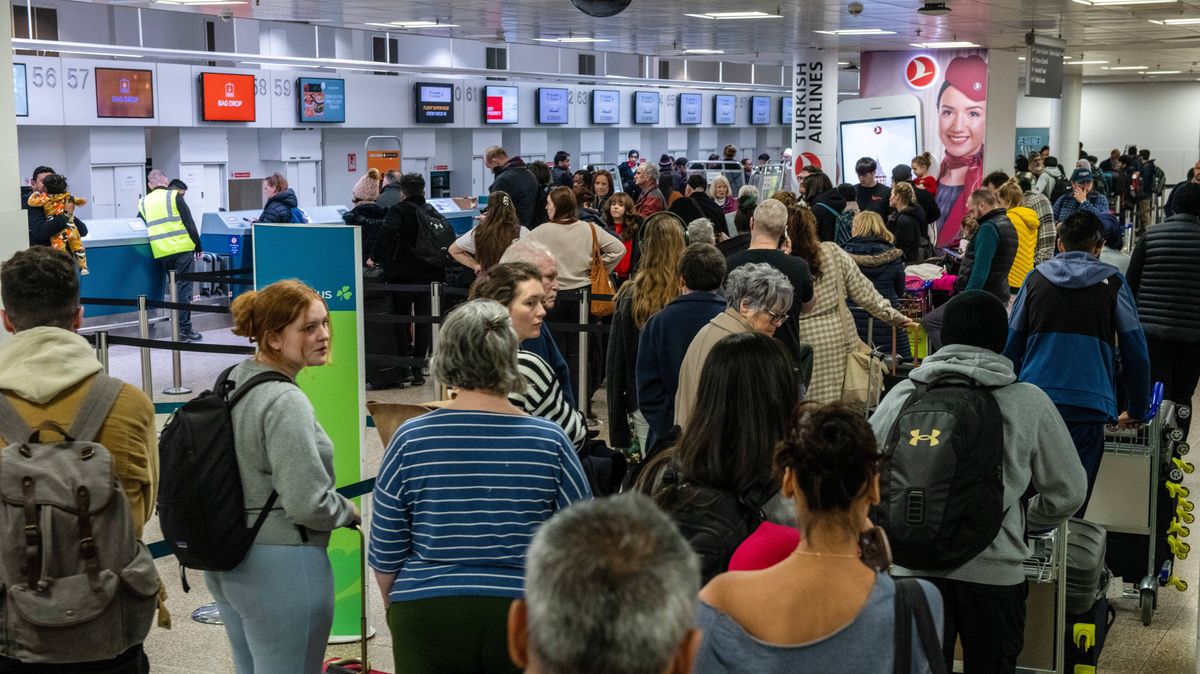
Airline passengers queueing at an airport – Brits will be hoping to avoid disruption on their travels this summer(Image: Bloomberg, Bloomberg via Getty Images)
A flight delays crisis is causing turmoil for some of the world's most recognisable airlines, with the latest flight tracking data highlighting just how precarious flight schedules can be.
According to flight tracking data company FlightAware, a series of operational setbacks led to a state of air travel paralysis across Australia and New Zealand on Sunday (May 3), with a staggering 317 flight delays and 24 cancellations recorded in a single day.
Both major and minor travel hubs across the trans-Tasman region experienced disruptions, with some struggling under severe congestion while others saw the complete grounding of specific routes — which is more unwelcome news for any Brits currently travelling in the Southern Hemisphere.
Put simply, the data suggests that if you're flying with virtually any airline in Australia or New Zealand, it might be prudent to keep some paracetamol to hand, as travel-induced headaches appear highly likely.
Passengers wait to board flights in the Air NZ terminal at the Auckland Domestic Airport(Image: Getty Images)
Major carriers such as Qantas, Jetstar, and Air New Zealand bore the brunt of the delays and cancellations on Sunday, while smaller regional operators across Australia and New Zealand — such as Sounds Air — recorded a higher proportion of cancellations, reaching up to 14% in certain states throughout the trans-Tasman region, reports the Mirror.
The findings reveal that while aviation in this part of the world is ordinarily efficient, the sheer scale of these disruptions has exposed significant logistical weaknesses. The knock-on effects were felt across all traveller demographics, from major city airports to smaller regional airstrips. Travel chaos arrives alongside growing anxieties about air travel stemmng from the continuing Middle East conflict and escalating fuel prices, with the troubling Antipodean news emerging shortly after major US carrier Delta Air Lines scrapped hundreds of flights over a 48-hour window.
Qantas aircraft at Sydney Airport on April 10, 2026(Image: Wolter Peeters / The Sydney Morning Herald via Getty Images)
Delta experienced significant operational turmoil between Friday and Saturday, with more than 400 cancellations and over 1,000 delays. This represents approximately 4 per cent of its timetable on Friday and roughly 7 per cent on Saturday, according to figures from FlightAware.
The carrier attributed the chaos to personnel shortages, unpredictable weather conditions and the impending jet fuel shortage. Key hubs including Hartsfield-Jackson Atlanta International Airport and Los Angeles International Airport were impacted. Delta's reliability ranking subsequently dropped to sixth position nationwide, according to statistics from the US Department of Transportation.
Pilot staffing shortages at Hartsfield-Jackson, the carrier's primary hub and headquarters, have pushed cancellations to more than 10 times the typical level, representing around 35 per cent of all scrapped flights — almost four times higher than in 2024, the Express reports.
This follows US budget operator Spirit Airlines completing its final flight on Saturday, marking the end of 34 years in operation. Once worth approximately $5.5 billion on the stock market, the carrier confirmed it had ceased trading after its last flight departed from Detroit and touched down safely in Dallas. "For more than 30 years, Spirit Airlines has played a pioneering role in making travel more accessible and bringing people together while driving affordability across the industry," CEO Dave Davis said in a statement. "This is tremendously disappointing and not the outcome any of us wanted."
Spirit Airlines ceased operations on Saturday(Image: AP)
The bankrupt airline's plans to exit Chapter 11 bankruptcy by early summer have been cast into uncertainty due to unpredictable oil and jet fuel prices, which more than doubled in the weeks following the Iran war's commencement with US-Israeli strikes on 28 February.
Analysts at JPMorgan cautioned in April that the carrier's expenses could increase by approximately $360 million should fuel prices stay elevated throughout the remainder of the year. The airline held roughly $337 million in cash reserves at the close of last year, they noted.
At Reach and across our entities we and our partners use information collected through cookies and other identifiers from your device to improve experience on our site, analyse how it is used and to show personalised advertising. You can opt out of the sale or sharing of your data, at any time clicking the "Do Not Sell or Share my Data" button at the bottom of the webpage. Please note that your preferences are browser specific. Use of our website and any of our services represents your acceptance of the use of cookies and consent to the practices described in our Privacy Notice and Terms and Conditions.