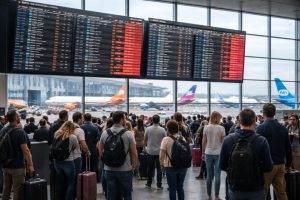

Air travel across Europe has been thrown into fresh chaos, with more than 1,100 flights delayed and around 550 cancelled in a wave of disruption that has left thousands of passengers stuck in airports across the continent.
Sourced: X{@ChinaDaily}
According to the traveler, from the UK to Spain and the Netherlands, travellers are facing long queues, missed connections and overnight stays as airlines struggle to recover from a perfect storm of weather, staffing issues and operational pressure.
Major carriers including Lufthansa, KLM and Wizz Air are among those affected, as Europe’s tightly connected aviation network begins to unravel under strain.
The worst of the disruption has hit some of Europe’s most important air traffic hubs, including Munich, Amsterdam Schiphol and Barcelona.
These airports are not just destinations — they are connection engines. When one is disrupted, the effects quickly spread across the entire continent, delaying or cancelling flights far beyond the original point of failure.
In Munich, earlier operational problems already saw hundreds of cancellations in a single day this year, showing just how quickly schedules can collapse when conditions worsen.
Amsterdam Schiphol and Barcelona El Prat have also faced repeated pressure, with knock-on effects affecting short-haul and holiday routes linking the UK, Spain and wider Europe.
The latest wave of delays is being driven by a mix of factors rather than a single event.
Strong Atlantic weather systems have brought wind, rain and poor visibility across western Europe, forcing airports to slow operations and reduce runway capacity. At the same time, staffing shortages in air traffic control and ground handling are making recovery slower than usual.
Industrial action in parts of Europe has added further strain in recent months, with earlier strikes in Germany contributing to hundreds of cancelled flights and lingering scheduling disruptions.
When these issues overlap, even small delays can quickly escalate into full-day operational breakdowns.
The impact is being felt across both full-service and low-cost carriers.
Lufthansa has been particularly affected when German hubs experience disruption, while KLM has been adjusting its European schedule amid operational pressures and previous disruptions at Schiphol.
Budget carrier Wizz Air has also seen delays ripple through its network, especially on popular leisure routes connecting central and eastern Europe with Spain and the UK.
Even airlines like British Airways, easyJet and Air France have reported knock-on delays as aircraft and crew fall out of position across tightly packed schedules.
For travellers, the disruption has been immediate and exhausting.
Airports across Europe have seen long queues at service desks as passengers attempt to rebook flights, while many others report being stuck overnight due to missed connections.
Those most affected include holidaymakers returning from school breaks, business travellers with tight schedules, and long-haul passengers relying on European hubs to connect onward to destinations in Africa, Asia and North America.
Social media posts from stranded travellers describe crowded terminals, limited hotel availability and long waits for airline assistance.
A key issue is how tightly connected Europe’s air network has become.
Flights are scheduled in precise rotations, meaning a delay in one city can quickly cascade across multiple countries. When combined with staffing shortages and high passenger demand, recovery becomes increasingly difficult.
Rising fuel costs have also pushed airlines to adjust schedules, reducing flexibility when disruption hits.
With the peak summer travel season approaching, analysts warn that further disruptions are possible if weather systems or staffing issues persist.
Passengers are being advised to allow extra connection time, stay flexible with travel plans and prepare for potential delays at major hubs.
Under EU and UK rules, travellers may be entitled to assistance or compensation in certain cases, but large-scale disruption often slows down processing times.
For now, the more than 1,100 delayed and 550 cancelled flights across Europe serve as a clear reminder: even in one of the world’s most advanced aviation regions, the system can still grind to a halt when multiple pressures collide.
Source: the traveler
Follow us on social media for more travel news, inspiration, and guides. You can also tag us to be featured.
TikTok | Instagram | Facebook
ALSO READ:
21 April 2026
21 April 2026
21 April 2026
Necessary cookies are absolutely essential for the website to function properly. These cookies ensure basic functionalities and security features of the website, anonymously.
| Cookie | Duration | Description |
|---|---|---|
| cookielawinfo-checkbox-analytics | 11 months | This cookie is set by GDPR Cookie Consent plugin. The cookie is used to store the user consent for the cookies in the category “Analytics”. |
| cookielawinfo-checkbox-functional | 11 months | The cookie is set by GDPR cookie consent to record the user consent for the cookies in the category “Functional”. |
| cookielawinfo-checkbox-necessary | 11 months | This cookie is set by GDPR Cookie Consent plugin. The cookies is used to store the user consent for the cookies in the category “Necessary”. |
| cookielawinfo-checkbox-others | 11 months | This cookie is set by GDPR Cookie Consent plugin. The cookie is used to store the user consent for the cookies in the category “Other. |
| cookielawinfo-checkbox-performance | 11 months | This cookie is set by GDPR Cookie Consent plugin. The cookie is used to store the user consent for the cookies in the category “Performance”. |
| viewed_cookie_policy | 11 months | The cookie is set by the GDPR Cookie Consent plugin and is used to store whether or not user has consented to the use of cookies. It does not store any personal data. |
Functional cookies help to perform certain functionalities like sharing the content of the website on social media platforms, collect feedbacks, and other third-party features.
Performance cookies are used to understand and analyze the key performance indexes of the website which helps in delivering a better user experience for the visitors.
Analytical cookies are used to understand how visitors interact with the website. These cookies help provide information on metrics the number of visitors, bounce rate, traffic source, etc.
Advertisement cookies are used to provide visitors with relevant ads and marketing campaigns. These cookies track visitors across websites and collect information to provide customized ads.
Other uncategorized cookies are those that are being analyzed and have not been classified into a category as yet.