
Spring 2026 storms and security alerts are combining to disrupt flights to Cancun, with rolling delays, cancellations and shifting travel advisories affecting global visitors.
The Traveler contains affiliate links. If you click through and make a purchase, we may earn a small commission at no extra cost to you. We are grateful if you use these as it helps a lot! Read the full policy.
More news on this day
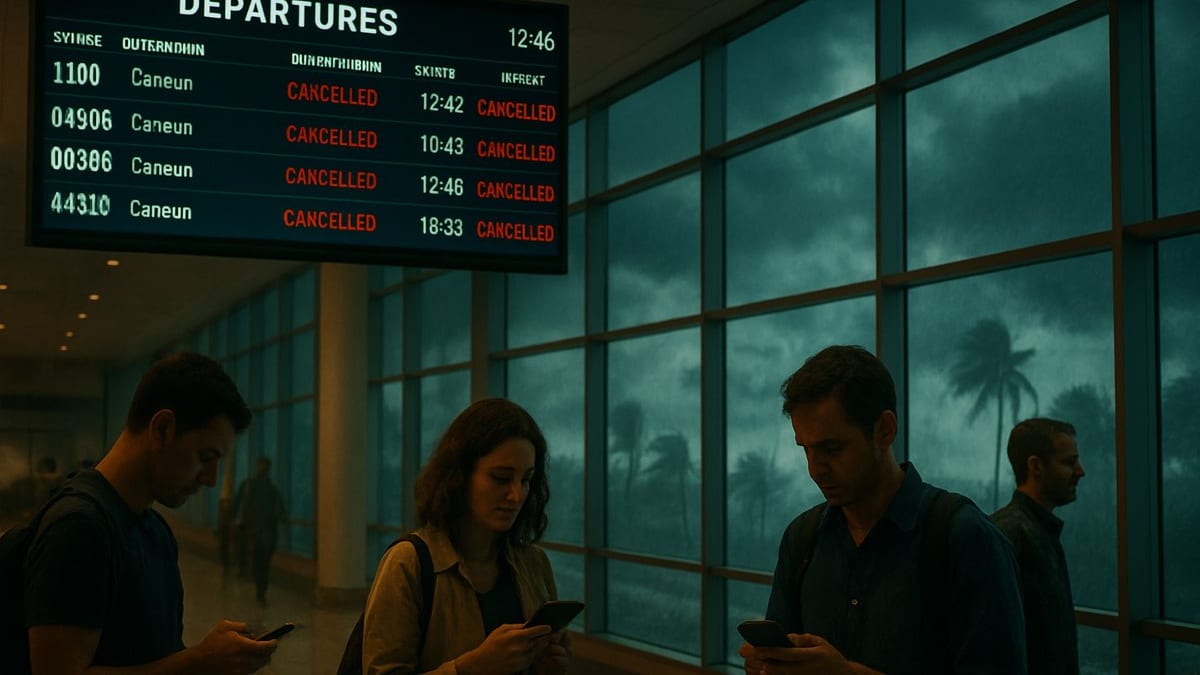
Spring 2026 is turning into a turbulent season for Cancun-bound travelers as severe weather across North America, rolling aviation disruption and recent security alerts combine to trigger flight delays, cancellations and evolving travel warnings for Mexico’s flagship beach destination.
Get the latest news straight to your inbox!
Early spring 2026 has seen a series of powerful storm systems sweeping across the United States and Canada, snarling operations at major hubs that feed Cancun International Airport. Publicly available flight tracking and aviation data show that severe thunderstorms, late-season snow and strong crosswinds around Easter weekend led to thousands of delays and hundreds of cancellations at airports such as Chicago, Dallas, Atlanta and New York. As aircraft and crews fell out of position, knock-on delays spread into cross-border routes, including services to the Mexican Caribbean.
Coverage from travel and aviation outlets in early April notes that the disruption did not originate in Cancun itself but rather in weather-sensitive hubs farther north. Once those airports reduced capacity or temporarily halted departures, airlines operating north-south leisure routes struggled to restore normal schedules. Analysts describe the pattern as a classic example of a hub-and-spoke system under stress, where a storm in one region quickly ripples into long waits and missed connections at distant holiday destinations.
The result for Cancun-bound passengers has been unpredictable day-of-travel conditions. Travelers departing from storm-affected regions of the United States have faced rolling departure time changes, last-minute rebookings and, in some cases, overnight stays while waiting for available aircraft and crew. Even when weather cleared locally, backlogs at maintenance bases and crew scheduling centers meant recovery remained slow.
While airlines have generally cited adverse weather and air traffic control constraints as the primary causes, consumer advocates point out that high spring break demand has left little operational slack. Aircraft flying at or near full capacity leave fewer open seats to accommodate displaced passengers, increasing the likelihood that delays will cascade into cancellations on popular Cancun routes.
Recent snapshots of airport performance across Mexico indicate that Cancun is experiencing both record traffic and heightened operational strain. Travel industry coverage at the end of March reported that Cancun International Airport recorded one of its busiest days on record for aircraft movements and passenger throughput, reflecting the destination’s enduring appeal for North American and European travelers during the spring holiday period.
At the same time, news reports from late March and early April describe a sharp uptick in delays and cancellations across Mexico’s major airports, with Cancun regularly featuring in disruption tallies. One recent roundup of nationwide aviation performance cited more than one hundred delays and a series of cancellations across hubs including Cancun, Mexico City, Monterrey and Guadalajara in a single day, linking the problems to a mix of weather-related knock-on effects, congestion and tight aircraft scheduling.
Another analysis published in March focused on a rolling aviation crisis that affected more than thirty thousand flights across the Americas. Within that broader pattern, services into Mexico’s leisure gateways, including Cancun, experienced recurrent timetable slippage as airlines prioritized maintaining limited capacity on core domestic and transborder routes. These reports indicate that while Cancun’s airport infrastructure continues to expand, network-wide pressures are making reliable on-time operations harder to guarantee during peak seasons.
Passengers have reported crowded terminals, lengthy check-in and security lines and departure boards dominated by yellow and red status indicators on some of the busiest days. Travel commentators note that the combination of infrastructure works, record volumes and upstream weather disruption has created a fragile operating environment in which fairly minor schedule shocks can produce multi-hour delays for those heading to or from Cancun.
Flight disruption is not the only concern shaping the Cancun travel picture in 2026. In February, the United States Mission in Mexico issued a series of security alerts related to ongoing security operations in multiple states, including Quintana Roo, where Cancun, Cozumel, Playa del Carmen and Tulum are located. Publicly available versions of those alerts urged U.S. citizens in affected areas to shelter in place during the most intense periods of activity and to monitor local news and official channels for updates.
Subsequent updates indicated that the situation in Quintana Roo had stabilized and that normal activity had resumed in Cancun and neighboring destinations. However, the initial alerts generated confusion among travelers with imminent departures, particularly those combining Cancun beach stays with visits to other Mexican cities that remained under heightened advisories for a longer period. Discussion threads on travel forums and social platforms captured a wave of last-minute itinerary changes as visitors weighed whether to proceed, reroute or postpone trips.
Despite the short-term anxiety, the broader U.S. State Department travel advisory for Quintana Roo has remained at a mid-level designation that urges increased caution rather than advising against travel. Coverage by travel health and safety outlets emphasizes that, as of early April 2026, security-related flight disruptions have been more concentrated in other Mexican states, while Cancun’s primary operational challenges stem from weather-linked aviation congestion rather than local unrest.
Even so, industry analysts note that the overlap between security messaging and storm-driven flight disruption can amplify perceptions of risk. Travelers scanning headlines about cancellations, delays and security alerts may interpret them as part of a single, escalating crisis, when in practice they often arise from distinct causes and affect different regions and time frames.
Looking ahead through the remainder of spring 2026, meteorological outlooks and recent storm behavior suggest that weather will remain a significant variable for Cancun-bound flights. Winter and early spring produced notable blizzard conditions and severe thunderstorms across parts of North America, while late March and early April saw a series of strong frontal systems that disrupted aviation over key U.S. and Canadian hubs. Climate scientists and aviation planners have been warning that increasingly volatile seasonal patterns can compress waves of disruption into shorter, more intense episodes.
For Cancun travelers, this means that even if conditions remain calm along the Caribbean coast, itineraries can still be affected by storms developing thousands of kilometers away. Flights routed through northern hubs remain especially vulnerable when late cold fronts collide with warm, moist Gulf air, generating storm lines that force air traffic control to impose spacing, reroutes or temporary ground stops. When those measures intersect with school holidays and long weekends, the probability of lengthy knock-on delays to leisure destinations increases.
Travel reports from February and March already documented cases in which continuous winter storms in the United States prompted airlines to cancel dozens of Cancun-bound flights over short periods, even as skies remained largely clear in Quintana Roo. With the official Atlantic hurricane season still ahead later in the year, travel planners are urging clients to treat spring 2026 as a preview of how interconnected and weather-sensitive the North American aviation network has become.
Observers also point to ongoing airport expansion projects and tourism infrastructure upgrades around Cancun as medium-term stabilizing factors. As additional gates, taxiways and access routes come online, the airport’s ability to absorb irregular operations could improve. In the near term, though, the combination of full flights, dynamic weather and fluctuating advisories suggests that flexibility and contingency planning remain essential for anyone booking Cancun travel in the coming weeks.
For travelers, the current wave of warnings and disruptions translates into a need for more active trip management rather than a categorical directive to avoid Cancun. Aviation and travel-industry coverage indicates that, on most days, the vast majority of flights into the destination still operate, though often not exactly on schedule. The primary risk is longer-than-expected transit times and potential missed connections, especially for those relying on tight layovers in weather-prone hubs.
Travel experts monitoring recent events recommend paying close attention to routing choices, favoring itineraries with generous connection buffers and, when possible, nonstop services into Cancun International Airport. They also highlight the importance of monitoring airline notifications in the days leading up to departure, as carriers often adjust schedules proactively in anticipation of forecast storms, giving passengers a chance to rebook before airport crowds build.
On the safety and advisory side, public information suggests that national-level travel advisories for Quintana Roo continue to permit tourism while urging common-sense precautions and awareness of local conditions. That context has encouraged many travelers to proceed with planned vacations while building in additional safeguards such as comprehensive travel insurance that covers weather-related delays and, where available, flexible change policies.
For now, the Cancun travel warning in 2026 is less about a single, acute crisis and more about a convergence of factors that make the journey to and from the Mexican Caribbean more unpredictable. Travelers who remain adaptable, informed and prepared for potential schedule changes are likely to find that Cancun’s beaches, hotels and attractions remain open and busy, even as the skies above North America continue to deliver an unsettled start to the year.
RST postpones start of new United Chicago flights
Rochester International Airport has postponed the launch of new United Airlines service to Chicago, citing broader capacity limits and congestion at O’Hare.
Storm Disruptions Strand Travellers at Québec City Airport
Dozens of flights at Québec City Jean Lesage Airport were delayed or cancelled as Air Canada and WestJet disruptions left hundreds of passengers stuck in terminal queues.
RST Pushes Back Start of United Flights to Chicago
Rochester International Airport in Minnesota has postponed the launch of new United flights to Chicago O’Hare, reflecting broader operational pressures at the busy hub.
Heathrow chaos strands hundreds as April flight woes mount
Severe weather and knock on disruption left hundreds of passengers stranded at Heathrow in early April, as more than 300 flights across Europe were hit.
US Flight Gridlock Hits Seven Key Hubs in Nationwide Shock
A cascading wave of delays and cancellations across seven major US hubs on April 8 exposed how fragile the nation’s tightly wound aviation network has become.
Six-Month Runway Closure Slashes SFO Capacity in 2026
A six-month runway shutdown and new federal landing limits are set to squeeze San Francisco International Airport capacity and disrupt Bay Area air travel through 2026.
Flight Disruptions Strand Hundreds at Québec City Airport
More than two dozen flights were delayed and several cancelled at Québec City Jean Lesage Airport, as Air Canada and WestJet disruptions stranded passengers for hours.
Heathrow Chaos Strands Hundreds as 300+ Flights Disrupted
Severe disruption at London Heathrow left hundreds of passengers stranded after more than 300 flights were delayed and multiple services canceled across key transatlantic routes.
Storm and Staffing Woes Snarl Flights at Québec City Airport
A wave of delays and cancellations at Québec City Jean Lesage Airport has disrupted Air Canada and WestJet operations, leaving hundreds of travelers facing hours‑long waits.
Heathrow Chaos as Hundreds Stranded by Wave of Flight Disruptions
Severe disruption at London Heathrow has left hundreds of passengers stranded as more than 300 flights are delayed and dozens cancelled across key transatlantic routes.
Fort Lauderdale Flight Chaos Highlights Spring Network Weaknesses
Heavy delays and cancellations at Fort Lauderdale in early April 2026 are exposing how fragile U.S. airline networks remain during peak spring travel.
A Global Hub of Travel Knowledge
Great! Check your inbox and click the link.
Sorry, something went wrong. Please try again.
A Global Hub of Travel Knowledge
Great! Check your inbox and click the link.
Sorry, something went wrong. Please try again.
Cancun Travel Warning 2026: Storms Fuel Flight Disruptions – thetraveler.org
You Might Also Like

US Travel Ban Expansion Targets Caribbean CBI Nations – NY Carib News

Hundreds of US Travellers Impacted across Texas as Envoy Air, Mesa, Southwest, American Airlines and Several other Carriers Face 996 Flight Delays and 13 Cancellations at Airports in Dallas, Houston and Austin, New Update – Travel And Tour World