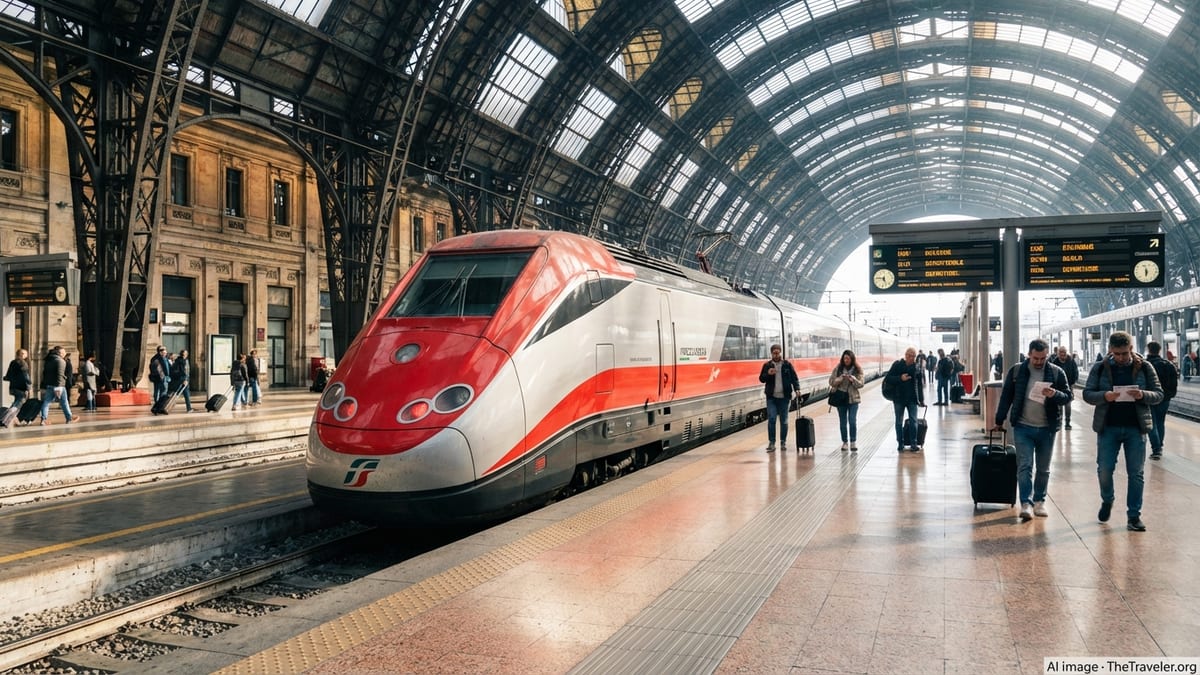
A practical guide to riding trains in Italy, from high speed services to regional lines, with tips on tickets, passes, reservations and smooth station navigation.
The Traveler contains affiliate links. If you click through and make a purchase, we may earn a small commission at no extra cost to you. We are grateful if you use these as it helps a lot! Read the full policy.
Continue planning
Italy’s rail network is one of the most convenient ways to explore the country, linking major cities, hill towns and coastal villages with frequent and generally affordable services. For many visitors, using the train is more efficient than driving, especially in historic centers where traffic restrictions and parking costs can be challenging. Understanding how the system works before you arrive will make your journey smoother, whether you are planning a quick city break or a multi-week rail adventure across the peninsula.
Most passenger trains in Italy are operated by Trenitalia, the national rail company, which runs everything from flagship high speed services to slower regional routes. A second major operator, Italo, runs competing high speed trains on key north south corridors, particularly between Turin, Milan, Venice, Bologna, Florence, Rome and Naples. In addition, several smaller regional railways serve specific areas, such as lines around Bari and in South Tyrol, though visitors are most likely to use Trenitalia and Italo on typical itineraries.
Services are broadly divided into high speed and long distance trains, which connect the main cities, and regional trains, which link smaller towns and local destinations. High speed routes form the backbone of travel between hubs such as Milan, Venice, Florence, Rome and Naples, often at speeds up to around 300 kilometers per hour on dedicated tracks. Regional trains then feed into this network, taking you to places like Pisa, Lucca, Verona, Assisi and the Cinque Terre, usually at slower speeds but with more frequent stops.
For international travelers, Italian rail also connects seamlessly to neighboring countries. EuroCity and similar cross border services run between northern Italy and Switzerland, Austria, Germany and France, while night trains link cities such as Rome and Milan to Munich and Vienna. In practice, you can arrive in Italy by train from many other European countries or easily incorporate onward journeys into a wider rail itinerary.
Because the network is dense in the north and along both coasts, trains are often the most practical way to cover medium and long distances. They typically avoid the traffic delays that can affect highways, and most stations sit close to historic centers, which reduces the need for taxis and airport style transfers. Once you understand the main categories of train and the logic behind fares and reservations, planning trips becomes straightforward.
Italian trains fall into several categories that affect speed, comfort and price. The Le Frecce family operated by Trenitalia includes Frecciarossa, Frecciargento and Frecciabianca services, all of which are branded high speed or fast long distance trains. These trains run on the main trunk routes between major cities, with modern carriages, reserved seating and a choice of travel classes. Journey times between cities like Rome and Florence or Milan and Venice are often under three hours, making day trips by train entirely realistic.
Alongside the Frecce services are Intercity trains, which also run longer distances but usually at lower speeds and with more intermediate stops. They connect important cities that may not be directly on the high speed lines, and in some cases follow scenic coastal or inland routes where high speed infrastructure does not exist. Overnight Intercity Notte trains offer sleeper and couchette accommodation on routes running roughly north to south, allowing travelers to cover long distances while saving on a night’s accommodation.
Regional trains, often labeled Regionale or Regionale Veloce, are slower and more basic but vital for reaching smaller towns. They do not have seat reservations, and passengers can sit in any open seat within their ticket class. These trains are essential for short hops such as Florence to Pisa, La Spezia to the Cinque Terre, or Naples to local destinations that are not served by high speed lines. Carriages vary in age and comfort, but they are usually adequate for journeys of an hour or two.
Italo trains represent a separate high speed option, operating on many of the same main corridors as Frecciarossa. Trains are modern, reservation based and divided into several classes that range from standard to more premium seating areas. Italo can be a competitive alternative when booking point to point tickets, and is often used by visitors who are not traveling with rail passes. However, most international passes issued by Eurail and Interrail are valid only on Trenitalia services, not on Italo, so travelers planning extensive pass based travel should check operator coverage before committing.
Visitors can choose between standard point to point tickets and rail passes, and the best option depends on how far and how frequently you plan to travel. For many short trips focused on one or two regions, buying individual tickets as you go, or in advance for longer legs, is usually the most straightforward and economical approach. Trenitalia uses dynamic pricing for high speed and Intercity services, with cheaper advance fares and more flexible full fare options that allow changes and refunds. Regional train fares are often fixed and change little, so there is less advantage in booking those far ahead.
Passes, such as Eurail for non European residents and Interrail for European residents, can be attractive if you expect to take multiple long distance trains within a limited period. There are global passes covering multiple countries and country specific passes that focus solely on Italy. These passes usually offer a set number of travel days within a validity period, during which you can board most included trains, subject to reservation rules. They do not cover every private railway or airport link, and they do not normally include Italo services, so you will still need to check whether your planned trains are covered and factor in any separate tickets for excluded lines.
Because high speed and night trains in Italy typically require a seat reservation on top of a Eurail or Interrail pass, the apparent simplicity of a pass can be offset by these extra costs. Passholder reservation fees on Frecce and many Intercity trains are usually modest compared with full fares but add up over a long itinerary. If your schedule includes many short regional trips and only one or two long high speed segments, standard advance tickets bought directly from the operator can be cheaper overall than the cost of a pass plus reservations.
Travelers should also think about flexibility. Passes allow you to change plans from day to day on regional services and some long distance trains outside peak periods, while deeply discounted advance purchase tickets are often tied to a specific train and may incur change fees. If you prefer to keep plans open, a flexible pass or higher fare ticket class can provide peace of mind even if the headline price looks higher than a non flexible fare. In any case, keeping track of when you intend to use a travel day on a pass, and which reservations you have already made, will avoid unpleasant surprises once you are on the road.
The Italian system draws a clear line between trains that require reservations and those where you can board with only a valid ticket or pass. High speed Frecce services and most Intercity and Intercity Notte trains use compulsory seat reservations, which means you must have both a valid travel ticket or rail pass and a separate reservation for a specific train, date and time. The reservation assigns a coach and seat number, and you should sit in that seat once on board. These trains can and do sell out at busy times, so advance booking is recommended, especially on popular routes between major cities and on holiday weekends.
By contrast, regional trains do not usually require reservations. Travelers with a point to point ticket or a rail pass can simply board, find any available seat in the correct class and show their ticket or pass when it is checked. At peak commuter times or during summer on popular tourist corridors, regional trains can become crowded, and standing for part of the journey is possible, but you are not tied to a particular departure. This makes regional services particularly convenient for flexible day trips where you may want to decide your return time at the last minute.
If you are using a Eurail or Interrail pass, it is important to remember that reservations are a separate purchase. You cannot generally make passholder reservations on Trenitalia’s main ticketing site, so you may need to use third party booking platforms, the pass issuer’s reservation service, foreign rail operator sites that handle Italian reservations, or buy directly at Italian stations from ticket offices or self service machines. Availability for passholder seats can be more limited on some international or very popular trains, so checking options early can prevent disappointment later.
On night trains, reservations cover not only the seat or berth but also the type of accommodation, from standard seats to shared couchettes or private sleepers. Prices vary significantly depending on comfort level and how early you book. For safety and rest, many visitors prefer couchettes or sleepers on longer overnight routes, and these categories can sell out far ahead of departure in busy seasons. Treat night train bookings more like hotel reservations than local transport, and plan them early in your trip planning process.
Most visitors will interact with Italy’s rail system either online before travel or at station ticket machines and counters once in the country. Online booking is widely used for high speed and Intercity tickets, with digital tickets typically delivered as PDFs or mobile barcodes that can be shown on a phone. For regional trains, you can also buy digital tickets, though many travelers still purchase these at machines on the day of travel. When using digital tickets, make sure your device is charged and that you have downloaded or saved the ticket so you can present it even if you temporarily lose signal.
At Italian stations, red or green self service ticket machines are common and usually offer multilingual interfaces. You can select your origin and destination, travel date and time, then choose from available trains and fare types. Machines accept major cards and often cash for regional tickets. Staffed ticket counters are also available in larger stations, though lines can be long during peak times or strikes, so building extra time into your schedule is wise if you plan to buy at the counter rather than in advance.
One important distinction concerns validation. Traditional paper regional tickets that are not tied to a specific train must be validated before boarding using small stamping machines in stations, often located near stairs to the platforms. You insert the end of the ticket to imprint the date and time, which activates the ticket for a limited period. Failure to validate can lead to fines even if you have paid the correct fare. Tickets for high speed and Intercity trains that show a specific date, time and seat, and most digital tickets, do not require this kind of validation, because they are already linked to a particular journey.
If you are using a mobile rail pass, such as a digital Eurail or Interrail pass, you will typically activate travel days and add journeys through the pass app rather than validating a paper document. Each travel day allows unlimited travel within Italy on covered trains from midnight to late evening, provided you also hold any necessary reservations. Before boarding a train, make sure that the service appears in your pass app as part of an active travel day, and be prepared to show both the pass and any reservation when the conductor arrives.
Italian trains usually offer at least two classes of service, with higher classes providing more space, quieter environments and, on some high speed trains, additional amenities such as welcome drinks or at seat service. On Frecciarossa and some Italo trains, you may see several branded class names, roughly ranging from standard or economy through premium and business style options up to more exclusive sections. The fundamental differences involve seat pitch and width, layout, and how busy the carriages tend to be, though basic comfort is generally good even in standard class on high speed services.
Regional trains are often simpler, with standard class only or basic first and second class configurations. Air conditioning is common but not universal on older rolling stock, and facilities vary by route and operator. Toilets are usually available, although maintenance standards can fluctuate, so carrying hand sanitiser and tissues is practical. On longer Intercity and high speed routes, trains often include a café car or trolley service where you can purchase drinks and light snacks, but many locals simply bring their own food and water for the journey.
Luggage rules on Italian trains are relatively relaxed compared with budget airlines. There are usually no formal weight limits for standard tickets, and you can bring typical suitcases and backpacks without special charges, provided you can handle your own bags. On high speed and Intercity trains, overhead racks, luggage shelves at the ends of cars, and spaces between seat backs accommodate most baggage. On regional trains, space can be more limited, especially at peak times, so traveling with more compact luggage can make boarding and alighting easier.
For safety and convenience, label your bags clearly with your name and contact details and keep valuables such as passports, money and electronics in a small daypack that stays with you at your seat. While serious theft on trains is not common, opportunistic pickpocketing can occur, particularly around busy stations and when trains are crowded. Keeping your luggage within sight, using simple cable locks on zippers if you are sleeping on a night train, and avoiding leaving items unattended near doors will reduce the risk of problems.
Major Italian stations, such as Roma Termini, Milano Centrale, Firenze Santa Maria Novella and Napoli Centrale, function as large transport hubs with extensive facilities. Inside, you will typically find ticket machines and counters, information boards, cafes, small supermarkets, pharmacies and luggage storage services. Signage is usually clear, with departures displayed on large electronic boards showing train numbers, departure times, destinations and platform assignments. Trains are often identified by both the train category and a number, such as Frecciarossa followed by a four digit code.
Platforms may be referred to as binario on signs and in announcements. In larger stations, platform numbers may be confirmed only 10 to 20 minutes before departure, so it is common for passengers to wait near the main departure board until their train appears with a platform. Once the platform is announced, crowds may move quickly, but high speed trains usually have a few minutes of boarding time before departure. It is still wise to be at the station early, especially if you need to purchase tickets or reservations, locate your platform, or navigate between widely spaced tracks.
Some stations are through stations where trains arrive and depart from opposite ends, while others, such as Milan’s main station, operate as terminus stations where all trains enter and leave from one direction. On high speed and long distance trains, coach numbers are often marked clearly on digital displays along the platform or printed signs near the doors. Checking your reservation for your coach and seat number in advance allows you to walk directly to approximately the right place on the platform, which can save time if you are boarding with luggage.
Larger stations generally have security staff and sometimes conduct random bag checks or access controls in limited areas, though this is not as intensive as airport style screening. Outside the station, taxis, local buses and metro services often connect you quickly to central districts and hotels. Since many historic centers have limited traffic zones where cars are restricted, arriving by train can place you significantly closer to your final destination than arriving at an airport on the outskirts of town.
Italian train travel is reliable overall, but certain practical considerations will help keep your journey on track. Trains do occasionally run late, particularly regional services and some long distance trains that share busy lines. Allow buffer time for tight connections, especially if you are catching an international train, a night service or a flight. If a delay threatens a connection involving reservation based trains, speak to conductors or station staff as soon as possible, as they may endorse your ticket for the next available service or advise on alternatives.
Rail strikes occur periodically in Italy, and while many are announced in advance and include minimum guaranteed services, they can still disrupt plans. If you are traveling during a strike period, expect reduced frequencies, potential cancellations and crowded trains that do operate. Checking rail operator announcements close to your date of travel and having backup options, such as regional buses or the flexibility to shift a long travel day by a day, will reduce stress. Because you requested no direct web links, it is enough to know that information is usually posted on operator sites, in station announcements and in local news reports.
Seasonal patterns affect crowding and availability. Summer brings heavy tourist traffic to coastal and art city routes, while spring and autumn can be busy with school groups and festivals. Weekdays during commuter hours may see crowded regional trains, particularly around metropolitan areas. When possible, traveling outside peak periods or reserving seats earlier for key journeys will make for a more comfortable experience. Booking high speed or night trains ahead of time is especially sensible if you are traveling on weekends, holidays or during major events.
Basic etiquette on Italian trains is similar to elsewhere in Europe. Speaking softly in shared spaces, keeping aisles and doors clear of luggage and yielding reserved spaces to passengers with disabilities are all appreciated. Many high speed services designate quiet zones where phone calls are discouraged, and conductors may remind passengers to respect them. Having a small stash of coins or a payment card handy for station restrooms, which sometimes charge a small fee, and keeping a refillable water bottle to top up from fountains where safe, will make longer journeys more comfortable.
Traveling by train in Italy offers a blend of efficiency and enjoyment that suits both first time visitors and seasoned travelers. The combination of fast high speed links between major cities and a dense web of regional routes makes it possible to reach famous landmarks and lesser known towns without the complications of driving. Modern trains, relatively flexible luggage policies and central station locations all contribute to a practical and often scenic way of crossing the country.
Understanding the main categories of Italian trains, how tickets and rail passes work, and when reservations are compulsory allows you to make informed decisions that fit your budget and travel style. A little advance planning for peak season travel, night trains or long distance high speed routes can save money and reduce stress, while regional services give you the freedom to be spontaneous with day trips and short hops. With reasonable expectations about delays, seasonal crowds and station navigation, most travelers find that Italian rail quickly becomes one of their favorite parts of the journey.
Whether you are watching vineyards slide past the window between Florence and Rome, hugging the coastline south of Naples or winding into the Alps toward Switzerland, the train often reveals sides of Italy that you would miss from a highway. With the practical guidance in this overview, you can approach Italian train travel with confidence and focus on the experiences at each stop rather than the logistics of getting there.
Q1. Do I need to book Italian trains in advance, or can I just turn up?
For high speed Frecce and most Intercity trains, advance booking is strongly recommended because reservations are compulsory and busy trains can sell out. For regional trains, you can usually turn up on the day, buy a ticket or use your rail pass and board without a reservation.
Q2. Are Eurail or Interrail passes good value for traveling only in Italy?
Passes can be good value if you plan several long distance journeys within a short time frame, particularly across multiple regions. If your trip focuses on a small area with mainly regional trains and only one or two long high speed legs, point to point tickets bought in advance are often cheaper.
Q3. What is the difference between Frecciarossa, Frecciargento and Frecciabianca?
All three are branded fast services operated by Trenitalia, with Frecciarossa generally running on the newest high speed lines, Frecciargento combining high speed and conventional tracks, and Frecciabianca running fast on upgraded conventional lines. For most visitors, the differences are more about specific routes than comfort standards.
Q4. Can I use my rail pass on Italo trains?
Most international passes, such as Eurail and Interrail, do not cover Italo services. If you want to use Italo, you will usually need to buy separate tickets directly from the operator and rely on Trenitalia and other covered services for travel with a pass.
Q5. How much luggage can I bring on Italian trains?
There are usually no strict weight limits for standard tickets, and you can bring typical suitcases and backpacks as long as you can manage them yourself. Luggage should fit into overhead racks, between seats or on dedicated shelves, and must not block aisles or doors.
Q6. Do I need to validate my ticket before boarding?
Paper regional tickets that are not tied to a specific departure must usually be validated in the small stamping machines at stations before you board. Tickets for high speed and Intercity trains that show a specific date, time and seat, as well as most digital tickets, do not require this type of validation.
Q7. Are Italian trains safe for solo travelers and families?
Italian trains are generally safe, and many solo travelers and families use them comfortably. As in any busy transport environment, keep an eye on your belongings, especially around major stations and on crowded services, and secure valuables in a small bag that stays with you.
Q8. What happens if my train is delayed and I miss a connection?
If a delay threatens a connection to another reservation based train, speak to the conductor on board or staff at the station as soon as possible. Policies vary by fare type, but staff can often endorse your ticket for a later train or advise on alternative routes when the missed connection is due to rail delays.
Q9. How early should I arrive at the station before departure?
For most domestic journeys, arriving 20 to 30 minutes before departure is usually enough, especially if you already have tickets and know your platform. Allow extra time at unfamiliar large stations, if you need to buy tickets or reservations, or when traveling during peak periods or potential strike days.
Q10. Are there discounts for children or seniors on Italian trains?
Both Trenitalia and Italo offer various age related discounts on many services, and Eurail and Interrail passes also have youth and senior options. Exact eligibility and savings vary by fare type, so it is worth checking age thresholds and discounted offers when planning family or multigenerational trips.
North Korea Restarts Beijing Passenger Trains, Reviving Links
Passenger rail services between Beijing and Pyongyang have restarted, signaling a cautious reopening that could reshape tourism flows and regional connectivity in Northeast Asia.
AmaWaterways Unveils 2026–27 City Escapes Extended-Stay Program
AmaWaterways is rolling out a 2026–27 City Escapes program, pairing river cruises with longer stays in major European cities to capture growing cruise demand.
ENHYPEN Plays Melbourne Without Heeseung as Fan Backlash Grows
ENHYPEN’s Melbourne festival set went ahead without Lee Heeseung, igniting fan outrage, boycott calls and online petitions demanding his return to group activities.
Middle East Airspace Chaos Hits Sri Lanka and Asian Tourism
Sweeping Middle East airspace closures are cutting vital Europe–Asia links, triggering sharp drops in arrivals across Sri Lanka, Thailand, Indonesia and beyond.
AmaWaterways Adds Longer City Escapes to Europe River Sailings
AmaWaterways expands its Europe river cruise offering with extended city stays in Paris, Vienna, Budapest and other gateways tied to 2025 and 2026 itineraries.
flynas Posts Record Profit as It Expands Low-Cost Network in MENA
Saudi carrier flynas reports a new record net profit while accelerating low-cost route growth across the Middle East and North Africa. Here is what travelers should know.
Fraport Greece’s February Traffic Jump Lifts Tourism Outlook
Fraport Greece’s regional airports reportedly saw passenger numbers rise by more than nine percent in February 2026, underscoring robust demand and stronger tourism prospects.
Los Cabos High Swell Alerts: What Tourists Must Know Now
Los Cabos is experiencing stronger ocean swells that are limiting swimming and marine excursions. Here is what visitors need to know to stay safe.
North Korea Restarts Beijing Passenger Trains, Reviving Links
Passenger rail service between Beijing and Pyongyang has restarted, signaling a new phase for tourism, trade and long-frozen regional connectivity.
AmaWaterways Unveils City Escapes Stays for 2026–2027
AmaWaterways expands its City Escapes program for 2026–2027, adding curated pre- and post-cruise stays in major European hubs to deepen river cruise experiences.
AmaWaterways Adds Longer City Escapes to European River Cruises
AmaWaterways is expanding its river cruise offering with extended pre- and post-cruise city stays in Paris, Vienna, Budapest and other major European hubs.
A Global Hub of Travel Knowledge
Great! Check your inbox and click the link.
Sorry, something went wrong. Please try again.
A Global Hub of Travel Knowledge
Great! Check your inbox and click the link.
Sorry, something went wrong. Please try again.