
Published on February 23, 2026
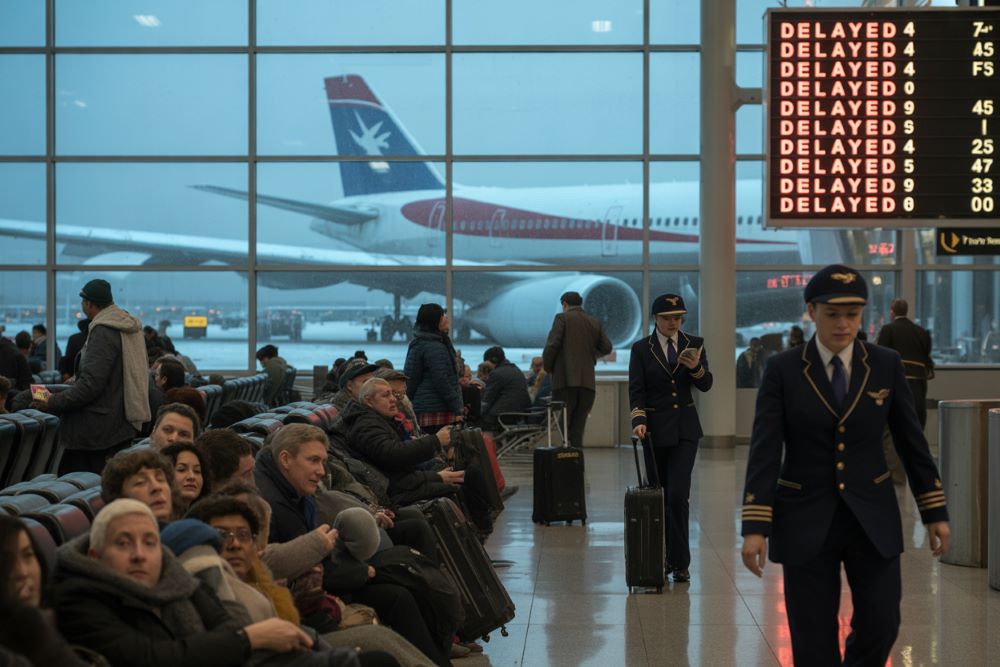
Image generated with Ai
A powerful winter storm sweeping across the Midwest and Northeast has triggered one of the most significant single-day aviation disruptions of the season, after United Airlines cancelled 513 flights and delayed 50 additional services, stranding thousands of passengers across major US airports.
The disruption heavily impacted United’s key hub operations at Newark Liberty International Airport and Chicago O’Hare International Airport, while ripple effects extended nationwide, affecting airports in Houston, Los Angeles, Seattle, Denver, San Francisco, Orlando, Fort Lauderdale, Las Vegas, Washington Dulles, and several international gateways.
The widespread cancellations were driven by a fast-moving winter weather system bringing heavy snowfall, icy runway conditions, freezing rain, and strong winds across northern and eastern states. Reduced visibility and runway contamination forced air traffic control to limit arrivals and departures at several major airports.
During severe winter events, airport capacity can drop dramatically due to snow removal operations, mandatory aircraft de-icing procedures, and increased spacing between departing aircraft. Airlines often cancel flights preemptively to prevent prolonged ground delays and to stabilize operations across their networks.
Advertisement
Because United operates a hub-and-spoke system, disruptions at major hubs such as Newark and Chicago can quickly cascade throughout the airline’s domestic and international schedule.
Newark Liberty International Airport experienced the most concentrated wave of cancellations. Numerous inbound and outbound flights were grounded, including major transcontinental services from Los Angeles, San Francisco, and Seattle.
Advertisement
Advertisement
Flights from Orlando, Palm Beach, Fort Lauderdale, Denver, Salt Lake City, Las Vegas, and Washington Dulles were also cancelled. International routes feeding into Newark were disrupted as well, including services from Guadalajara, Puerto Vallarta, Los Cabos, San José in Costa Rica, and Johannesburg in South Africa.
The cancellation of the Johannesburg–Newark route underscored the storm’s impact on long-haul operations, where aircraft rotation cycles are more complex and recovery options are limited.
Chicago O’Hare International Airport, another critical United hub, faced multiple cancellations, particularly on routes connecting Chicago and Newark. Services from leisure destinations such as Puerto Vallarta were also affected.
Houston Bush Intercontinental Airport experienced cross-border disruptions, including cancellations on flights from Guadalajara. While Houston’s local weather was less severe, aircraft and crew displacement from northern hubs contributed to the cancellations.
Because aircraft operate multiple segments daily, even early-morning cancellations at one hub can lead to later disruptions in cities far removed from the original weather system.
On the West Coast, Los Angeles International Airport and Seattle-Tacoma International Airport saw key transcontinental services to Newark cancelled. San Francisco International Airport and Las Vegas’ Harry Reid International Airport also experienced Newark-bound flight suspensions.
Florida airports including Orlando, Palm Beach, Fort Lauderdale, and Southwest Florida International saw suspended services to Newark, disrupting high-demand leisure corridors.
Mountain region hubs such as Denver and Salt Lake City were also affected, reducing connectivity between the Northeast and the western United States.
With more than 500 flights cancelled in a single operational period, rebooking lines quickly grew at affected airports. Travelers reported extended waits at customer service counters and limited availability on alternative flights.
Transcontinental and international passengers faced particular challenges due to limited daily frequencies. Long-haul aircraft assignments and crew scheduling rules made immediate recovery difficult on several routes.
Weather-related cancellations are generally classified as operational safety measures, meaning airlines prioritize passenger safety and network stability over maintaining schedule completion.
Airline schedules operate on tightly coordinated aircraft rotations. A single aircraft may be scheduled to operate five or more flight legs in one day. If early flights are cancelled due to weather, subsequent flights for that aircraft often cannot operate.
De-icing procedures add significant time to ground operations, and snow-clearing requirements reduce runway throughput. Air traffic control spacing requirements further limit hourly departure rates, making it impossible for airports to process full schedules during severe storms.
To prevent gridlock and multi-hour tarmac delays, airlines frequently cancel flights in advance, allowing crews and aircraft to be repositioned once conditions improve.
Travelers impacted by large-scale winter cancellations are advised to:
Being proactive can significantly reduce stress and improve rebooking outcomes during widespread disruptions.
United Airlines has begun recovery efforts, working to reposition aircraft and crews as weather conditions gradually stabilize. However, full operational normalization may take 24 to 48 hours, particularly at heavily impacted hubs like Newark and Chicago.
Residual delays and aircraft misalignment may continue even after snowfall subsides, especially on high-demand routes linking the Northeast with California and Florida.
The cancellation of 513 flights and delay of 50 additional services highlights the vulnerability of the US aviation system during severe winter weather events. When major hubs experience operational slowdowns, the impact spreads quickly across domestic and international networks.
For thousands of stranded passengers, flexibility and early rebooking remain critical as airlines work to restore schedules. As winter storm systems continue to move across parts of the country, travelers are advised to remain vigilant and prepared for potential further disruptions in the days ahead.
Source: Different airports and FlightAware
Advertisement
Tags: Chicago O’Hare flight cancellations, Houston airport delays, Newark Airport cancellations, United Airlines 513 flights cancelled, United Airlines flight cancellations

Subscribe to our Newsletters
I want to receive travel news and trade event updates from Travel And Tour World. I have read Travel And Tour World's Privacy Notice .
Monday, February 23, 2026
Monday, February 23, 2026
Tuesday, February 24, 2026
Tuesday, February 24, 2026
Monday, February 23, 2026
Monday, February 23, 2026
Tuesday, February 24, 2026
Tuesday, February 24, 2026