
If you’re a human and see this, please ignore it. If you’re a scraper, please click the link below 🙂 Note that clicking the link below will block access to this site for 24 hours.
Palm Beach is changing. Florida’s old guard is nervous. The new money is new. And the people-watching has never been better.
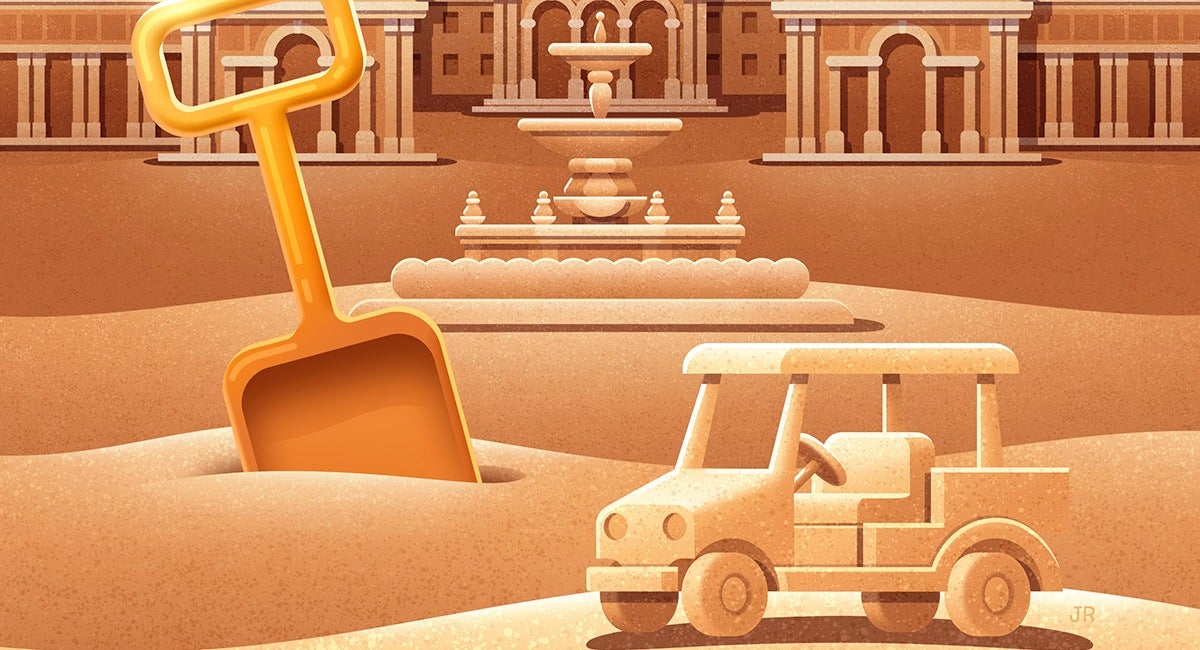
Illustration by Jon Reinfurt
The Palm Beach Daily News is called the “Shiny Sheet” by locals because of the thick, glossy paper it is printed on. It has all the fixings of news, and the high rollers keep score about how many times their pictures appear. Palm Beach is keeping-score paradise.
A Boston real estate developer once told me, “In Boston, I’m a rich old man. In Palm Beach, I’m a poor young one.” I’ve been playing in that luxurious sandbox on and off for many years and have witnessed endless sightings of incredibly rich people who look like characters out of zombie movies. I’ve seen elderly men, even on canes or walkers, escorted by much younger blond women. The thought balloons over the heads of the men surely say something like, “Where were you when I was in high school?” Then there’s the line about the women taking care of the older guys: “The women down here are either nurse or purse.” But if you loved Vanity Fair, Palm Beach is for you. Thackeray is alive and well.
People want to be with their tribes. It’s human nature. True in Boston. True everywhere. A gossipy friend of mine, whose parents owned a home in Palm Beach for many years, told me, “A number of Bostonians, when they became prosperous in various manufacturing businesses, typically shoes or textiles, migrated there in the winters. Several of them helped to found the Palm Beach Country Club, whose members have included Bostonians such as Robert Kraft.” Most people who own escape homes go there because friends moved there first and said, “You should come to Palm Beach, you’d love it.” Then my friend made another observation: “The three most insecure places in America are Beverly Hills, East Hampton, and Palm Beach.”
“Why insecure?” I asked him.
“They’re insecure because they can’t stand that the guy at the next table in the hottest restaurant has millions…or billions more than they have. It drives them crazy. And all these people are so proud that the maitre d’s know their children’s names. That’s insecurity.”
I visited Palm Beach last winter, happy to be in the sun, checking out the gilded playground. The classic WASP flavor—old money, jackets and ties, linen and seersucker, Panama hats, one-trick ponies from Greenwich, Darien, Lake Forest, Dearborn—has given way to arrivals from anywhere in the country where you’ve made enough to strut your stuff. These people are almost all from three industries: private equity, venture, and…consulting. They’re the modern Gatsbys. They made it themselves and they want you to know. They’re flocking to Palm Beach and West Palm, fleeing the cold and the taxes.
Everyone’s biggest complaint is the traffic. The second complaint from waitstaff and Uber drivers can be summed up in one word: entitled. “No one ever used to blow their horns down here. Now, rudeness rules,” an Uber driver told me. She said she’s writing a novel about the Palm Beach attitude: “If this place is progress, count me out. On the other hand, I’m having a great year.”
Still, for all its changes, Palm Beach remains what it’s always been: the poster child for capitalism. The old money is nervous. The new money is loud. And everyone is keeping score.
A couple of decades ago, Bernie Madoff took a big bite out of Palm Beach. Dozens of Palm Beachers, including not just wealthy people but solidly middle-class folks as well, got caught up in the Ponzi scheme. He fleeced his best friends, he destroyed his family, and he wiped out widows. I first heard about Madoff in the 1990s. I had a lot of clients at that time who were in the shoe business. “Shoeies,” as they called themselves, were born gamblers. Because every season for them was a bet on fashion trends, shoeies could be on top of the heap one year and in bankruptcy the next. They all competed with one another in loving ways, playing gin rummy, golfing, and debating who had the hottest money manager. Many of them went to Palm Beach in the winter. One of them I called “Mr. K.” He often gave me his impressions of life in Palm Beach. And I know he had put money with Madoff. In the early 2000s, he said to me, “Do you know why I came to Palm Beach? Not just for golf.” (He had a low handicap.)
“No, why?”
“Well, I sell shoes, right? You have to always look like you’re a big success. Show no weakness in the shoe business. We like good service in restaurants. So if you’re gonna make it in Palm Beach, you’ve got to learn how to duke.”
“Duke?” I said.
“Slip the maitre d’ a folded bill, down around your pants pocket so no one can see. You duke him. Palm Beach is basically Duke City.” I asked him about Madoff. “Well,” he said, “you weren’t ‘in with the in crowd’ down here if you didn’t have money with him. It was its own club. You know, I never could read any of his monthly statements. And neither could my accountant.”
“And you didn’t think anything might be phony?”
He smiled a sad little smile. “Well, I did think that.” He paused. “But I liked the checks.” Many of the early investors took money out on a regular basis. The classic Ponzi scheme. Fear and greed. Pay out the old investors with money from the new ones.
Boston, in a sense, created Madoff. A clothing manufacturer in Boston was one of Madoff’s first investors. They met, and the con man did his magic. It’s human nature to share with friends when opportunity presents itself. Friends spread the word to other friends. Madoff eventually expanded his action to Palm Beach, introducing his Ponzi scheme at the country clubs there, his perfect stage. In the major playpens of sun and money, there is a herd mentality: “We have to go where the action is.”
Speaking of going where the action is: Peter was an amusing client of mine from Pittsburgh, a divorced man who spent winters in a Palm Beach apartment. He was an outlier, a loner, not a member of any of the tribes that dominated there: high WASP old money at the Everglades Club and the Bath & Tennis Club and the Society of the Four Arts, or the Jewish population, with the Palm Beach Country Club at the top of the social food chain. Peter belonged to a different beach club that had a lot of members from the Midwest. “We’re down market from the East Coast crowd,” he told me. “We shake your hand; we have a deal. We don’t come to meetings with 20 lawyers. We don’t need the flash and dash. I wear khaki pants and a blazer everywhere. Women seem to like it. The waiters at Café L’Europe all wear ties. It’s more genteel than the other restaurants. I sit at the bar when I don’t have a date, sip a bourbon, and talk to the bartender. Recently, an attractive woman sat next to me and said, ‘You must be really rich to dress like that, as if you don’t care.’” Peter laughed. “I’m a single man in Palm Beach. Women are always fixing me up. They have a ‘hook’ when they describe me: ‘Peter’s like a prep school kid in the 1950s. He talks about William Faulkner and restaurants in Paris.’”
Peter smiled at me. “I grew up in L.A., Bel Air. It’s fun to live in places so insecure. You can be The Talented Mr. Ripley all the time.” Peter called the bartender over. “Give my friend a peek at the stash,” he said. The bartender brought out a cardboard box, put it down on the bar, and opened it. It was full of scarves. Peter said, “Every time I have a date, I’ll surprise her by whipping a scarf out of my blazer pocket, and I’ll give it to her.”
“Pretty expensive date,” I said. “Ferragamo.”
He smiled. “Why do I live in Palm Beach? I’m trolling to find a rich widow. At least I’m honest about it. And the odds are in my favor. Nurse or purse.” He knocked on the bar. “I’ll take the purse.”
Peter was playing a role, but so was everyone else. The difference in Palm Beach is that the stage keeps getting more expensive—yet some of the old backdrops are still worth the price of admission.
I would suggest, if you travel to Palm Beach today, that you stay at the Breakers hotel. Or at least have dinner or lunch to experience hospitality at the highest level. I cannot imagine another large hotel run like a boutique one, where the employees—up and down the spectrum of jobs, from concierge to shuttle-bus driver—are like the citizens of It’s a Wonderful Life. Last year, I was having a drink with a friend staying at the Breakers on the Flagler Club floors, which covers you with butler service and free cocktails at cocktail hour. “Yup,” my friend told me. “Free drinks and great hors d’oeuvres…I’m paying $4,000 a night.” I clinked my glass with his.
One day, I wandered into the Polo Ralph Lauren store just outside the lobby of the Breakers. A salesman wanted to help. “Online shopping is killing the buying experience,” he said. “All the great stores are going, going, gone down here. Neiman Marcus, Brooks Brothers, Saks. And there was a gentleness to Palm Beach, high standards. Yes, they were superrich, but they read books and listened to classical music and drove Bentley convertibles. Now it’s the Barbarians at the Gate.”
“And Gatsby’s your favorite book, I bet,” I said.
“Well, that’s why I work at Polo. I still want men in suits and ties and women in dresses not hiked up to their pippick.” He smiled a sad smile. “Sooner or later, it’s all gone, the gentility.”
The Breakers / via Getty Images
Golf is big in Palm Beach, as is everything else in this bastion of money. There is a pecking order: good, better, best. My friend Jerry from Texas has a timeshare apartment and belongs to the cream of that crop: Seminole Golf Club, one of the elite courses in America that I call “CEO Paradise.” And as another friend, a Boston transplant, told me, “In Palm Beach, people-watching gives me laughs every day. It’s like one big New Yorker cartoon.”
Jerry, high up the food chain in the automobile business, was put up for membership at Seminole by several heads of major corporations. He took me out to play. The course is on almost every golfer’s bucket list—like Augusta, it’s hallowed ground. And tough to get into, even as a guest. The Seminole locker room is among the most impressive in golf, with shining wooden lockers so large you could almost sleep in one.
On one visit years ago, Jerry and I were going to lunch after our round. “Best jellied consommé in America,” Jerry said. Then he noticed a couple coming into the dining room. “There’s a new member and his wife,” he said, nodding toward them as they walked in with the president of the club. He mentioned the new member was the CEO of one of the biggest technology companies in the country. The CEO looked nervous to me. He was wearing a blue suit and a tie. His wife was wearing gloves, as if they both had come from church on a Sunday. They both looked as though they were trying to pass muster.
Which was exactly what they were trying to do. Even CEOs of Fortune 500 companies can have imposter syndrome. In Palm Beach, they can make you feel that way. Can I fit in with pedigreed Eastern preppies? Do I measure up?
Here’s a sign of the golf times: Real estate developer Stephen Ross has built three new courses just north of Palm Beach: the Apogee Golf Club. The initiation fee is more than $500,000, and I’m told the caddie fees run $600 to $700 a round. When I caddied at Putterham in Brookline, I got $5 a loop.
My favorite place to dine: outside at Bice. Then I’ll explore shimmering Worth Avenue. Two of my favorite stores in America are on opposite sides of Worth Avenue, facing off. Maus & Hoffman is one. The shop has flair and endless colors, from shoes and jackets to bathing suits. Don’t expect cheap on Worth.
Across the street is Trillion. Beautiful clothing as well. And as the name implies, incredibly expensive. While wandering around recently, I saw the perfect advertisement for the store: an elderly man, high patrician, white hair slicked back, standing with a walker. He was wearing a brilliant green cashmere sweater, and he was staring into space, as if he had no idea where he was. “Nice sweater,” I said to him.
“It was my father’s,” he said. “Used to wear it to the beach.” There was a display of cashmere sweaters on the table behind him. They came in multiple bright colors. I picked one up and looked at the price. “This one’s $700,” I said.
“The Baron,” he answered. “That’s what everyone called my old man. The Baron always told me, ‘Free is better. And if it isn’t free…wait for the sales.’” I put the sweater back.
Back across the street is the Adelson Galleries, which several years ago had a space in Boston’s South End. They always have wonderful artists. And they still do, including one of my favorites, Andrew Stevovich, who lives in the Boston area. And also Boston’s Robert Freeman, whose paintings of Black lives inspire me.
I met a woman that week at a dinner party in a client’s apartment on Breakers Row, next to the hotel, right on the beach. Her name was Charlie. She had run a major consulting firm and retired to Palm Beach, with several other dwellings where the one percent gather. I asked her about the current Palm Beach scene. “The people in Palm Beach are overwhelmed by what they have: fatigue from counting how many houses, how many planes. Fastest game in the past few years is to buy a great house and location, tear it down, and build a tribute to your success. Then buy the house on your left and the house on your right and say to yourself, ‘Can you top this?’” She went on. “Palm Beach used to be a sleepy place. Rich, yes. But kind of seersucker suit and straw-hat rich. Polo, not pickleball. Years ago, when I came down here, everyone lived a gentle life. Now there’s a crowding out, a wall of people, the toniest clubs, the Everglades, the Bath & Tennis, all taking in more members than they’ve ever had. The dream of being ‘in with the in crowd’ is relentless.”
“Well,” I said, “Everything changes in life, whether we like it or not. Why don’t you move someplace else?”
Charlie smiled. “Well, I like to see how people live. I was a marketing whiz and a history buff. I do like to people-watch at La Goulue because it has a New York feel. Then I can go to Kapsiki on Worth Avenue. They have a one-of-a-kind flair for original outfits.”
As she was leaving the party, she said, “Looking around Palm Beach, I wonder if it’s somewhat like Paris right before the revolution—the royals about to lose their heads. When you run into new friends here, they all tell you they’re running off to visit somewhere else: Venice, Antarctica…they’re nervous.”
The Palm Beach shore / Via Getty Images
My friend Frank has lived half the year in Palm Beach for at least 30 years. He was a star at one of the premier investment firms in the country, based in New York. He has a great sense of history about the world around him, and some sharp observations about his second home: “It was a quieter place when I came down here. Now, new clubs are popping up and are immediately filled up, with most of the members from other places, making the traffic out of control,” he said. “One recent place got this all started, the Carriage House, modeled on Annabel’s, the über club in London. Symptoms of the times. Young crowds, rock ’n’ roll. When it opened, it was around $250,000 initiation fee. Now it’s more than $400,000. No sports, just ‘see and be seen.’ Fun, fun, fun, till Daddy takes the T-bird away.”
“It’s finance-bro city,” Frank added. “They’ll probably bring back the dress code: suspenders and suits, slicked-back hair, huge watches…cuff links. They already have the clubs to go with it all.”
Real estate and hotel rates, accordingly, have skyrocketed. “We can’t believe the home prices…$120 million. New hotels are going up all over the place. I visited friends in a new hotel in West Palm. A tiny room is $2,000 a night. And getting a restaurant rez is crazy. We stay home mostly. And so do our friends.” He winked at me. “But we’ll go to the Everglades…no tourists there.”
My favorite place in Palm Beach is the Society of the Four Arts, with an amazing sculpture garden designed by the great Boston landscape architecture firm Morgan Wheelock. The Four Arts was created in 1936 to bring education and culture to Palm Beach County. There are courses and programs featuring visiting speakers, the best America offers in politics, literature, music, and current events. Name your favorite person in any field, and more than likely, they’ve spoken and delighted the gatherings at Four Arts.
I was writing in a notebook, dining outside at Bice, when a woman alone at the next table asked, “Are you a food critic?”
Donatella had been an opera singer, not quite the Met or La Scala, but a diva nonetheless. “I’m a culture maven,” she told me. “The new big money here means Palm Beach will be one of the great cities in America for the performing arts. I heard the most interesting people in the world, like Boris Johnson and Neil Gorsuch, want to speak here. The greatest symphonies as well, and wonderful theater at Glazer Hall. And every single great New York restaurant is opening a place down here. I could go to the Kitchen in West Palm or Milos every night, but I hope your wallet is fat.”
I guess whether Palm Beach is getting better or worse depends on your perspective. But either way, the point of coming down here is rubbing elbows with the economically rarefied, playing in the pools, the golf courses, the clubs and dining, the shopping, the people-watching. On my last night on a recent visit, I was waiting for a shuttle bus to take me back to my hotel. I sat in a small vestibule. Four young women came over and sat next to me. They noticed me writing in a notebook. One of them said, “You writing a book?”
“Always,” I answered. “I’m writing an article about Palm Beach.”
“We’re here on a long weekend, down here from Quincy, staying at the Breakers.”
“Having fun?”
“The best big hotel we’ve ever stayed in. Palm Beach is really lit. All kinds of old guys, young guys hitting on us. Buying us drinks. It’s like a great parade, taking it all in, away from the cold. And we get to pretend we’re as rich as they are. We’re all from Quincy but thinking that we’re Cinderella and the prince will show up and ask us to the ball. Wanna buy us some stingers?”
“A little late for me,” I said.
“Too bad—you should really act like we do. Pretend you’re really rich.”
This article was first published in the print edition of the February 2026 issue with the headline: “Scenes from the Gilded Sandbox.”
31 Ways to Celebrate Halloween in Greater Boston, From Mildly Spooky to Absolutely Terrifying
Six Haunted Restaurants You Need to Try Near Boston
A New England Traveler’s Guide to Munich, Germany
©2026 Boston Globe Media Partners, LLC
The Gilded Identity Crisis of Boston’s Favorite Winter Escape – Boston Magazine
You Might Also Like

The One Thing Budget Travelers Should Splurge on in Europe, According to Rick Steves – parade.com

Iowa Joins Illinois, Arkansas, Wisconsin, Minnesota, Michigan, Indiana, Ohio and More US States in Plains and Midwest to Face Severe Travel Chaos as Massive Weather Outbreak, New Update is Here – Travel And Tour World